

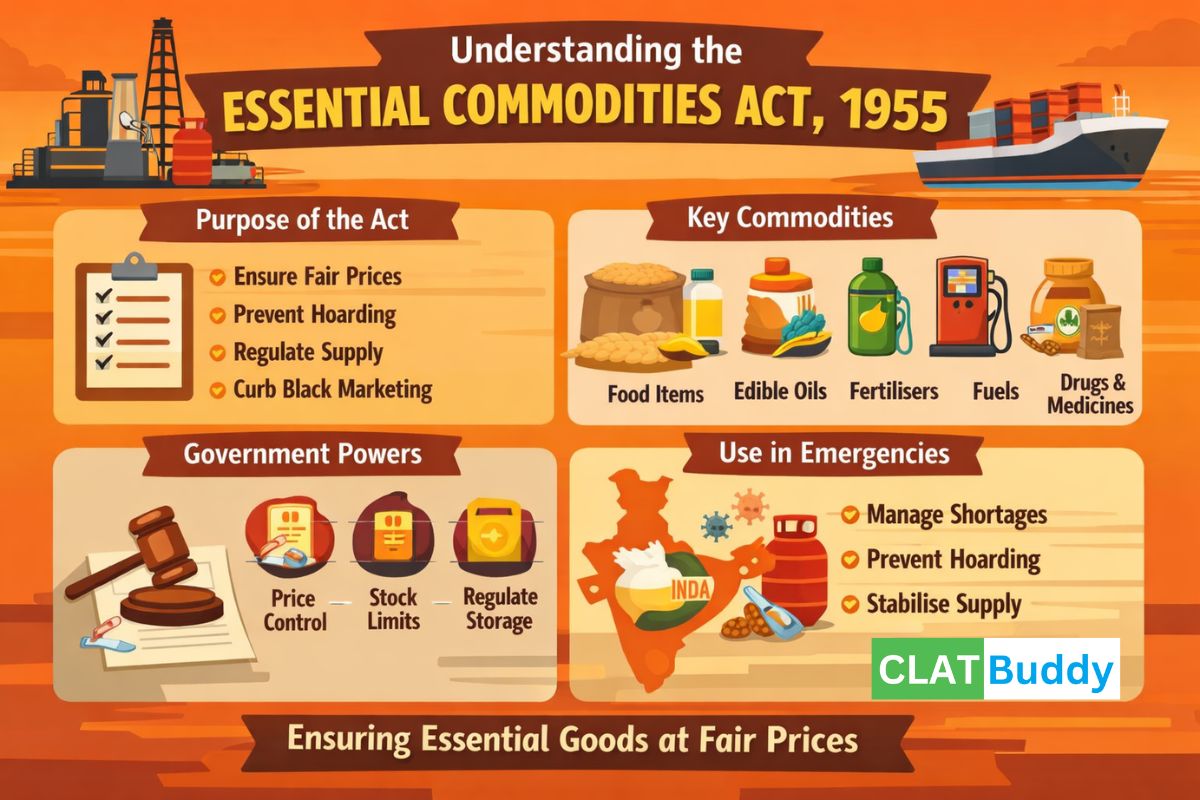
The Essential Commodities Act, 1955 is one of India’s key economic laws that allows the government to regulate the production, supply and distribution of essential goods during shortages or emergencies. The objective of the Act is to ensure that commodities necessary for everyday life remain available to the public at fair prices and are not hoarded or manipulated in the market.
The law becomes particularly relevant during situations of supply disruption, price volatility or panic buying. In such circumstances, the government can intervene to stabilise markets, maintain availability and prevent unfair trade practices. Recently, the Act gained attention when the Union government invoked it to manage supply concerns related to cooking gas following disruptions in energy shipments through the Strait of Hormuz.
The Essential Commodities Act was enacted to address a basic challenge in large economies: ensuring that critical goods reach people even during periods of crisis. The Act enables the government to step in when market forces alone may not ensure equitable distribution.
The primary purposes of the Act include:
Through these powers, the government can protect consumers while also stabilising the broader economy during disruptions.
The Act allows the government to regulate commodities that are considered essential for daily life and economic stability. Over time, several goods have been included under the law.
Some of the important commodities covered include:
The list of commodities can be modified by the government depending on economic conditions and national requirements.
One of the most important features of the Essential Commodities Act is the wide regulatory authority it gives to the government. Section 3 of the Act empowers the government to issue orders necessary for maintaining or increasing supplies of essential goods.
Under these powers, the government can:
These measures allow the government to intervene quickly when market conditions threaten public access to essential goods.
The Essential Commodities Act has been invoked several times in India to manage shortages and supply disruptions.
For instance, the government has used the Act in the past to regulate stocks of commodities such as wheat, sugar and pulses when prices surged due to shortages. During the COVID-19 pandemic, the Act was used to curb hoarding and profiteering in items like masks, sanitizers and other essential products.
More recently, the Act was invoked to regulate Liquefied Petroleum Gas (LPG) supply after geopolitical tensions disrupted shipping routes in West Asia. Since a large portion of India’s LPG imports pass through the Strait of Hormuz, concerns about supply shortages led the government to step in under the provisions of the Act.
India is a large and diverse country with varying levels of access to essential goods. Market disruptions, global conflicts, natural disasters or sudden demand spikes can affect supply chains. In such situations, the Essential Commodities Act provides the government with a legal mechanism to ensure that essential goods remain accessible to the public.
While long-term solutions such as increasing domestic production and diversifying supply sources are important, the Act functions as an emergency tool that allows immediate intervention. By preventing hoarding, controlling prices and directing supply where it is most needed, the Essential Commodities Act continues to play a crucial role in protecting consumers and maintaining economic stability during times of crisis.