

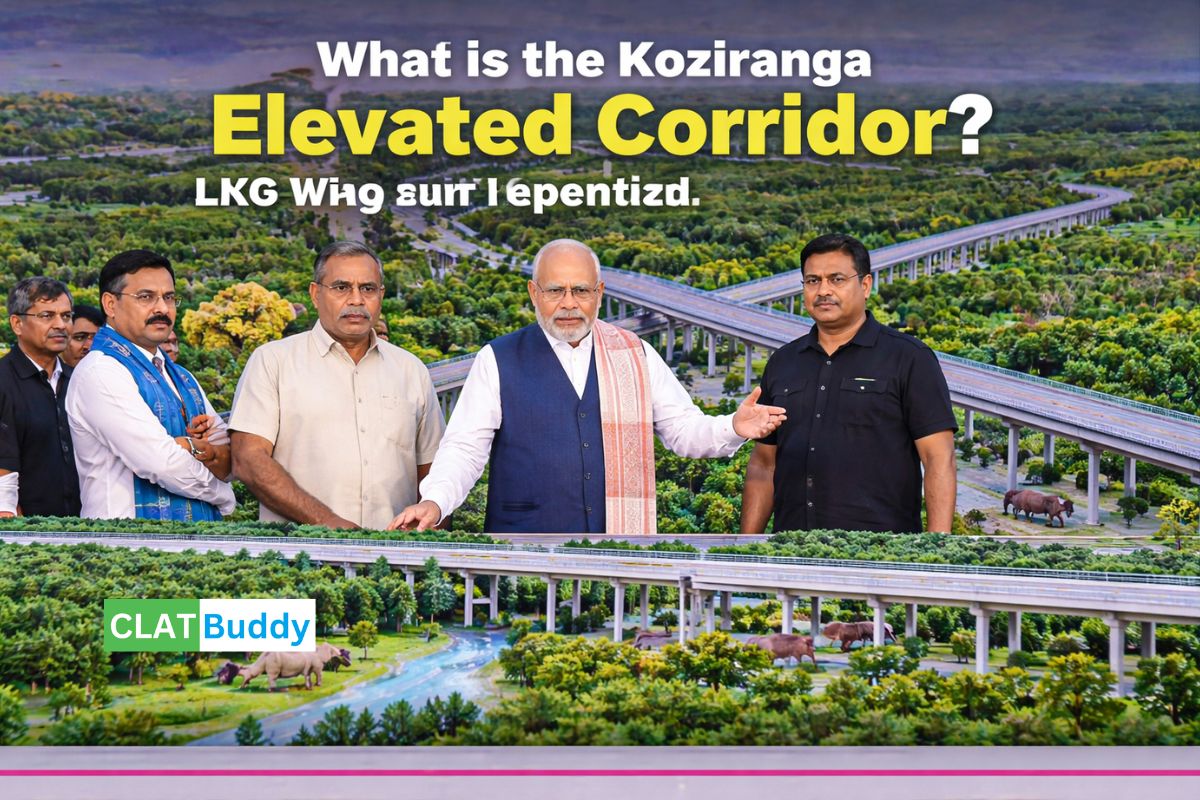
Prime Minister Narendra Modi on January 18, 2026, laid the foundation stone for the ₹6,957-crore Kaziranga Elevated Corridor in Assam’s Nagaon district. During the same event, he also virtually flagged off two Amrit Bharat Express trains, marking a significant push for infrastructure, connectivity, and wildlife protection in the region.
The Kaziranga Elevated Corridor is a major road infrastructure project planned across the Kaziranga National Park and Tiger Reserve. It is part of the four-laning of the Kaliabor–Numaligarh section of National Highway-715. The project includes approximately 34.45 km of elevated, wildlife-friendly road corridors, along with bypasses at Jakhalabandha and Bokakhat.
The corridor is designed to allow vehicles to pass over critical wildlife movement zones, instead of cutting through them at ground level. This elevated structure is intended to ensure that animals can move freely and safely across the landscape.
Kaziranga National Park is located in the floodplains of the Brahmaputra River. Every year, especially during the monsoon season, animals are forced to move to higher ground due to flooding. National Highway-715 runs close to the park and has historically been a major cause of road accidents involving wildlife.
The elevated corridor aims to reduce such incidents by separating fast-moving vehicular traffic from animal movement paths. By lifting the highway above the ground, the project seeks to minimise human-wildlife conflict and improve safety for both animals and road users.
Kaziranga is globally recognised for its rich biodiversity. It is home to the world’s largest population of one-horned rhinoceroses, as well as tigers, elephants, wild water buffalo, and swamp deer. The park consists of grasslands, forests, and wetlands that depend on uninterrupted ecological movement.
The elevated corridor is expected to safeguard animals, particularly during floods, when wildlife migration peaks. The Prime Minister himself noted that the project would go a long way in protecting animals during the monsoon season.
Assam Chief Minister Himanta Biswa Sarma described the corridor as a landmark step that balances wildlife protection with improved connectivity.
Apart from conservation, the project is expected to boost eco-tourism in Kaziranga by making travel safer and smoother. Improved road infrastructure can attract more visitors while reducing environmental stress on the park.
The construction and associated activities are also expected to generate local employment opportunities, providing economic benefits to nearby communities.
Alongside the corridor project, the Prime Minister virtually flagged off two Amrit Bharat Express trains:
These trains are aimed at strengthening long-distance rail connectivity between Assam and several States, including West Bengal, Bihar, Uttar Pradesh, Delhi, and Haryana. The services are expected to reduce travel time and offer modern passenger amenities.
This move is part of a broader effort to improve railway connectivity between the Northeast and the rest of the country.
The Kaziranga Elevated Corridor represents an approach where infrastructure development and environmental protection are planned together, rather than in conflict. It reflects a shift towards wildlife-sensitive infrastructure in ecologically fragile areas.
At the same time, the launch of new train services highlights the focus on integrating the Northeast more closely with national transport networks. Together, these initiatives signal a development strategy that combines connectivity, conservation, and regional growth.