

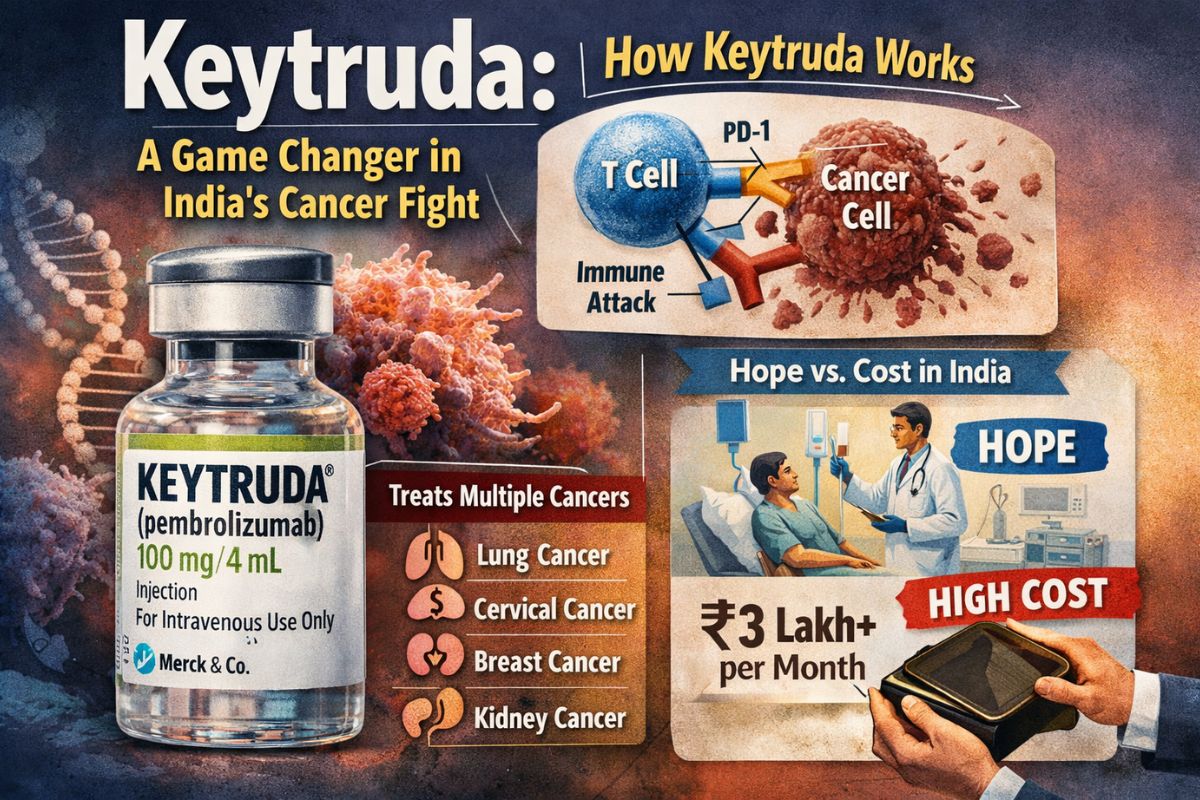
In recent years, cancer treatment has been undergoing a major shift — from directly attacking tumours to empowering the body’s own immune system to fight them. At the centre of this shift is Keytruda, a drug that has become one of the most talked-about therapies globally and increasingly relevant in India.
But what exactly is Keytruda, and why is it being seen as a game-changer?
Keytruda is the brand name for pembrolizumab, an advanced cancer drug developed by US pharmaceutical giant Merck & Co.
It belongs to a class of drugs called checkpoint inhibitors, a type of immunotherapy. Instead of killing cancer cells directly, it helps the immune system recognise and destroy them.
The human immune system uses T cells to detect and attack harmful cells. However, cancer cells often “hide” by exploiting a pathway involving proteins called PD-1 (on immune cells) and PD-L1 (on cancer cells).
Keytruda blocks this interaction:
In simple terms, Keytruda removes the brakes from the immune system.
Traditional cancer treatments like chemotherapy and radiation:
In contrast, immunotherapy like Keytruda:
In some advanced-stage cancers, patients have seen:
This shift from “destroying cancer” to “training the immune system” is what makes Keytruda a breakthrough.
Initially approved in 2014 for advanced skin cancer (melanoma), Keytruda is now used globally for multiple cancers, including:
It has become one of the world’s best-selling drugs, reflecting both its demand and effectiveness.
Cancer treatment today is no longer one-size-fits-all. Doctors often combine therapies:
Among immunotherapies, Keytruda falls under monoclonal antibodies — lab-made molecules designed to target specific pathways in cancer.
Yes, Keytruda is available in India, especially in tertiary care hospitals and cancer centres.
India has also seen progress in immunotherapy:
However, access remains limited due to cost.
India is witnessing a steady increase in cancer cases. Advanced therapies like Keytruda offer new hope, especially for late-stage patients.
For cancers where traditional treatments fail, immunotherapy has shown:
Keytruda represents a move towards personalised and targeted treatment, which is the future of oncology.
Despite its benefits, cost remains the biggest barrier in India.
For most patients, this is unaffordable without support.
To improve accessibility, several options exist:
Pharmaceutical companies offer schemes where:
However, eligibility conditions often apply, limiting access.
Keytruda symbolises both hope and inequality in healthcare:
This gap highlights the need for:
Keytruda marks a fundamental shift in how cancer is treated.
By harnessing the immune system, it offers:
In India, its impact is growing, but real transformation will depend on making such therapies accessible, affordable, and widely available.