
Preparing for CLAT can feel overwhelming, especially when you hear seniors and toppers constantly talking about mocks. Some say you should start giving mocks immediately, while others advise waiting until your syllabus is complete. This confusion is common, and if you are in Class 11 or 12, it is natural to wonder whether you are late, early, or right on time.
The truth is that there is no single universal answer. When you should start giving CLAT mocks depends on where you are in your preparation, how well you understand the exam, and what you want to achieve at that stage. This article will help you understand the right time to start mocks, how your mock strategy should change over time, and how to use mocks in a smart and stress-free way.
CLAT mocks are full-length practice tests designed to simulate the actual CLAT exam. They follow the same pattern, time limit, and difficulty level as the real paper.
Mocks are important because they help you understand:
More importantly, mocks help you identify your strengths, weaknesses, and recurring mistakes. Studying concepts alone cannot do this. Only mocks show you how well you can apply what you have studied under time pressure.
Yes, but with the right expectations.
You do not need to complete 100 percent of the syllabus before attempting your first mock. Waiting too long can actually delay your learning. However, early mocks should not be treated as score tests.
At the beginning, mocks are meant to:
If you start mocks early, your scores will naturally be low. That does not mean you are weak. It simply means you are learning how the exam works.
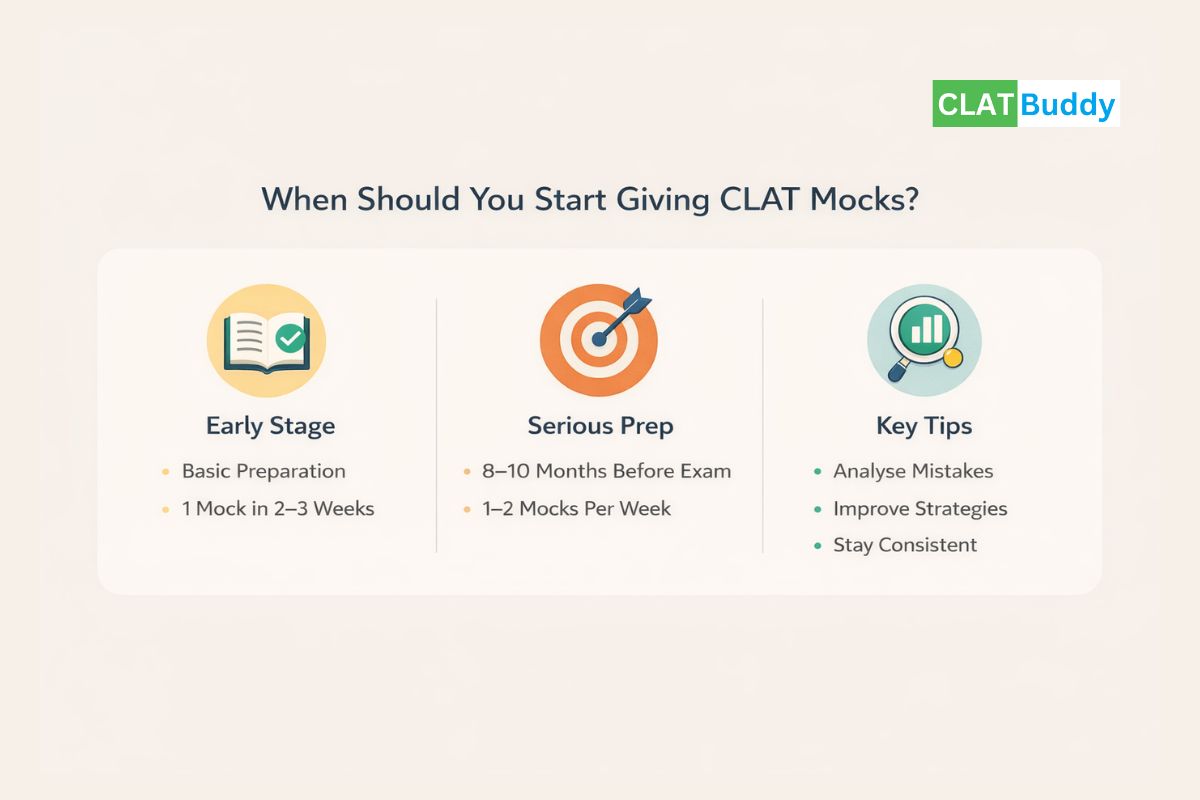
If you are in Class 11 and have just started your CLAT journey, you can begin mocks after 2 to 3 months of basic preparation.
At this stage, you should already have:
Your mocks should be:
The goal here is not performance. The goal is comfort with the exam format and building reading stamina.
If you are in Class 12, mocks should become a regular part of your preparation.
Ideally, you should start giving mocks:
At this stage:
Mocks during Class 12 help you align your preparation with CLAT’s demands while balancing school studies.
Serious mock practice usually begins 8 to 10 months before the CLAT exam.
This is the phase where:
During this phase:
This phase plays a major role in shaping your final rank.
The number of mocks should increase gradually as the exam approaches.
A general progression looks like this:
Giving too many mocks too early can cause burnout. Giving too few mocks close to the exam can leave you underprepared. Balance is key.
Yes, delaying mocks for too long is a common mistake.
If you wait until your syllabus feels perfect:
Mocks are not just tests. They are learning tools. Starting them late reduces their effectiveness.
Mock analysis is more important than the mock itself, especially in the early stages.
After each mock, focus on:
Do not just check answers and move on. Spend at least twice the mock duration on analysis. This habit will make mocks truly useful.
No, you should avoid comparison in the early and middle stages.
Early mock scores depend on:
Comparing ranks too early can:
Focus on your own progress, not others’ scores.
Mocks start becoming realistic indicators only in the final 3 to 4 months before CLAT.
By then:
Even then, remember that mocks are not destiny. Many students outperform their mock averages in the actual exam.
The biggest mistake is treating mocks as judgment tools instead of learning tools.
Other common mistakes include:
Mocks should guide your preparation, not control your emotions.
A healthy mock strategy includes:
When used correctly, mocks become your strongest ally in CLAT preparation.
You should start giving CLAT mocks as soon as you understand the exam pattern and have basic exposure to all sections, even if your syllabus is not complete.
If you treat mocks as part of the learning journey and not as a constant test of intelligence, they will significantly boost your confidence and readiness for CLAT.
If you want, the next step can be creating a month-wise mock plan based on your current class and preparation level. Just say the word.