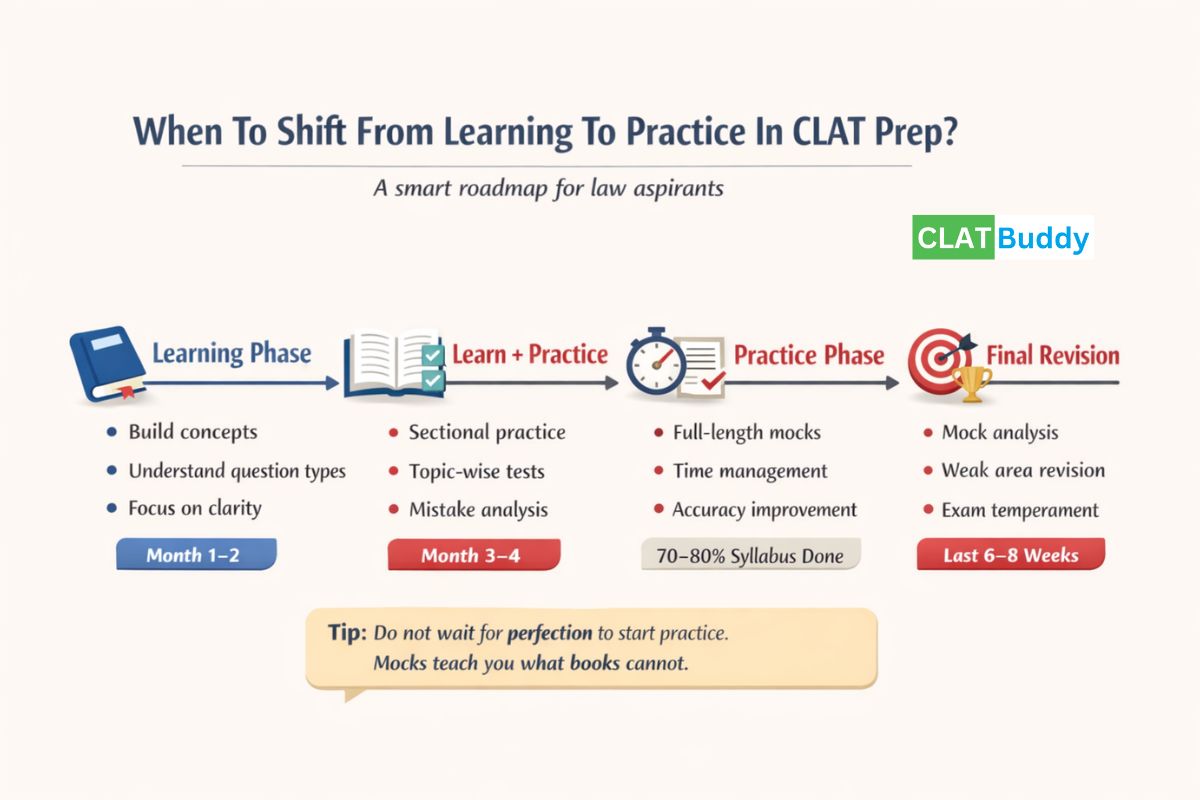
If you are preparing for CLAT or other law entrance exams, one question will keep coming back at every stage of your preparation.
Should you keep learning new concepts or should you start practising questions and mocks?
Many students either rush into mocks too early or stay stuck in learning mode for too long. Both mistakes can cost you marks and confidence. CLAT is not just about knowing concepts. It is about applying them under time pressure.
This guide will help you clearly understand when to shift from learning to practice in CLAT preparation, how to do it step by step, and how to avoid common mistakes that students your age often make.
Why Is This Shift So Important in CLAT Preparation?
CLAT is a comprehension-based exam. It tests how well you read, understand, analyse, and apply information. Learning concepts gives you tools, but practice teaches you how to use those tools in real exam conditions.
If you only keep learning:
- You may feel confident but score poorly in mocks
- You may struggle with speed and accuracy
- You may panic during the actual exam
If you only practice without learning:
- You may repeat the same mistakes
- You may guess answers without logic
- You may feel confused and demotivated
The real improvement happens when learning and practice are balanced correctly at the right time.
What Does Learning Phase Actually Mean in CLAT Prep?
The learning phase is where you build your foundation. This phase is especially important if you are starting CLAT preparation from Class 11 or early Class 12.
During this phase, you focus on understanding:
- How CLAT questions are framed
- What each section demands from you
- Basic concepts needed to solve questions confidently
What You Should Learn in This Phase
English Language
- Reading comprehension basics
- Vocabulary from context
- Understanding tone, inference, and main idea
Legal Reasoning
- Basic legal principles
- How to apply principles to facts
- Common legal terms used in passages
Logical Reasoning
- Cause and effect
- Assumptions and conclusions
- Strengthening and weakening arguments
Quantitative Techniques
- Percentages, ratios, averages
- Data interpretation basics
- Calculation shortcuts
GK and Current Affairs
- Understanding events instead of memorising facts
- Linking news with law, polity, economy, and international affairs
At this stage, your focus is clarity, not speed.
How Long Should You Stay in the Learning Phase?
There is no fixed number of months that works for everyone, but there is a practical rule you can follow.
You should stay mainly in the learning phase until:
- You have covered basic concepts of all five sections
- You understand why an answer is right or wrong
- You are not guessing blindly in practice questions
For most students, this phase lasts:
- 2 to 3 months in a long-term preparation plan
- 1 to 1.5 months in a shorter preparation plan
Staying longer than this without practising is usually a mistake.
When Should You Start Practising Questions Seriously?
You should start practising seriously as soon as your basics are clear, even if the syllabus is not fully complete.
Many students wait for the perfect moment. That moment never comes.
Practice does not mean full-length mocks on day one. It means controlled and focused practice.
Signs That You Are Ready to Practise
You are ready to practise when:
- You understand question patterns
- You can explain your answer logic
- You feel curious about improving speed and accuracy
- You can read passages without fear
If you relate to these signs, practice should already be part of your routine.
What Kind of Practice Should You Do in the Beginning?
Early practice should be section-wise and topic-wise.
Sectional Practice
This helps you apply what you learned without pressure from other sections.
Examples:
- One Legal Reasoning passage set
- One Logical Reasoning practice set
- One Quant topic practice set
Timed but Relaxed Practice
Do not focus too much on speed initially. Focus on:
- Understanding mistakes
- Identifying weak areas
- Building confidence
Daily Reading Practice
This is non-negotiable.
- Read editorials
- Read legal news
- Read long-form articles
This improves English, Legal Reasoning, and GK together.
When Should You Shift to Full-Length Mock Tests?
This is the most important shift in CLAT preparation.
You should move to full-length mocks when:
- Around 70 to 80 percent of your syllabus is covered
- You have done enough sectional practice
- You can sit for two hours with focus
Mocks are not just tests. They are diagnostic tools.
How Often Should You Take Mocks at Different Stages?
Initial Mock Phase
- 1 mock every 10 to 14 days
- Focus more on analysis than scores
Mid Preparation Phase
- 1 mock per week
- Start working on time management
- Experiment with section order
Advanced Preparation Phase
- 2 mocks per week
- Improve consistency
- Reduce silly mistakes
Final Phase Before Exam
- 2 to 3 mocks per week
- Focus on revision and confidence
- Avoid overloading yourself
Remember, more mocks without analysis do not help.
How Should You Analyse Mocks Properly?
Mock analysis is where real learning happens.
After every mock, ask yourself:
- Why did I get this question wrong?
- Was it a concept issue or a reading mistake?
- Did I mismanage time?
- Did I panic or rush?
What to Note During Analysis
- Weak sections
- Repeated mistakes
- Questions you guessed
- Time spent per section
Maintain a simple error notebook. This builds self-awareness and discipline.
Should You Stop Learning New Topics Once You Start Practising?
No. This is a common misunderstanding.
Even during heavy practice, learning never completely stops.
What changes is the priority.
- Early stage: learning more, practising less
- Middle stage: learning and practice together
- Final stage: practising more, learning less
In the last 1 to 2 months, avoid completely new topics unless they are basic or high-value.
What Are the Biggest Mistakes Students Make During This Shift?
- Staying in Comfort Zone: Many students feel safe learning theory because it feels productive. Practice exposes weaknesses, which feels uncomfortable.
- Chasing Scores Too Early: Initial mock scores do not define your potential. Focus on improvement, not rank.
- Ignoring Analysis: Giving mocks without analysis is wasted effort.
- Comparing With Others: Everyone has a different pace. Your journey is personal.
How Can You Balance School, Boards, and CLAT Practice?
Since you are between 16 and 18 years old, balancing academics is crucial.
Simple tips:
- Use weekdays for learning and sectional practice
- Use weekends for mocks and analysis
- Integrate GK reading with daily news habits
- Keep realistic daily targets
Consistency matters more than long study hours.
How Do You Know If Your Strategy Is Working?
Your strategy is working if:
- Your mock scores are slowly improving
- Your accuracy is increasing
- You feel calmer during tests
- You understand your mistakes clearly
Progress in CLAT is gradual. Trust the process.
Final Advice
CLAT preparation is not about choosing learning or practice. It is about knowing when to prioritise what.
Start learning early, but do not get stuck there. Start practising early, but do not rush blindly. Let your preparation evolve with time.
If you stay consistent, honest with your mistakes, and patient with your growth, results will follow.
CLAT is not won in one mock or one month. It is won through smart transitions and steady effort.
Calling all law aspirants!
Are you
exhausted from constantly searching for study materials and question banks?
Worry not!
With over
15,000 students already engaged, you definitely don't want to be left out.
Become a member of the most vibrant law aspirants community out there!
It’s
FREE! Hurry!
Join our
WhatsApp Groups (
Click Here) and
Telegram Channel (Click Here) today, and receive instant notifications.