
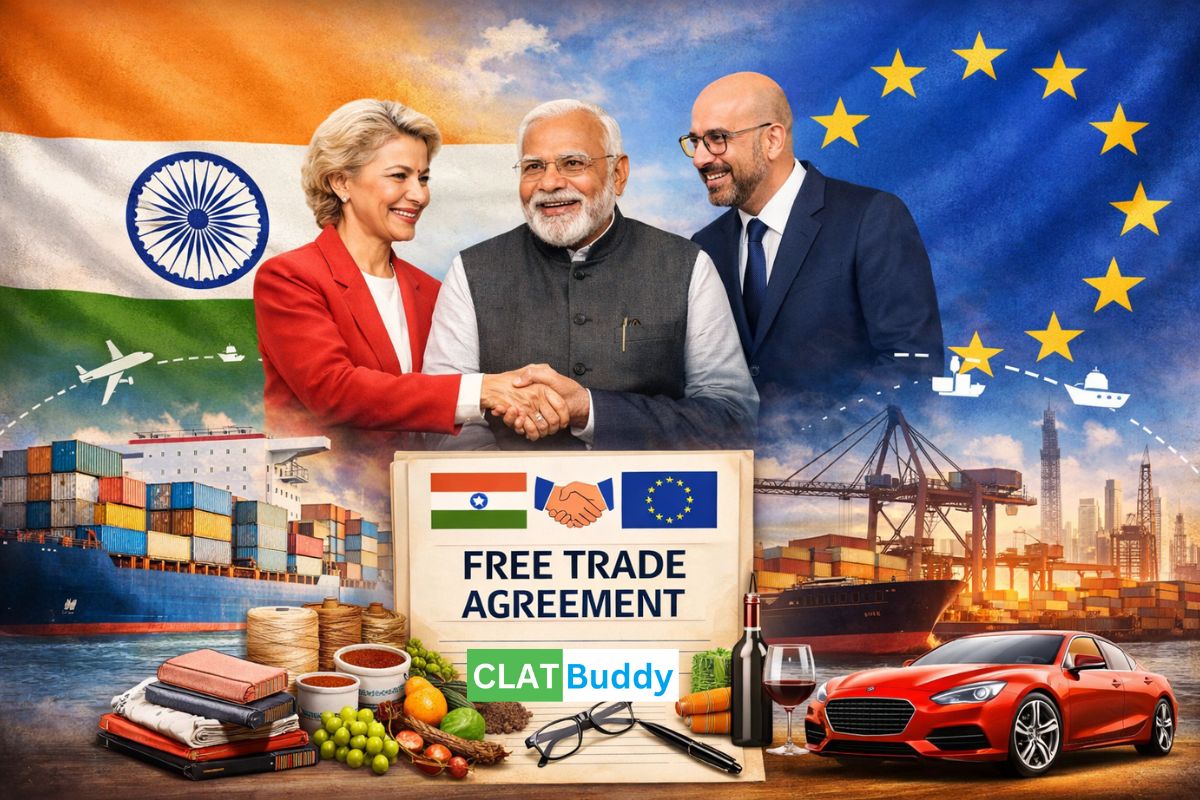
After nearly two decades of on-and-off negotiations, India and the European Union formally concluded talks on their long-awaited Free Trade Agreement (FTA) on January 27, 2026. Leaders on both sides described it as the “mother of all deals”, signalling both the scale of the agreement and its economic importance. While the full legal text is yet to be made public, official statements indicate that the deal carefully balances market access with protection of sensitive sectors.
Why is it called the “mother of all deals”?
The description stems from the size of the two economies and the volume of trade involved. India and the EU together represent one of the largest combined markets in the world, valued at around $24 trillion. The EU alone accounts for nearly 12% of India’s total trade, making it one of India’s biggest trading partners. In 2024–25, merchandise trade between the two stood at over $136 billion, while trade in services crossed $83 billion. No other recent FTA signed by India covers a market of comparable scale.
What does India gain from the agreement?
According to government disclosures, the EU will remove tariffs on about 70% of its tariff lines immediately when the agreement comes into force. This alone covers over 90% of India’s export value to the EU. A further set of products will see duties eliminated over the next three to five years, while some items will receive partial reductions or quota-based concessions. Taken together, EU tariff concessions are expected to cover more than 99% of the value of Indian exports to the region.
Beyond goods, the EU has also offered wider access in services across 144 sub-sectors, including IT and IT-enabled services, professional services, education, and other business services. Though services liberalisation is more limited than goods, the commitments are described as deeper than in many earlier EU trade deals.
Which sectors are expected to benefit most?
Labour-intensive sectors are seen as the biggest winners. These include textiles, apparel, leather, footwear, marine products, gems and jewellery, chemicals, plastics, sports goods, and toys. Many of these sectors currently face tariffs between 4% and 26% in the EU market. Under the FTA, a large share of these exports will become duty-free from day one, significantly improving their competitiveness.
Agricultural and processed food exports such as tea, coffee, spices, fruits, vegetables, and certain marine products are also expected to gain from preferential market access. Another notable inclusion is Indian traditional medicine. In EU countries where no local regulations exist, practitioners of AYUSH systems will be able to offer services based on their Indian qualifications.
What has India offered in return?
India has agreed to eliminate or gradually reduce tariffs on over 92% of its tariff lines, covering nearly 98% of trade value. For European exporters, this means easier access to the Indian market over phased timelines ranging from five to ten years.
For consumers, the most visible changes relate to wine and automobiles. Duties on European wine, currently as high as 150%, will be reduced in stages to 20–30% depending on price brackets, though only within specified quotas. Cheap wines remain excluded to protect domestic producers. Similarly, tariffs on high-end European cars will fall from around 110% to 10%, again under quota limits. Mass-market cars remain outside the agreement, safeguarding India’s domestic automobile industry.
Which sectors are excluded from the deal?
Both sides have drawn clear “red lines”. India has kept out sensitive agricultural sectors such as dairy, poultry, beef, cereals like rice and wheat, edible oils, tobacco, and certain fruits and vegetables. The EU, on its part, has excluded products such as beef, sugar, rice, milk powder, honey, bananas, and ethanol, while offering limited quotas for some other agricultural items. These exclusions were crucial for political and economic reasons on both sides.
What are the key concerns?
One major unresolved issue is the EU’s Carbon Border Adjustment Mechanism (CBAM), which imposes carbon-related tariffs on imports. The EU has maintained that CBAM applies uniformly and cannot offer country-specific exemptions. India, however, has secured an assurance that any future concessions granted to other countries will automatically extend to it.
Another concern lies in implementation. To fully benefit from the FTA, India will need to accelerate domestic reforms to attract investment and integrate more deeply into global value chains. The agreement still requires legal vetting, translation, approval by all EU member states, and ratification by the European Parliament before it comes into force.
Why does this deal matter overall?
The India–EU FTA is significant not just for its scale, but for what it signals: India’s intent to deepen trade ties with major economies while protecting core domestic interests. If implemented smoothly, it could reshape India’s export profile, strengthen labour-intensive industries, and position India as a key economic partner for Europe in a shifting global trade landscape.