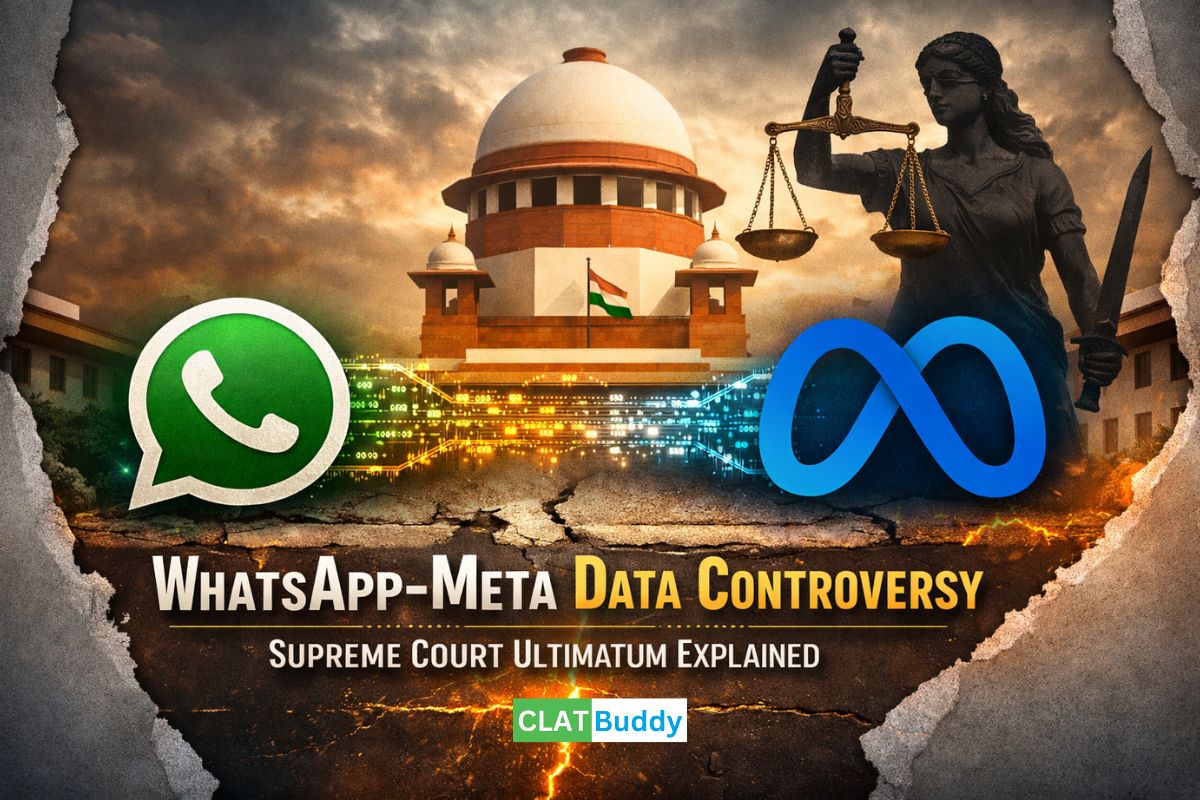
For years, Meta has built its business on a simple trade-off: users get “free” digital services, and in return, their data fuels a sophisticated advertising engine. In India, this model has now hit a constitutional and regulatory roadblock. In early February 2026, the Supreme Court of India issued a sharp ultimatum to Meta over data-sharing practices linked to WhatsApp, questioning whether user consent in a monopolistic digital ecosystem can ever be truly free.
The controversy traces back to 2021, when WhatsApp rolled out a revised privacy policy that required users to accept greater data sharing with Meta. The policy was effectively “take it or leave it.” While WhatsApp maintained that messages remained protected by end-to-end encryption, regulators focused on metadata and behavioural information that could be combined across Meta’s platforms for targeted advertising.
India’s Competition Commission of India (CCI) intervened, holding that Meta had abused its dominant position. The CCI reasoned that for most Indian users, leaving WhatsApp was not a realistic option because of its deep integration into social, professional, and even governmental communication. A penalty of ₹213.14 crore followed, along with a direction restraining data sharing for advertising purposes for five years.
Meta appealed, and the matter reached the National Company Law Appellate Tribunal (NCLAT). While the tribunal upheld the finding of abuse of dominance and retained the financial penalty, it set aside the five-year data-sharing ban. The NCLAT viewed such a prohibition as a disproportionate structural remedy that could disrupt technical integration across Meta’s services. It also appeared inclined to leave finer questions of data protection to sector-specific legislation.
This mixed verdict did little to satisfy Meta, which then approached the Supreme Court.
Before the Supreme Court, the debate took a decisive turn. The Bench, led by Chief Justice Surya Kant, emphasised the “network effect” that locks users into dominant platforms. Opting out of WhatsApp in India, the Court observed, is not a meaningful choice; it is closer to opting out of everyday digital life. In such circumstances, the idea of voluntary consent becomes suspect.
Justice Joymalya Bagchi went further, reframing the issue from privacy alone to the economic value of data. India’s Digital Personal Data Protection Act, 2023 focuses primarily on safeguarding personal information, but it is largely silent on who benefits economically from that data. If a company monetises the behavioural patterns of millions of users, should all the value accrue to the platform, or does the individual have a stake?
This line of reasoning places India closer to the European regulatory approach, where data rights increasingly intersect with competition and consumer protection law.
A recurring concern for the Court was digital literacy. Meta argued that its policies are transparent and publicly available. The Bench responded with a practical question: can an average user—such as a domestic worker or a first-time smartphone user—meaningfully understand dense, legalistic terms and conditions? Transparency, the Court suggested, is not the same as comprehension. In a country with vast disparities in education and digital awareness, consent obtained through complexity risks becoming illusory.
The Supreme Court has now directed Meta to give an undertaking to stop sharing personal user data during the pendency of the case, failing which its appeal could be dismissed under strict conditions. Interim directions are expected shortly, and the outcome could recalibrate how global technology companies operate in India.
Beyond Meta and WhatsApp, the case signals a broader judicial unease with the “free internet” model built on large-scale data extraction. Users are increasingly being recognised not just as consumers of digital services, but also as contributors of valuable economic resources. Whether Indian law evolves to recognise data as a form of property or value-bearing asset remains to be seen, but the Supreme Court has made one thing clear: consent in the age of digital monopolies will no longer be taken at face value.