

Full-Length vs Sectional Mocks for CLAT: What Should You Prioritise?
Preparing for CLAT is not just about studying concepts. It is about applying them under pressure. This is where mock tests come in. But one common confusion many aspirants face is this:
Should you focus more on sectional mocks or full-length mocks?
If you have ever felt stuck between the two, this guide will clear everything. Think of this as a mentor sitting next to you and helping you plan your preparation smartly.
What Are Sectional and Full-Length Mocks in CLAT Preparation?
Before deciding what to prioritise, it is important to understand what each type of mock actually does for you.
What are sectional mocks?
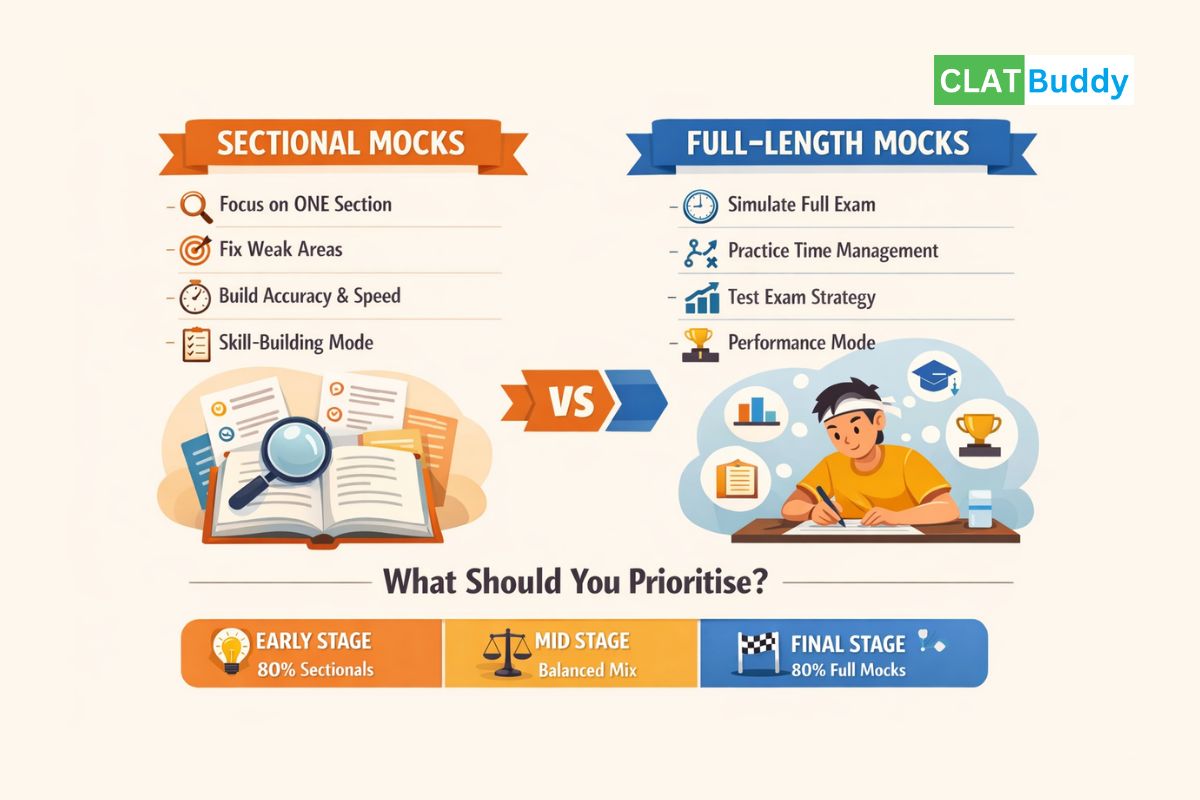
Sectional mocks are tests that focus on one specific section of CLAT such as Legal Reasoning, Logical Reasoning, English, GK or Quantitative Techniques.
These mocks help you:
- Build strong fundamentals in a single subject
- Identify weak areas without distraction
- Improve accuracy and speed in that section
- Practise question patterns in depth
They are shorter and easier to analyse, which makes them perfect for focused improvement.
What are full-length mocks?
Full-length mocks simulate the actual CLAT exam. They include all sections and are taken in a fixed time limit.
These mocks help you:
- Practise time management across sections
- Build exam temperament and stamina
- Decide the order in which you attempt sections
- Understand your real score and rank level
In simple terms, full mocks prepare you for the actual exam environment.
Why Is This Confusion So Common Among CLAT Aspirants?
Most students either:
- Start with full mocks too early and feel demotivated due to low scores
- Or stick only to sectionals and struggle in actual exam conditions
The truth is, both types of mocks are important. But the priority changes depending on your preparation stage.
When Should You Prioritise Sectional Mocks?
If you are in the early phase of preparation, sectional mocks should be your main focus.
Why should beginners focus on sectionals?
At this stage, your goal is to understand the exam and build concepts.
You should focus on sectionals because:
- You are still learning question patterns
- Accuracy is more important than speed right now
- Weak areas need targeted improvement
- Full mocks may feel overwhelming
What happens if you ignore sectionals?
If you jump directly into full mocks:
- You may keep repeating the same mistakes
- Your weak sections will remain weak
- Your confidence may drop due to low scores
How to use sectional mocks effectively?
- Pick 2 to 3 sections per week
- Solve timed sectional tests
- Analyse mistakes immediately
- Maintain an error notebook
At this stage, sectionals act as your foundation.
When Should You Start Giving Full-Length Mocks?
Full-length mocks become important once you have basic clarity in most sections.
How do you know you are ready for full mocks?
You are ready when:
- You understand question types in each section
- Your accuracy is improving in sectionals
- You can solve passages with reasonable speed
Why are full mocks important at this stage?
Full mocks help you:
- Combine all sections in one sitting
- Learn time allocation
- Avoid spending too much time on one section
- Build mental stamina for a 2-hour exam
Without full mocks, you may perform well in practice but struggle in the actual exam.
What Should You Prioritise at Each Stage of CLAT Preparation?
This is the most important part of your strategy.
Early Stage of Preparation
Focus more on learning and building concepts.
Ideal ratio:
- Sectional mocks: 70 to 80 percent
- Full mocks: 20 to 30 percent
Your priority should be improving accuracy and understanding.
Mid Stage of Preparation
Now you start balancing both types of mocks.
Ideal ratio:
- Sectional mocks: 50 percent
- Full mocks: 50 percent
At this stage:
- You fix weak areas using sectionals
- You test overall performance using full mocks
Final Stage Before CLAT
This is where your focus shifts completely towards performance.
Ideal ratio:
- Full mocks: 70 to 80 percent
- Sectional mocks: 20 to 30 percent
Now your goal is:
- Maximising score
- Improving time management
- Reducing silly mistakes
Full mocks become your primary tool.
How Many Mocks Are Enough for CLAT?
This is another common question among aspirants.
There is no fixed number, but a general guideline is:
- Sectional mocks: 100 plus across preparation
- Full-length mocks: 40 to 60 before the exam
However, the real value lies in analysis, not just giving mocks.
Why Is Mock Analysis More Important Than Giving Mocks?
Many students keep attempting mocks but do not improve. The reason is poor analysis.
What should you analyse after every mock?
After each mock, spend at least as much time analysing as you spent taking it.
Focus on:
- Why a question was wrong
- Whether it was a conceptual mistake or time pressure
- Questions you guessed correctly
- Questions you left but could have attempted
How to improve through analysis?
- Maintain a mistake log
- Identify patterns in errors
- Revise weak topics regularly
- Track improvement over time
Without analysis, mocks become just numbers.
What Are the Common Mistakes Students Make?
Understanding mistakes can save months of effort.
Ignoring weak sections
Many students focus only on their strengths. This creates imbalance in full mocks.
Giving too many mocks without learning
More mocks do not mean better preparation. Learning from mocks is what matters.
Not building a strategy
Every student needs a strategy for:
- Section order
- Time allocation
- Attempt selection
Panicking during full mocks
This usually happens when full mocks are started too late or too early.
What Is the Ideal Weekly Mock Plan for CLAT Aspirants?
A simple and practical plan can help you stay consistent.
Suggested weekly structure
- 1 to 2 full-length mocks
- 3 to 4 sectional mock sessions
- 1 dedicated analysis day
This ensures:
- Continuous improvement
- Balanced preparation
- Regular performance tracking
How Do You Decide Between Sectional and Full Mocks on a Given Day?
Instead of following a fixed rule, ask yourself one question:
What is your current problem?
If your problem is low accuracy
Focus on sectional mocks.
If your problem is poor time management
Focus on full-length mocks.
If your problem is weak GK or Legal
Do targeted sectional practice.
If your problem is exam pressure
Increase full mock frequency.
Your preparation should be flexible, not rigid.
Final Takeaway: What Should You Really Prioritise?
There is no single answer like “only sectionals” or “only full mocks”.
The smartest approach is:
- Start with sectionals to build strength
- Gradually include full mocks
- Shift focus to full mocks near the exam
- Continue sectional practice for weak areas
In simple words:
Sectional mocks make you better.
Full-length mocks make you exam ready.
If you balance both correctly, your CLAT preparation becomes much more effective and less stressful.
Calling all law aspirants!
Are you exhausted from constantly searching for study materials and question banks? Worry not!
With over 15,000 students already engaged, you definitely don't want to be left out.
Become a member of the most vibrant law aspirants community out there!
It’s FREE! Hurry!
Join our WhatsApp Groups (Click Here) and Telegram Channel (Click Here) today, and receive instant notifications.