

How to Make Short Notes That Actually Help in CLAT Preparation

Preparing for CLAT is not just about studying for long hours. It is also about revising smartly. Many students spend months reading books, watching lectures, and solving mocks, but when revision season starts, they realise they have too much material and too little time.
This is where short notes become extremely important.
Good short notes can save you during the final months before CLAT. They help you revise faster, remember concepts better, and avoid panic before mocks and the actual exam. But the problem is that many students make notes that are too lengthy, too decorative, or impossible to revise quickly.
If you are preparing for CLAT 2027 or any other law entrance exam, this guide will help you understand how to make short notes that genuinely improve your preparation.
Why Are Short Notes Important for CLAT Preparation?
CLAT is a highly revision-based exam. You cannot depend only on reading new material every day. You need repeated revision of:
- Current affairs
- Legal concepts
- Vocabulary
- Static GK
- Logical reasoning tricks
- Quant formulas and methods
Without short notes, revision becomes messy.
Imagine trying to revise 8 months of current affairs from full newspapers or entire coaching PDFs. It becomes stressful and time-consuming. Short notes reduce that burden.
They help you:
- revise quickly before mocks
- retain concepts longer
- identify weak areas
- improve recall speed
- avoid resource overload
Most toppers do not revise from textbooks in the final months. They revise from their own notes.
What Makes Short Notes Actually Useful?
A lot of students confuse short notes with copied class notes.
Useful short notes are:
- concise
- revision-friendly
- easy to scan
- focused on recall
- personalised according to your weak areas
Your notes should help you remember information within seconds.
If your “short notes” are 15 pages long for one topic, they are not short notes anymore.
The purpose is not to create beautiful notebooks. The purpose is to create a revision tool that works during pressure situations.
Should You Make Separate Notes for Every Subject?
Yes, but the format should change according to the subject.
CLAT is not a theory-heavy exam like school exams. Different sections require different note-making strategies.
Current Affairs Notes
For current affairs, avoid writing full news articles.
Instead, note:
- event name
- date
- organisation involved
- why it matters
- important keywords
Example:
| Topic | Key Points |
| G20 Summit | Host country, theme, important agreements |
| Supreme Court Judgement | Issue, judgement, significance |
Your current affairs notes should be quick to revise in 5 to 10 minutes.
Legal Reasoning Notes
For legal reasoning, focus on:
- legal maxims
- important principles
- landmark cases
- frequently confused concepts
You can also use:
- flowcharts
- issue-based tables
- one-line explanations
Example:
| Concept | Meaning |
| Negligence | Failure to exercise reasonable care |
| Mens Rea | Guilty intention |
English Language Notes
For English, maintain:
- vocabulary notebook
- idioms and phrases
- confusing words
- grammar mistakes from mocks
Do not try to memorise huge vocabulary lists. Focus on words you repeatedly encounter during practice.
Quantitative Techniques Notes
For Quant:
- formulas
- shortcuts
- percentage tricks
- ratio methods
- common mistakes
Keep Quant notes extremely short because revision speed matters here.
How Can You Make Notes That Improve Memory?
The best notes are based on active recall.
This means your notes should force your brain to remember information instead of simply rereading it.
Instead of writing:
Doctrine of Severability means invalid parts can be separated from valid parts.
Write:
What is Doctrine of Severability?
Then answer it mentally before checking the explanation.
This technique improves retention significantly because your brain becomes active during revision.
Should You Use Digital Notes or Handwritten Notes?
There is no universal answer.
Choose the method that helps you revise consistently.
Handwritten Notes Work Better If:
- you remember things by writing
- you get distracted on devices
- you prefer physical revision
- you like visual memory
Digital Notes Work Better If:
- you update notes frequently
- you want searchable notes
- you prefer organised folders
- you prepare from multiple sources
Many CLAT aspirants use a hybrid system:
- handwritten for difficult concepts
- digital for current affairs and revision sheets
The best system is the one you can maintain for months.
How Much Should You Write in Short Notes?
This is where most students make mistakes.
Your notes should contain:
- keywords
- triggers
- examples
- formulas
- mistakes
- shortcuts
They should not contain full textbook paragraphs.
A good rule is:
One topic should usually fit within one or two pages.
If your notes become too lengthy, revision becomes difficult.
Remember that CLAT preparation already involves:
- mocks
- analysis
- reading practice
- sectional tests
- current affairs
You cannot spend your entire day maintaining elaborate notes.
Why Is an Error Notebook Extremely Important?
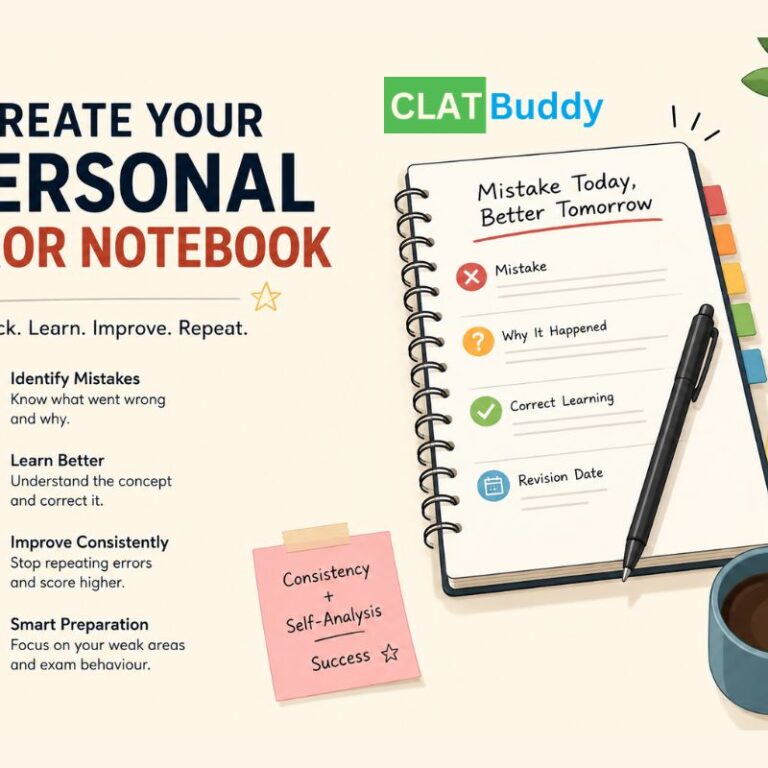
One of the smartest things you can do during CLAT preparation is maintain an error notebook.
This notebook should include:
- mistakes from mocks
- concepts you repeatedly forget
- silly errors
- trap questions
- incorrect assumptions
Your mistakes are actually your best teachers.
Suppose you repeatedly get assumption-based Critical Reasoning questions wrong. Instead of simply moving on, note:
- what mistake you made
- why the correct answer worked
- what pattern you missed
Over time, this notebook becomes more valuable than ordinary notes because it directly targets your weaknesses.
How Often Should You Revise Short Notes?
Making notes is useless without revision.
Revision should happen in cycles.
You can follow a simple pattern:
- revise within 24 hours
- revise again after 3 days
- revise after 1 week
- revise after 1 month
This improves long-term memory.
Even short 15-minute revisions can make a huge difference if done consistently.
Many students keep making new notes but never revisit old ones. That defeats the entire purpose.
What Are the Biggest Mistakes Students Make While Making Notes?
- Writing Too Much: Your notes should reduce information, not duplicate books.
- Focusing Too Much on Decoration: Using colours occasionally is fine, but spending hours beautifying notes is not productive. CLAT rewards clarity and consistency, not artistic notebooks.
- Copying Coaching Material Word-for-Word: Copied notes rarely help because your brain stays passive during the process.
- Not Updating Notes: Your understanding changes over time. Your notes should evolve too.
- Ignoring Mock Analysis: Mock analysis notes are often more important than theory notes.
How Can You Make Revision Faster Before CLAT?
As CLAT approaches, your short notes become your primary revision source.
To make revision faster:
- use headings
- highlight important points
- create one-page summaries
- use arrows and tables
- mark frequently forgotten topics
You can also create:
- weekly revision sheets
- monthly current affairs summaries
- formula pages
- legal principle flashcards
The easier your notes are to scan, the better your revision speed becomes.
Can Short Notes Reduce CLAT Stress?
Yes, significantly.
One major reason students panic before CLAT is because they feel they have too much left to revise.
Short notes create psychological clarity.
When you know that your important concepts are organised properly, revision feels manageable.
Instead of revising 10 bulky books, you revise:
- your summaries
- your mistake notebook
- your revision sheets
- your mock analysis
That improves confidence before the exam.
Final Thoughts
Short notes are not magic tools. Their real power comes from consistency.
You do not need perfect notes. You need usable notes.
During CLAT preparation, your goal should be:
- understanding concepts clearly
- revising repeatedly
- identifying mistakes early
- simplifying information
If your notes help you revise faster and remember better, they are working.
Start simple. Improve gradually. Do not compare your notes with others. Your preparation journey is personal, and your notes should reflect your own learning style.
In the end, the best short notes are the ones you actually revise.
Calling all law aspirants!
Are you exhausted from constantly searching for study materials and question banks? Worry not!
With over 15,000 students already engaged, you definitely don't want to be left out.
Become a member of the most vibrant law aspirants community out there!
It’s FREE! Hurry!
Join our WhatsApp Groups (Click Here) and Telegram Channel (Click Here) today, and receive instant notifications.