

Guesswork vs Intelligent Attempts in CLAT: What Should You Really Do in the Exam?
If you have been preparing for CLAT for some time, you already know that this exam is not just about knowledge. It is about decision-making under pressure. Many students walk out of the exam hall thinking they did well, only to realise later that guesswork cost them their rank.
So the real question is not how much you know. The real question is how you attempt.
This article will help you clearly understand the difference between guesswork and intelligent attempts in CLAT, and more importantly, how to apply this understanding in your mocks and the actual exam.
What is Guesswork in CLAT and Why Do Students Fall Into This Trap?
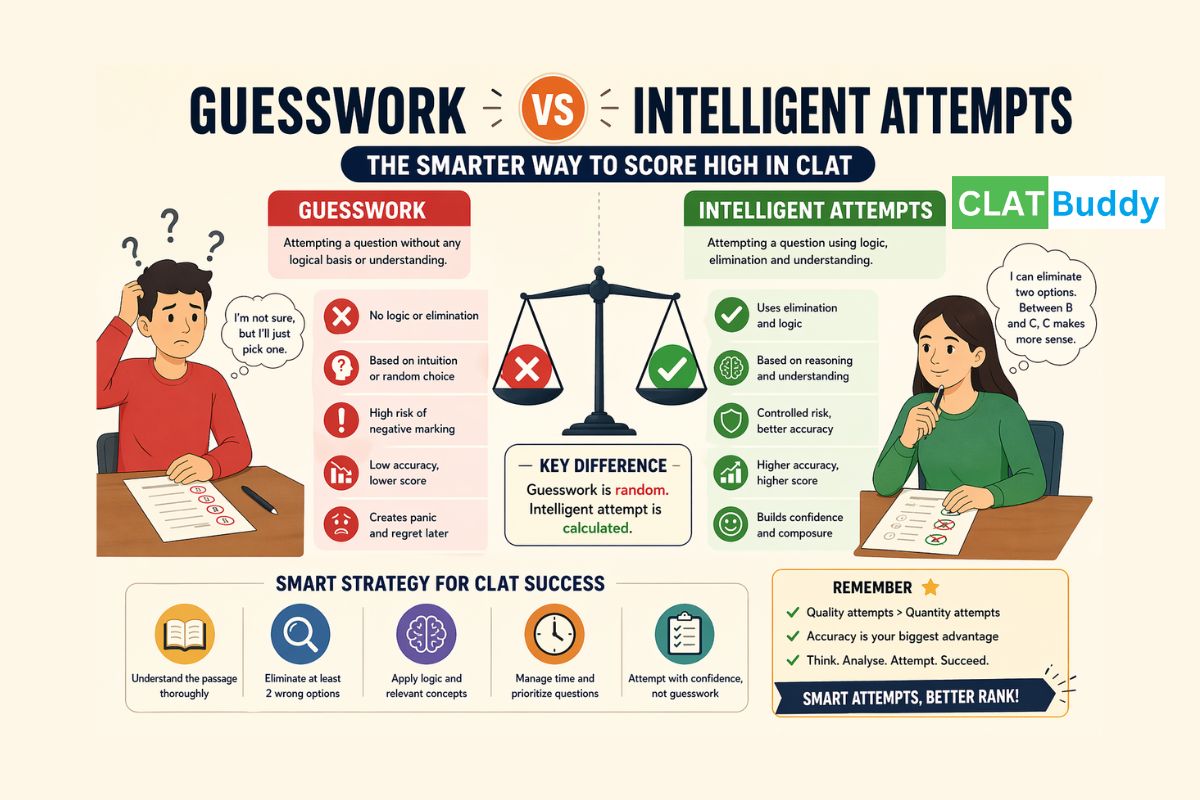
Guesswork in CLAT simply means attempting a question without any logical reasoning or elimination. It usually happens when you are unsure but still attempt the question just to increase your attempt count.
Most students fall into guesswork because of pressure. You might feel that attempting more questions will automatically increase your score. That assumption is dangerous.
Why do students rely on guesswork?
- Fear of leaving questions unattempted
- Panic during the exam
- Lack of time management
- Overconfidence or underconfidence
- Not following a proper strategy during mocks
Guesswork feels like a shortcut, but in CLAT, it often backfires because of negative marking.
How Does Negative Marking Make Guesswork Risky?
CLAT has a penalty for wrong answers. For every incorrect answer, marks are deducted. This means that random guessing can reduce your overall score significantly.
Think about this practically. If you guess 20 questions randomly, even if you get a few correct, the incorrect ones will cancel out your gains.
Instead of increasing your score, guesswork often pulls it down.
This is why toppers focus more on accuracy than on the number of attempts.
What is an Intelligent Attempt in CLAT?
An intelligent attempt is when you attempt a question using logic, elimination, and understanding of the passage, even if you are not fully confident.
It is not about being 100 percent sure. It is about making a calculated decision.
What does an intelligent attempt look like?
- You eliminate at least one or two clearly wrong options
- You refer back to the passage for confirmation
- You apply logic instead of intuition
- You choose the most reasonable answer among the remaining options
This approach reduces risk and improves accuracy over time.
How is Intelligent Guessing Different from Blind Guessing?
Many students confuse intelligent guessing with guesswork. They are not the same.
Here is the key difference.
Blind guessing is random. Intelligent guessing is structured.
When you make an intelligent attempt, you are not guessing randomly. You are narrowing down options and then making a logical choice.
This is exactly what CLAT demands. The exam tests your reasoning ability, not your ability to memorise.
What is the Ideal Attempt Strategy for CLAT?
You should not aim to attempt all questions. That is one of the biggest myths in CLAT preparation.
The ideal strategy is to focus on high-quality attempts.
What does that mean?
- Attempt questions you are confident about
- Attempt questions where you can eliminate options
- Skip questions where you have no idea
A student who attempts 85 questions with high accuracy will usually score better than someone who attempts 110 with guesswork.
When Should You Skip a Question in CLAT?
Knowing when not to attempt is as important as knowing when to attempt.
You should skip a question when:
- You cannot eliminate even one option
- The passage is unclear or confusing
- You are running out of time and need to prioritise easier questions
- You feel completely blank about the concept
Skipping is not a weakness. It is a smart decision in a time-bound exam.
When Should You Make an Intelligent Attempt?
You should attempt a question when there is at least some clarity.
Indicators that you can attempt:
- You can eliminate two options confidently
- You understand the passage but are confused between two choices
- The options are similar and require logical comparison
- You have seen similar questions in mocks
In such cases, attempting the question makes sense because your probability of getting it right is higher.
How Can You Develop Intelligent Attempt Skills?
This is not something that happens automatically. You need to train yourself through consistent practice.
Focus on option elimination
While practising mocks, do not just check whether your answer is correct or wrong. Analyse how many options you were able to eliminate.
Try to build the habit of eliminating at least two options in every question.
Analyse your mistakes deeply
After every mock, ask yourself:
- Was this a guess or an intelligent attempt?
- Did I have enough reasoning to attempt this question?
- Could I have eliminated more options?
This reflection is what separates average students from top rankers.
Improve your reading comprehension
A major part of CLAT depends on how well you understand passages. Better comprehension leads to better elimination.
Focus on:
- Reading editorials daily
- Practising passage-based questions
- Understanding the tone and argument of the author
Build logical thinking
CLAT is not about memorisation. It is about reasoning.
Practise:
- Legal reasoning questions
- Critical reasoning sets
- Logical deduction exercises
Over time, you will start identifying patterns in options.
What Role Do Mocks Play in Reducing Guesswork?
Mocks are not just for testing knowledge. They are for building exam temperament.
Use mocks to experiment with your attempt strategy.
During mocks, try this:
- Track how many questions you guessed
- Identify how many of those guesses were correct
- Reduce random guesses in every mock
Gradually, shift from guesswork to intelligent attempts.
What is the Common Mistake Students Make?
The biggest mistake is focusing only on attempts and ignoring accuracy.
Many students say:
“I attempted 100 questions”
But the real question is:
“How many were correct?”
Another mistake is not analysing mocks properly. If you do not review your mistakes, you will keep repeating them.
How Do Toppers Approach Attempts in CLAT?
Toppers are not necessarily the ones who know everything. They are the ones who make better decisions in the exam.
Their approach usually includes:
- Prioritising accuracy over attempts
- Avoiding unnecessary risks
- Using elimination effectively
- Staying calm under pressure
They treat the exam like a strategy game, not a race.
How Can You Apply This in Your Next Mock?
Start small. You do not need to change everything at once.
Action plan for your next mock:
- Decide in advance that you will avoid blind guessing
- Attempt only when you can eliminate at least one option
- Mark questions you are unsure about and review them later
- Analyse your performance in terms of intelligent attempts
Over a few mocks, you will notice a clear improvement in your score.
Final Takeaway: What Should You Remember?
CLAT is not about attempting everything. It is about attempting smartly.
If you rely on guesswork, negative marking will reduce your score. If you rely on intelligent attempts, your accuracy will improve.
Always remember:
- More attempts do not mean more marks
- Better decisions lead to better ranks
- Skipping is sometimes the smartest move
If you train yourself to think before attempting, you will not just improve your score. You will gain control over the exam.
And that is what truly matters in CLAT.
Calling all law aspirants!
Are you exhausted from constantly searching for study materials and question banks? Worry not!
With over 15,000 students already engaged, you definitely don't want to be left out.
Become a member of the most vibrant law aspirants community out there!
It’s FREE! Hurry!
Join our WhatsApp Groups (Click Here) and Telegram Channel (Click Here) today, and receive instant notifications.