


How Many Mocks Are Enough for CLAT?
If there is one thing that separates average aspirants from top rankers, it is how seriously they take mock tests. Mocks are not just practice papers. They are simulations of the actual exam.
When you give a mock, you are training your brain to handle pressure, manage time, and make decisions quickly. CLAT is not just about knowledge. It is about how well you perform under time constraints.
Mocks help you:
- Understand the exam pattern in a practical way
- Improve speed and accuracy
- Build stamina for a 2-hour exam
- Identify weak areas early
Many students spend months studying concepts but hesitate to give mocks. That is a mistake. CLAT is a performance-based exam, and mocks are your rehearsal.
How Many Mock Tests Are Enough for CLAT?
This is one of the most common questions among CLAT aspirants. The answer is not a fixed number, but there is a practical range that works for most students.
A realistic breakdown looks like this:
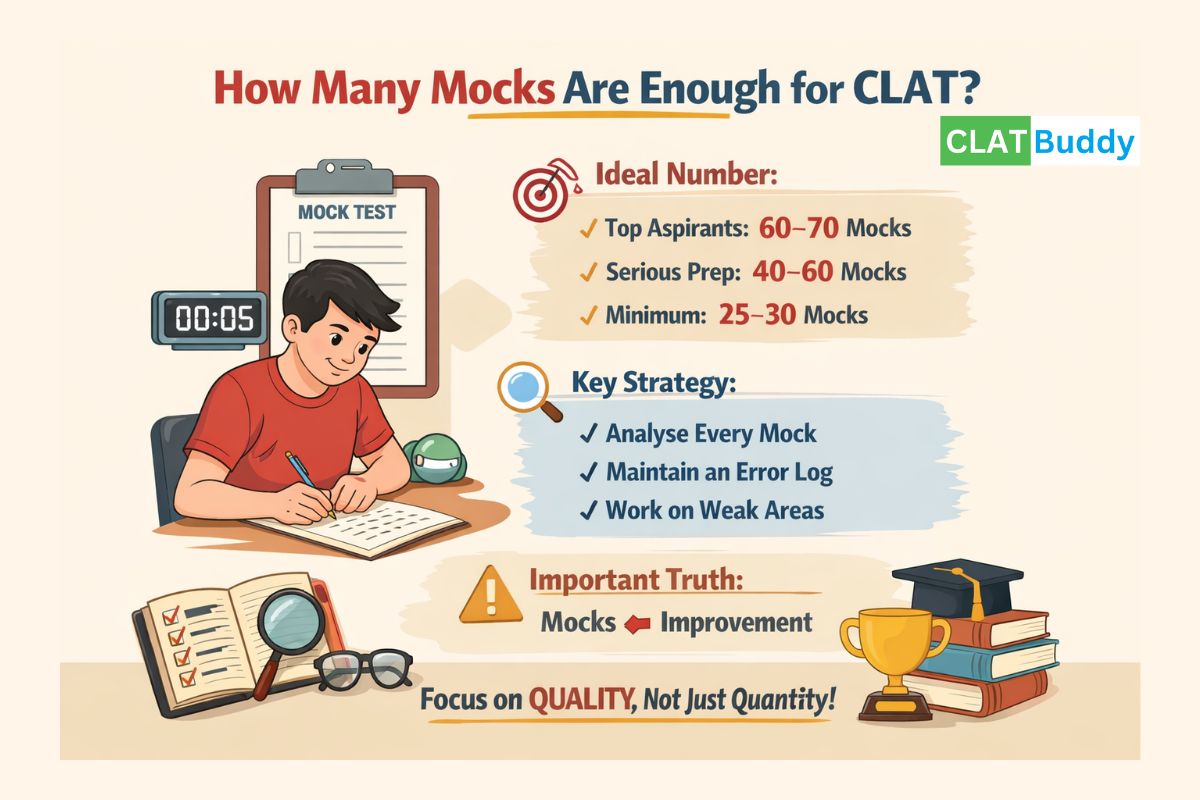
- Top aspirants: 60 to 70 mocks
- Serious preparation: 40 to 60 mocks
- Minimum requirement: 25 to 30 mocks
If you are aiming for a top National Law University, staying in the 50 plus range is advisable. However, the number alone does not decide your rank.
What truly matters is how well you analyse each mock.
Is Giving More Mocks Always Better?
It may feel like giving more mocks will automatically improve your score, but that is not always true.
There are students who give 80 mocks and still struggle, while others give 40 mocks and perform extremely well.
The difference lies in how mocks are used.
If you:
- Give a mock and move on without analysing
- Do not understand your mistakes
- Repeat the same errors in the next mock
Then even 100 mocks will not help.
But if you:
- Analyse every question carefully
- Maintain an error log
- Work on weak areas
Then even 30 to 40 mocks can bring strong improvement.
Quality always beats quantity.
When Should You Start Giving CLAT Mocks?
Timing is important. Starting too late can hurt your preparation, and starting too early without basics can be confusing.
A smart approach is:
If You Are Starting Early for CLAT 2027
You can begin mocks within 1 to 2 months of starting preparation. Initially, your scores may be low, and that is completely normal.
Start with:
- 1 mock per week
- Focus on understanding the pattern
Gradually increase the frequency as your preparation improves.
If You Have 3 to 4 Months Left
At this stage, mocks should become a core part of your routine.
- 2 to 3 mocks per week
- Focus on time management and accuracy
- Start refining your attempt strategy
If You Are in the Last 1 to 2 Months
This is your peak phase.
- 3 to 5 mocks per week
- Simulate exam conditions strictly
- Focus heavily on revision and analysis
At this stage, mocks are your main tool for improvement.
What Is the Ideal Mock Strategy for CLAT?
Giving mocks randomly will not help. You need a structured approach.
Step 1: Give the Mock Seriously
Treat every mock like the actual CLAT exam.
- Sit in a quiet place
- Follow the exact time limit
- Avoid distractions
This builds discipline and exam temperament.
Step 2: Analyse the Mock Properly
This is the most important step.
Spend at least 2 to 3 hours analysing a single mock. Many students skip this, and that is where they lose marks.
During analysis:
- Check every wrong answer
- Understand why you got it wrong
- Identify whether it was a concept mistake or a silly error
Step 3: Maintain an Error Log
Create a simple notebook or document where you track your mistakes.
Include:
- Type of mistake
- Section involved
- Correct concept or approach
This helps you avoid repeating the same mistakes.
Step 4: Work on Weak Areas
Mocks show you your weak areas clearly.
For example:
- Low score in Legal Reasoning
- Slow reading in English
- Poor accuracy in Logical Reasoning
Once identified, work on these areas before the next mock.
How Should You Analyse CLAT Mock Tests?
Many aspirants do not know how to analyse mocks effectively. Simply checking answers is not enough.
A proper analysis should include:
Accuracy Check
Calculate:
- Total questions attempted
- Correct answers
- Incorrect answers
Focus on improving accuracy, not just attempts.
Section-wise Performance
Check how you performed in:
- English
- Legal Reasoning
- Logical Reasoning
- GK
- Quantitative Techniques
Identify which section needs maximum improvement.
Time Management
Ask yourself:
- Which section took the most time
- Where you got stuck
- Whether you rushed at the end
Time management is a key factor in CLAT success.
Pattern of Mistakes
Look for patterns such as:
- Misreading passages
- Guessing answers
- Losing marks in easy questions
Fixing patterns is more important than fixing individual mistakes.
What Are Common Mistakes Students Make with Mocks?
Many aspirants unknowingly reduce the effectiveness of mocks due to certain mistakes.
Giving Mocks Without Preparation
Jumping into mocks without basic understanding leads to frustration. Build a foundation first.
Ignoring Mock Analysis
This is the biggest mistake. Without analysis, mocks lose their purpose.
Comparing Scores with Others
Every student has a different pace. Focus on your own improvement instead of comparing scores.
Chasing Number of Mocks
Some students aim for 100 mocks just to feel productive. This is not necessary.
It is better to give fewer mocks with proper analysis.
Not Revising Mistakes
If mistakes are not revised, they will keep repeating.
Always revisit your error log.
How Do Toppers Approach CLAT Mock Tests?
Toppers do not just give mocks. They use them as a strategic tool.
Their approach usually includes:
- Consistent mock schedule
- Deep analysis after every test
- Strong focus on accuracy
- Continuous improvement in weak areas
They also treat every mock seriously, which helps them stay mentally prepared for the actual exam.
How Will You Know If You Have Given Enough Mocks?
Instead of focusing on a number, look for these signs:
- Your scores are becoming stable
- You have a clear attempt strategy
- Your accuracy is improving
- You feel comfortable with the exam pattern
When these things start happening, it means your mock preparation is on the right track.
Final Thoughts: Focus on Smart Preparation, Not Just Hard Work
Preparing for CLAT can feel overwhelming at times, especially when it comes to deciding how many mocks to give.
The truth is simple. There is no magic number.
A range of 40 to 60 mocks works well for most aspirants. If you are aiming higher, you can go up to 70.
But remember, mocks are not about quantity. They are about learning.
Every mock is an opportunity to improve. Every mistake is a lesson.
If you stay consistent, analyse properly, and keep improving, your CLAT preparation will move in the right direction.
Calling all law aspirants!
Are you exhausted from constantly searching for study materials and question banks? Worry not!
With over 15,000 students already engaged, you definitely don't want to be left out.
Become a member of the most vibrant law aspirants community out there!
It’s FREE! Hurry!
Join our WhatsApp Groups (Click Here) and Telegram Channel (Click Here) today, and receive instant notifications.