

How to Analyse CLAT Mocks Properly
Most CLAT aspirants focus on the number of mocks they give. But here is the truth. Giving mocks alone will not improve your score. Improvement comes from analysing them.
When you analyse a mock, you understand your thinking process. You identify where you went wrong, where you got lucky, and where you can improve. Without analysis, mocks become just another test. With analysis, they become your strongest learning tool.
If you want to increase your CLAT score, reduce mistakes, and build confidence, mock analysis is non-negotiable.
What Does “Proper CLAT Mock Analysis” Actually Mean?
Many students think analysis means checking answers and reading explanations. That is not enough.
Proper analysis means:
- Understanding why you got a question wrong
- Identifying patterns in your mistakes
- Fixing weak areas through targeted practice
- Improving your strategy for the next mock
Think of it this way. Every mock is giving you feedback. If you ignore that feedback, you will keep repeating the same mistakes.
How Should You Start Analysing a CLAT Mock?
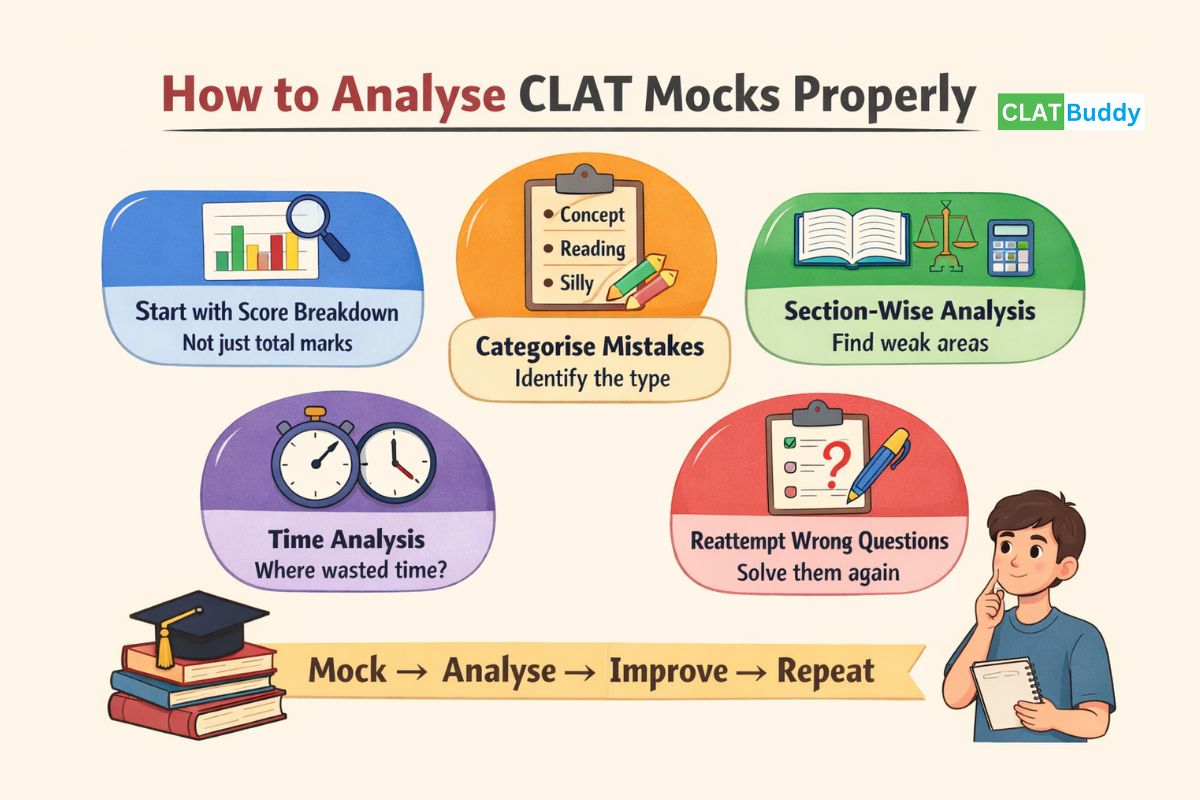
Before jumping into questions, start with a basic overview of your performance.
Look at:
- Total score
- Number of attempts
- Accuracy percentage
- Section-wise performance
This step helps you understand your overall standing. For example, a low score can happen due to low attempts or poor accuracy. Both need different solutions.
Spend 10 to 15 minutes on this overview before going deeper.
How to Identify and Categorise Your Mistakes?
This is the most important part of mock analysis. Every mistake has a reason. If you do not identify that reason, improvement becomes difficult.
What are the main types of mistakes in CLAT?
Conceptual Mistakes
These happen when you do not know the concept or rule properly.
- Common in Legal Reasoning and Quant
- Also seen in Logical Reasoning questions
If you find many conceptual mistakes, it means your basics need revision.
Misreading or Interpretation Errors
These happen when you misunderstand the passage or question.
- Missing keywords like “not” or “except”
- Incorrect interpretation of the passage
- Confusion between close options
This is very common in English and Logical Reasoning.
Silly Mistakes
These are avoidable errors.
- Marking the wrong option
- Calculation errors
- Changing correct answers
These mistakes reduce your score the most because they are completely in your control.
Why is this categorisation important?
When you categorise mistakes, you stop guessing your weaknesses. You get clarity.
For example:
- Too many conceptual mistakes means revise
- Too many misreading errors means improve reading
- Too many silly mistakes means improve focus
This clarity helps you work smarter.
Should You Maintain a CLAT Mock Analysis Notebook?
Yes, and this can completely change your preparation.
A mock analysis notebook helps you track your mistakes and learn from them. Instead of forgetting errors, you start noticing patterns.
What should you include in your notebook?
- Question type
- Your answer and correct answer
- Reason for mistake
- What you will do to fix it
For example:
- Legal question wrong because principle was misapplied
- RC question wrong due to misreading
- Quant question wrong due to formula confusion
Over time, this notebook becomes your personal guide to improvement.
How to Analyse Each Section in CLAT?
Every section in CLAT requires a different approach. Analysing them in the same way will not help.
How to Analyse English and Reading Comprehension?
Focus on understanding rather than speed.
Ask yourself:
- Did you understand the passage or guess answers?
- Are you falling for trap options?
- Are you reading too fast or too slow?
If accuracy is low, work on comprehension. If time is an issue, improve reading speed gradually.
How to Analyse Legal Reasoning?
This section is about application, not prior knowledge.
Check:
- Did you apply the principle correctly?
- Did you assume outside knowledge?
- Did you overthink simple questions?
If mistakes are frequent, focus on understanding principles and practising application.
How to Analyse Logical Reasoning?
Logical Reasoning tests your thinking clarity.
Identify:
- Are you weak in assumptions or inferences?
- Are you getting confused between options?
- Are you missing key arguments in passages?
Practice targeted question types based on your weak areas.
How to Analyse Quantitative Techniques?
Quant is often ignored by students, but it can boost your score.
Check:
- Is the issue concept or time?
- Are calculations taking too long?
- Are you skipping easy questions?
If concepts are weak, revise basics. If time is the issue, practise calculation speed.
How Important is Time Analysis in CLAT Mocks?
Time analysis is a game changer in CLAT preparation.
Many students lose marks not because they lack knowledge, but because they manage time poorly.
What should you check?
- Time spent per section
- Questions where you wasted time
- Sections you rushed through
For example:
- Spending too much time on Legal may reduce time for other sections
- Avoiding Quant may cost easy marks
Once you identify these issues, adjust your strategy in the next mock.
Should You Reattempt Questions After the Mock?
Yes, this is one of the most underrated techniques.
After analysing your mock, go back and reattempt:
- Questions you got wrong
- Questions you guessed
- Questions you skipped
Try solving them without looking at the solution.
Why does this help?
- Improves retention
- Strengthens concepts
- Reduces chances of repeating mistakes
Reattempting helps convert mistakes into learning.
How to Track Progress Across Multiple Mocks?
Looking at one mock is not enough. Improvement comes from tracking patterns across multiple mocks.
Ask yourself:
- Is your accuracy improving?
- Are the same mistakes repeating?
- Is your score stuck at a certain range?
Tracking helps you understand whether your strategy is working or not.
What is a Personal Mistake List and Why Do You Need It?
Every aspirant has different weaknesses. A personal mistake list helps you identify yours.
Examples of common mistakes:
- Over-attempting difficult questions
- Falling for extreme options
- Misreading legal principles
- Guessing without elimination
Write these down and review them before every mock. This simple habit can significantly improve your performance.
What Should You Do After Analysing a Mock?
Analysis without action is useless.
After every mock, create a small action plan.
Your action plan should include:
- Topics to revise
- Question types to practise
- Strategy changes for next mock
For example:
- Practise inference questions daily
- Reduce time spent on Legal section
- Improve accuracy before increasing attempts
This ensures that every mock leads to improvement.
How Much Time Should You Spend on Mock Analysis?
Ideally, you should spend at least 2 to 3 hours analysing one mock.
This may feel time-consuming, but it is worth it.
Remember:
- Giving more mocks without analysis will not help
- Giving fewer mocks with deep analysis will improve your score
Quality matters more than quantity.
What Are the Golden Rules of CLAT Mock Analysis?
If you follow these rules consistently, your performance will improve.
- Always ask why a mistake happened
- Focus on accuracy before increasing attempts
- Track your mistakes regularly
- Do not repeat the same errors
- Learn from every mock
These habits separate serious aspirants from average ones.
Final Thoughts: How to Improve CLAT Score Through Mock Analysis?
CLAT is not just about knowledge. It is about strategy, accuracy, and consistency.
Mocks are your testing ground. Analysis is your improvement tool.
If you start analysing your mocks properly:
- Your accuracy will improve
- Your confidence will increase
- Your score will rise gradually
Remember this simple cycle:
Mock → Analyse → Improve → Repeat
Stay consistent, trust the process, and keep learning from your mistakes. That is how top CLAT ranks are achieved.
Calling all law aspirants!
Are you exhausted from constantly searching for study materials and question banks? Worry not!
With over 15,000 students already engaged, you definitely don't want to be left out.
Become a member of the most vibrant law aspirants community out there!
It’s FREE! Hurry!
Join our WhatsApp Groups (Click Here) and Telegram Channel (Click Here) today, and receive instant notifications.