

How to Choose the Right CLAT Preparation Material (2027 Guide)
Preparing for CLAT can feel overwhelming, especially when you see hundreds of books, coaching materials, PDFs, and online resources being recommended everywhere. If you are just starting out, the biggest confusion is not how to study, but what to study from.
Here is the truth that most toppers realise early: your selection of preparation material can make or break your CLAT journey. The right material saves time, builds clarity, and improves accuracy. The wrong material leads to confusion, burnout, and poor performance in mocks.
This guide will help you choose the right CLAT preparation material in a smart, practical, and exam-oriented way.
Why Is Choosing the Right CLAT Material So Important?
Before jumping into book recommendations, it is important to understand why this decision matters.
CLAT is no longer a memory-based exam. It is a comprehension-based test where reading, analysis, and application matter more than theory. This means that outdated or theory-heavy material can actually harm your preparation.
When you use the right material:
- You build exam-relevant skills
- You avoid wasting time on irrelevant topics
- You improve your mock test performance faster
On the other hand, using too many or wrong resources can lead to:
- Information overload
- Lack of revision
- Poor accuracy under pressure
What Does CLAT Actually Test You On?
Before choosing any book or resource, you need to align it with the exam pattern.
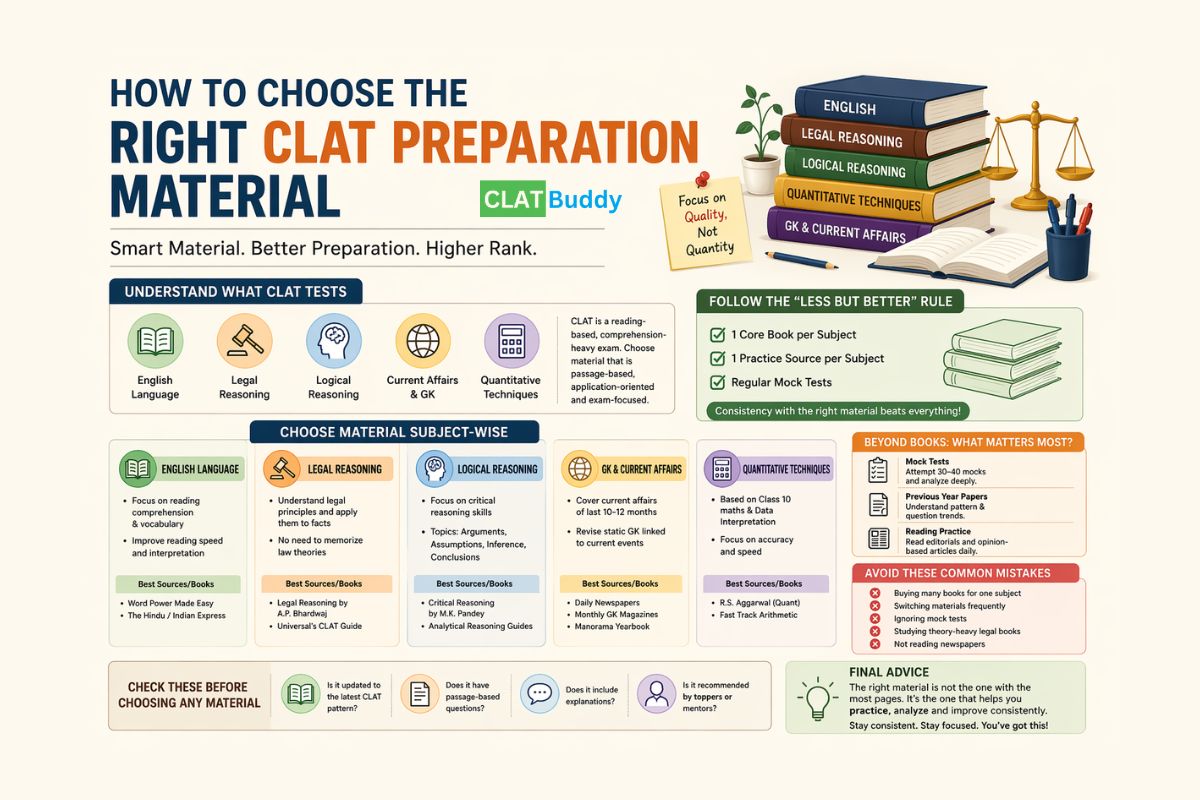
CLAT tests you in five sections:
- English Language
- Legal Reasoning
- Logical Reasoning
- Current Affairs including GK
- Quantitative Techniques
Each section is passage-based. This means your material should focus on:
- Reading comprehension
- Application of concepts
- Practice through passages
If a book focuses only on theory or objective questions without context, it is not aligned with CLAT.
How Do You Apply the “Less but Better” Strategy?
One of the biggest mistakes students make is collecting too many books.
You might feel that more material means better preparation, but the opposite is true. The more sources you have, the less you revise.
What should you do instead?
Follow this simple rule:
- One core book per subject
- One practice source per subject
- Regular mock tests
This helps you:
- Revise multiple times
- Build depth instead of shallow knowledge
- Track improvement clearly
Consistency beats variety in CLAT preparation.
Which Material Should You Choose for Each Subject?
Now let us break this down subject-wise so you can build a strong and balanced preparation strategy.
How Should You Prepare for English Language?
CLAT English is entirely comprehension-based. It tests your ability to read, understand, and interpret passages.
You should focus on:
- Daily newspaper reading
- Vocabulary building
- Reading speed and comprehension
What material works best?
- A standard vocabulary book like Word Power Made Easy
- Newspapers such as The Hindu or Indian Express
- Practice sets with passage-based questions
What should you avoid?
- Grammar-heavy books with little comprehension practice
- Rote vocabulary memorisation without usage
How Do You Choose Material for Legal Reasoning?
Legal Reasoning is often the most feared section, but it is actually one of the most scoring if prepared correctly.
CLAT does not test prior legal knowledge. It tests:
- Your ability to understand legal principles
- Your ability to apply them to given facts
What material works best?
- Books that focus on principle-fact questions
- Practice passages based on legal scenarios
- Mock tests with detailed explanations
What should you avoid?
- Bare Acts and law textbooks
- Memorising legal terms without understanding application
What Is the Right Approach for Logical Reasoning?
Logical Reasoning in CLAT focuses on critical reasoning rather than puzzles.
You will be tested on:
- Arguments
- Assumptions
- Conclusions
- Inference
What material works best?
- Books focused on critical reasoning
- Passage-based logical exercises
- Practice sets with explanations
What should you avoid?
- Puzzle-heavy reasoning books
- Excessive focus on non-CLAT topics like coding-decoding
How Should You Prepare for Current Affairs and GK?
This section carries high weightage and can significantly impact your rank.
You need to cover:
- Current affairs of the last 10 to 12 months
- Static GK linked to current events
What material works best?
- Daily newspaper reading
- Monthly current affairs compilations
- Yearly revision material
How should you study?
- Make short notes
- Revise weekly and monthly
- Focus on understanding events, not just memorising facts
What Material Is Best for Quantitative Techniques?
This section is often ignored, but it can boost your score if prepared well.
CLAT maths is based on:
- Basic Class 10 concepts
- Data interpretation
What material works best?
- Basic arithmetic books
- DI practice sets
- Sectional tests
What should you avoid?
- Advanced mathematics
- Time-consuming calculations
Why Are Mock Tests More Important Than Books?
This is something every CLAT topper agrees on.
Books help you learn, but mock tests help you perform.
Why mocks matter:
- They simulate the real exam
- They improve time management
- They help identify weak areas
How should you use mocks?
- Attempt at least 30 to 40 full-length mocks
- Analyse every mock in detail
- Focus on mistakes and patterns
Mock analysis is where real improvement happens.
How Do You Check If a Book Is Worth Using?
Before adding any new material, ask yourself these questions:
- Is it updated as per the latest CLAT pattern?
- Does it include passage-based questions?
- Does it provide detailed explanations?
- Is it recommended by reliable mentors or toppers?
If the answer is no, you do not need that book.
What Are the Most Common Mistakes Students Make?
Avoiding these mistakes can give you an immediate advantage.
Common mistakes:
- Using too many books for one subject
- Changing material frequently
- Ignoring mock tests
- Not reading newspapers regularly
- Focusing too much on theory
These mistakes slow down your preparation and reduce your efficiency.
What Is the Ideal CLAT Material Strategy?
If you are confused, keep your preparation simple and structured.
A practical strategy:
- English: One vocabulary source plus daily newspaper
- Legal Reasoning: One good practice book
- Logical Reasoning: One critical reasoning source
- GK: Newspaper plus monthly compilation
- Quant: One basic maths book
- Mock tests: Regular and consistent
This is more than enough to crack CLAT if followed properly.
How Do You Stay Consistent With Limited Material?
Choosing the right material is only the first step. The real challenge is staying consistent.
Tips to stay on track:
- Fix daily reading time
- Set weekly targets
- Revise regularly
- Analyse your mocks seriously
Remember, CLAT is not about studying everything. It is about mastering what you study.
Final Thoughts
Choosing the right CLAT preparation material is about clarity, not quantity.
If you focus on:
- Limited and relevant resources
- Regular practice
- Mock test analysis
you will already be ahead of most aspirants.
The goal is simple. Build strong reading skills, improve accuracy, and stay consistent. That is what gets you into a top NLU.
Calling all law aspirants!
Are you exhausted from constantly searching for study materials and question banks? Worry not!
With over 15,000 students already engaged, you definitely don't want to be left out.
Become a member of the most vibrant law aspirants community out there!
It’s FREE! Hurry!
Join our WhatsApp Groups (Click Here) and Telegram Channel (Click Here) today, and receive instant notifications.