

How to Create a Personal Error Notebook for CLAT Preparation
Every CLAT aspirant gives mocks. But not every aspirant improves after mocks.
That is the real difference.
Many students keep solving more questions, buying more test series, and collecting more study material, but their scores remain stuck in the same range. Usually, the problem is not lack of effort. The problem is repeating the same mistakes again and again without tracking them properly.
This is where a personal error notebook can completely change your preparation.
If you learn how to maintain it correctly, your error notebook becomes your most powerful revision tool during CLAT preparation. It helps you identify weak areas, improve accuracy, avoid silly mistakes, and become more aware of your exam behaviour.
Over time, it starts showing you patterns that normal mock analysis cannot.
What Is a Personal Error Notebook in CLAT Preparation?
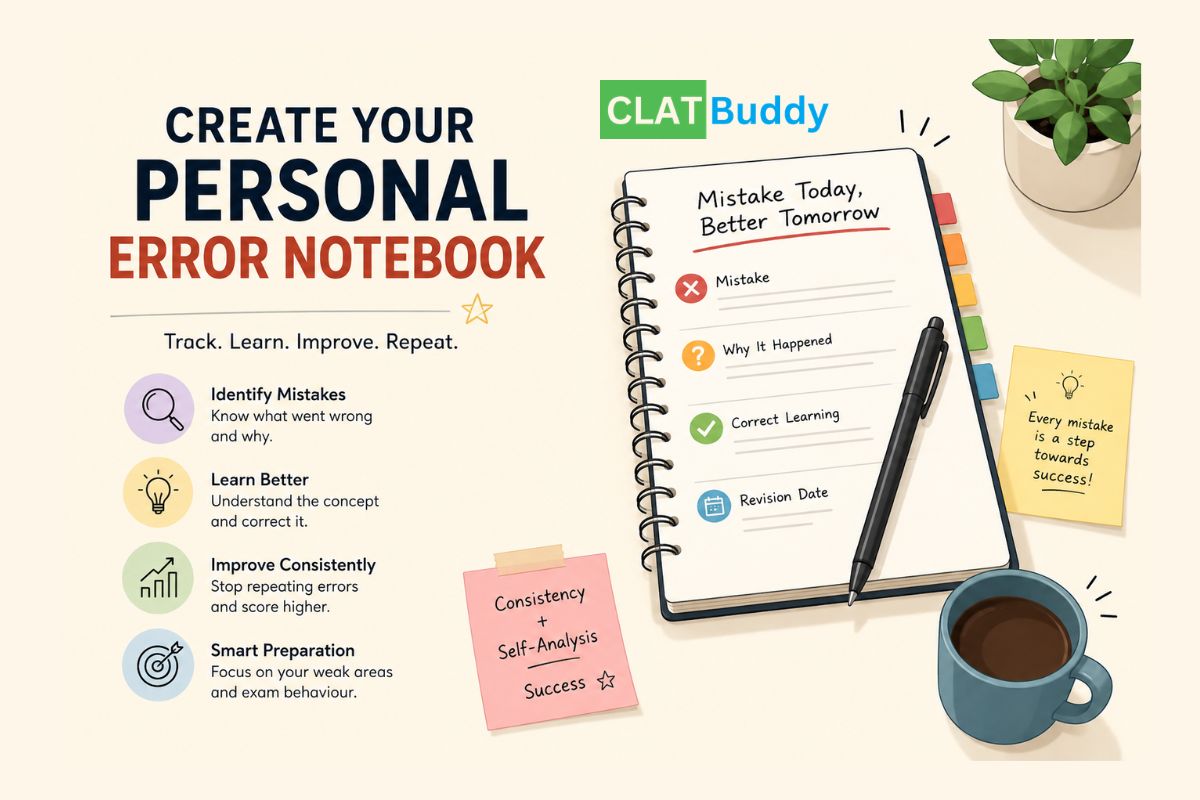
A personal error notebook is a dedicated place where you record and analyse your mistakes from mocks, sectional tests, practice questions, and previous year papers.
Instead of simply checking which answers were wrong, you try to understand:
- Why the mistake happened
- What thought process led to it
- Whether it is a conceptual issue or a careless mistake
- How to avoid repeating it
Think of it as your personal improvement tracker.
The purpose is not to write every single wrong answer. The purpose is to record mistakes that can teach you something important.
Why Do Most CLAT Aspirants Keep Repeating the Same Mistakes?
Many students finish mock analysis like this:
- “Legal was difficult.”
- “English passage was confusing.”
- “Quant took too much time.”
- “I need more practice.”
But this type of analysis is too general.
Real improvement happens when you identify specific problems.
For example:
- Are you changing correct answers due to panic?
- Are you reading Legal principles too fast?
- Are you making calculation mistakes in DI sets?
- Are you spending too much time on one RC passage?
- Are you guessing blindly in Current Affairs?
Without tracking these patterns, your preparation becomes random.
A personal error notebook gives structure to your learning.
Why Is an Error Notebook More Important Than Extra Study Material?
A lot of CLAT students suffer from resource overload.
They keep searching:
- Best CLAT books
- Best CLAT mock tests
- Best coaching material
- Best YouTube strategy
But improvement does not come from collecting endless resources.
Improvement comes from fixing repeated mistakes.
One student may solve 20 mocks and improve steadily because they analyse mistakes deeply.
Another student may solve 50 mocks and still remain stuck because they never study their errors properly.
Your error notebook helps you focus on quality over quantity.
What Should You Include in Your Personal Error Notebook?
Your notebook should contain mistakes that have learning value.
You can divide it section-wise.
How Should You Track English Language Mistakes?
In English, many students lose marks because of rushed reading and poor option elimination.
Track mistakes such as:
- Wrong inference questions
- Tone and attitude confusion
- Vocabulary in context errors
- Misreading keywords in options
- Overthinking simple RC questions
- Falling for extreme options
You should also note whether the issue happened because of speed, lack of concentration, or poor comprehension.
What Mistakes Should You Record in Legal Reasoning?
Legal Reasoning is one of the most scoring sections in CLAT if analysed correctly.
Your notebook should track:
- Applying outside legal knowledge
- Ignoring the principle given in the passage
- Missing factual details
- Emotional decision-making
- Reading too quickly
- Confusing legal terms
Many CLAT aspirants know the concept but still mark wrong answers because they do not stick to the passage principle strictly.
Your notebook helps you identify such habits early.
How Can You Analyse Logical Reasoning Errors?
Logical Reasoning mistakes often happen because students assume too much.
Track:
- Assumption and inference confusion
- Strengthen and weaken question errors
- Extreme option traps
- Time wasted on difficult sets
- Missing conclusion statements
- Poor elimination techniques
You should also mention whether you solved the question calmly or under pressure.
Sometimes the issue is not logic. It is panic.
What Should You Note in Quantitative Techniques?
Quantitative Techniques is less about difficult maths and more about smart interpretation.
Track:
- Calculation mistakes
- Wrong formula application
- Poor table interpretation
- Time-consuming methods
- Percentage and ratio confusion
- DI set selection mistakes
Many students lose marks because they panic after seeing numbers.
An error notebook helps you build confidence gradually.
How Should You Maintain Current Affairs and GK Errors?
Current Affairs mistakes usually happen because of poor revision, not lack of studying.
Your notebook should include:
- Topics repeatedly forgotten
- Important government schemes
- International organisations
- Legal current affairs
- Constitutional amendments
- Static GK linked to current events
You can also create monthly revision pages.
This helps during the final revision phase before CLAT.
What Is the Best Format for an Error Notebook?
You do not need anything complicated.
You can create columns like these:
| Date | Mock/Test | Section | Mistake | Why It Happened | Correct Learning | Revision Date |
For example:
| 20 May | Mock 14 | Legal | Applied outside knowledge | Rushed reading | Stick only to passage principle | 25 May |
This simple structure keeps your analysis organised.
Why Is the “Why It Happened” Column So Important?
This is the most important part of the notebook.
Most students only write:
“Wrong answer.”
That does not help.
Instead, write:
- Changed answer due to self doubt
- Missed the word “not” in the question
- Panicked after difficult RC passage
- Guessed without elimination
- Spent too much time on one question
These insights help you improve your exam behaviour.
CLAT is not only a knowledge exam. It is also a decision-making exam.
Should You Use a Digital or Handwritten Error Notebook?
Both methods work.
The best option is the one you can maintain consistently.
Handwritten Error Notebook
Best for:
- Better memory retention
- Faster revision before mocks
- Visual learners
- Reduced screen distraction
Digital Error Notebook
Best for:
- Easy search and organisation
- Adding screenshots
- Sorting mistakes by subject
- Long-term tracking
Many serious aspirants use Google Sheets or Notion for this purpose.
How Often Should You Update Your Error Notebook?
You should update it immediately after mock analysis.
A good process looks like this:
- Attempt mock seriously
- Take a short break
- Analyse every wrong and skipped question
- Enter important mistakes
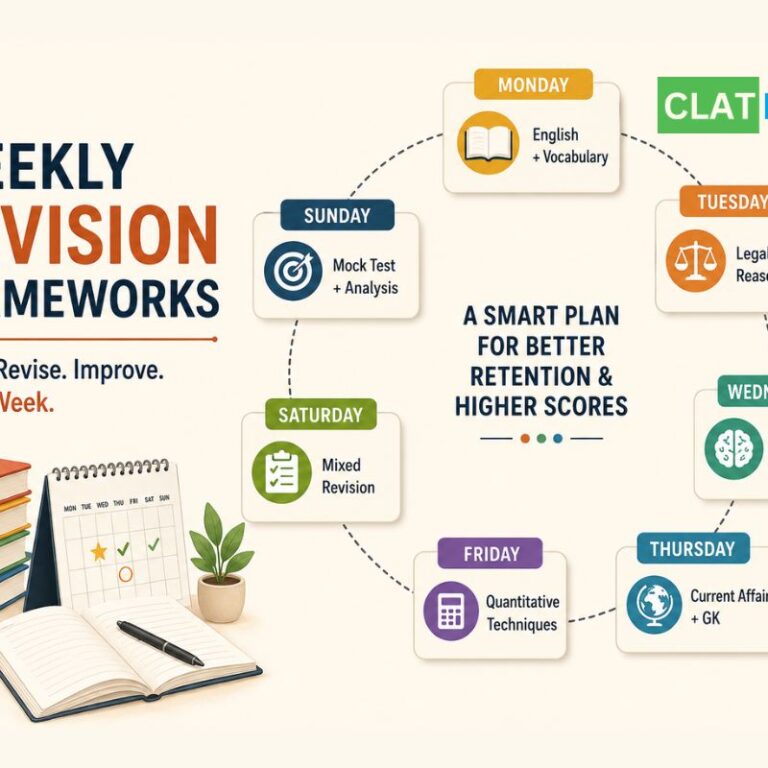
- Revise notebook weekly
Do not delay analysis for days.
Your memory of the mistake becomes weaker over time.
How Often Should You Revise Your Error Notebook?
Revision is what makes the notebook useful.
Weekly Revision
At least once every week, go through:
- Repeated mistakes
- Time management problems
- Common traps
Before Every Mock
Spend 10 to 15 minutes revising:
- Your biggest weaknesses
- Previous silly mistakes
- Common behavioural errors
This improves awareness during the test.
During the Last 30 Days Before CLAT
Your error notebook becomes more valuable than new study material.
At this stage, your focus should shift toward:
- Accuracy
- Consistency
- Smart attempts
- Avoiding repeated errors
Can an Error Notebook Improve CLAT Mock Scores?
Yes, significantly.
Most students improve because they solve more questions.
Top performers improve because they understand themselves better.
Your notebook helps you:
- Reduce repeated mistakes
- Improve accuracy
- Build discipline
- Manage exam pressure
- Increase self-awareness
- Strengthen weak areas systematically
Even a 4 to 6 mark improvement in CLAT can change your college options completely.
Final Thoughts
A personal error notebook may look simple, but it can become one of the strongest tools in your CLAT preparation journey.
It teaches you something very important:
Making mistakes is normal. Repeating the same mistakes is avoidable.
As you continue preparing, your notebook slowly becomes:
- Your strategy guide
- Your revision companion
- Your weakness tracker
- Your improvement roadmap
The students who improve consistently are not the ones who never make mistakes.
They are the ones who learn from them properly.
Calling all law aspirants!
Are you exhausted from constantly searching for study materials and question banks? Worry not!
With over 15,000 students already engaged, you definitely don't want to be left out.
Become a member of the most vibrant law aspirants community out there!
It’s FREE! Hurry!
Join our WhatsApp Groups (Click Here) and Telegram Channel (Click Here) today, and receive instant notifications.