


How to Handle Negative Marking Smartly in CLAT
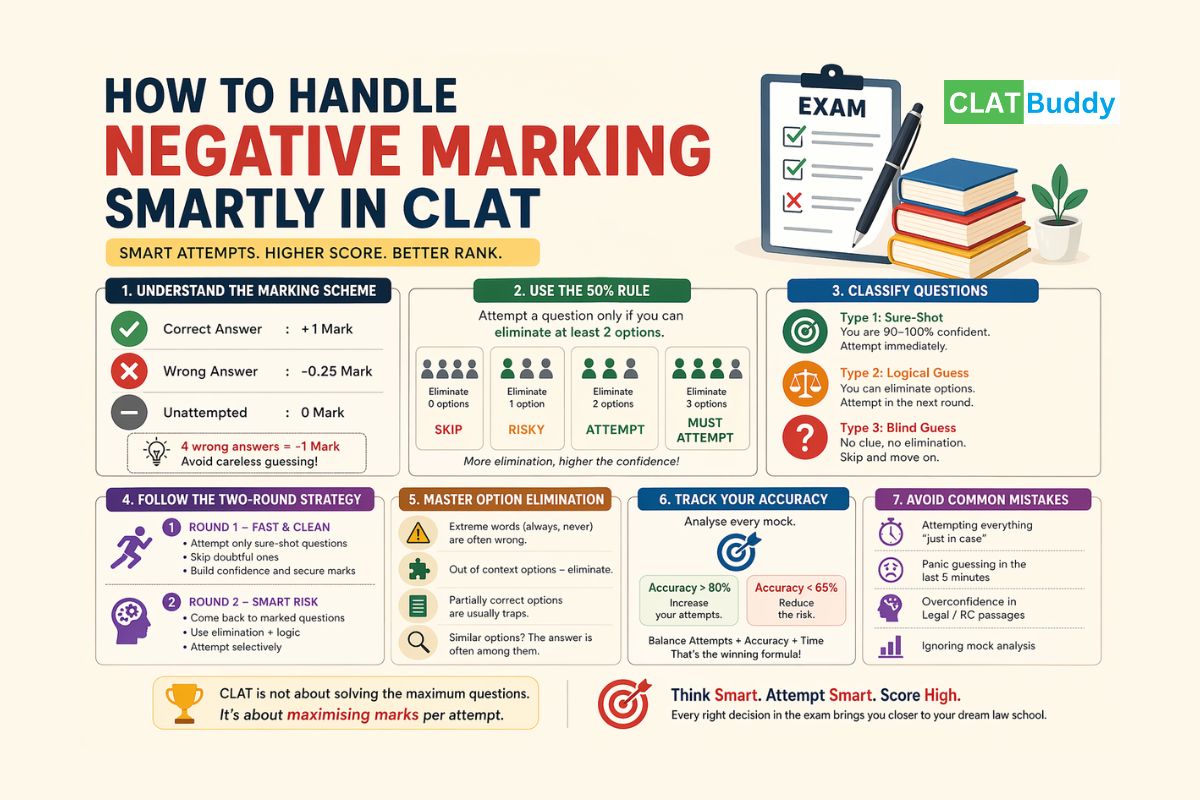
Preparing for CLAT is not just about knowledge. It is also about strategy. One of the biggest factors that decides your rank is how well you handle negative marking. Many students lose marks not because they do not know the answers, but because they attempt questions without a clear plan.
If you want to improve your score, you need to shift your mindset. Instead of thinking “how many questions should I attempt”, start thinking “how many correct answers can I maximise with minimum risk”.
This guide will help you understand exactly how to approach negative marking in a smart, practical way.
What Does Negative Marking in CLAT Really Mean?
Before you build a strategy, you must understand how the marking system works.
- Each correct answer gives you +1 mark
- Each wrong answer deducts 0.25 marks
- Unattempted questions give 0 marks
At first glance, this seems simple. But the impact is huge.
If you get:
- 4 questions wrong, you lose 1 full mark
- 8 wrong answers cancel out 2 correct answers
So, random guessing can easily reduce your overall score even if your preparation is decent.
The goal is not to avoid attempts. The goal is to attempt in a calculated way.
Why Do Students Struggle with Negative Marking?
Most students fall into one of these traps:
- Trying to attempt every question
- Guessing blindly in the last few minutes
- Not trusting their preparation
- Panic during difficult sections
The problem is not knowledge. It is decision-making under pressure.
CLAT is designed to test not just what you know, but how you think.
Should You Attempt All Questions in CLAT?
This is one of the most common questions.
The honest answer is no.
Attempting all questions is not a smart strategy unless your accuracy is extremely high. If you attempt everything with average accuracy, negative marking will pull your score down.
Instead, focus on:
- High accuracy in your attempts
- Selective risk-taking
- Avoiding blind guesses
A student who attempts 80 questions with 85 percent accuracy will score better than someone attempting 110 questions with 60 percent accuracy.
What Is the Ideal Attempt Strategy for CLAT?
You need to strike a balance between attempts and accuracy.
A practical benchmark for most students is:
- Attempt around 75 to 90 questions
- Maintain accuracy above 75 to 80 percent
This balance helps you maximise your score without taking unnecessary risks.
But remember, this is not a fixed rule. Your ideal attempt range depends on your mock performance.
How Can You Decide Whether to Attempt a Question?
This is where most students make mistakes. You need a clear decision rule in your mind during the exam.
The 50 Percent Rule
Only attempt a question if you can eliminate at least two options.
Why this works:
- Each question has four options
- If you eliminate two, you are left with two choices
- Your probability of getting the answer correct becomes 50 percent
At this point, the risk is manageable and often worth taking.
When Should You Skip?
Skip the question if:
- You cannot eliminate any option
- You are completely guessing
- The question is taking too much time
Skipping is not weakness. It is a smart decision.
How to Categorise Questions During the Exam?
To handle negative marking effectively, train yourself to classify questions quickly.
Type 1: Sure-Shot Questions
These are questions you are confident about.
- You know the answer clearly
- No confusion between options
- Quick to solve
These should be attempted immediately. They are your strongest scoring opportunities.
Type 2: Logical Guess Questions
These are questions where:
- You can eliminate one or two options
- You are not fully sure but can reason
These are worth attempting, but preferably in the second round.
Type 3: Blind Guess Questions
These are dangerous.
- No idea about the answer
- Cannot eliminate options
- Pure guessing
These should be skipped to avoid unnecessary negative marking.
What Is the Best Attempt Strategy During the Exam?
A structured approach helps you stay calm and make better decisions.
First Round Strategy
In the first round:
- Attempt only sure-shot questions
- Move quickly through the paper
- Do not get stuck on difficult questions
The goal is to secure maximum correct answers with minimum risk.
Second Round Strategy
In the second round:
- Come back to marked questions
- Attempt questions where you can eliminate options
- Take calculated risks
This is where you improve your overall score without increasing negative marking significantly.
How Can Option Elimination Improve Your Score?
Option elimination is one of the most powerful skills in CLAT.
Even if you do not know the exact answer, you can often identify wrong options.
Common Elimination Techniques
- Extreme words like always and never are often incorrect
- Options that are out of context with the passage can be eliminated
- Very similar options usually indicate that the answer lies among them
- Options that sound correct but do not answer the question directly are often traps
With practice, your ability to eliminate options improves, and so does your confidence.
How Do You Control Guesswork in the Last Few Minutes?
The last 5 to 10 minutes of the exam are critical.
Many students lose marks here due to panic.
What You Should Do
- Avoid attempting completely unknown questions
- Focus only on questions where you have partial clarity
- Recheck marked answers if time allows
What You Should Not Do
- Do not fill all unanswered questions randomly
- Do not change answers without a strong reason
Remember, careless guessing in the last few minutes can undo your entire effort.
How Do Mocks Help in Handling Negative Marking?
Mocks are not just for testing knowledge. They help you build strategy.
After every mock, analyse:
- How many questions were correct
- How many were wrong
- Which questions were guessed
Key Metrics to Track
- Accuracy percentage
- Number of attempts
- Number of blind guesses
How to Improve
- If accuracy is low, reduce attempts
- If accuracy is high, increase attempts gradually
- Identify patterns in your mistakes
Consistent analysis will help you find your ideal balance between risk and reward.
What Mindset Should You Have During the Exam?
Your mindset plays a major role in handling negative marking.
Instead of thinking:
“I need to attempt everything”
Train yourself to think:
“I need to maximise correct answers”
Confidence, patience, and discipline are more important than speed.
What Are the Most Common Mistakes to Avoid?
Many students repeat the same mistakes every year.
- Over-attempting questions
- Ignoring elimination techniques
- Panicking in difficult sections
- Not analysing mocks properly
- Blind guessing at the end
Avoiding these mistakes alone can improve your score significantly.
Final Thoughts: How to Think Like a Topper
Handling negative marking is not about fear. It is about control.
A topper does not attempt every question. A topper attempts the right questions.
Focus on:
- Accuracy over quantity
- Smart attempts over maximum attempts
- Strategy over panic
If you train yourself to make better decisions during the exam, your score will automatically improve.
Quick Revision Cheat Sheet
- Attempt only when you can eliminate options
- Follow a two-round strategy
- Avoid blind guessing
- Track accuracy in mocks
- Stay calm in the last minutes
Mastering negative marking is one of the fastest ways to improve your CLAT score. Start applying these strategies in your mocks, and you will see the difference.
Calling all law aspirants!
Are you exhausted from constantly searching for study materials and question banks? Worry not!
With over 15,000 students already engaged, you definitely don't want to be left out.
Become a member of the most vibrant law aspirants community out there!
It’s FREE! Hurry!
Join our WhatsApp Groups (Click Here) and Telegram Channel (Click Here) today, and receive instant notifications.