


How to Improve Accuracy in CLAT Without Reducing Attempts (Complete Strategy Guide for Aspirants)
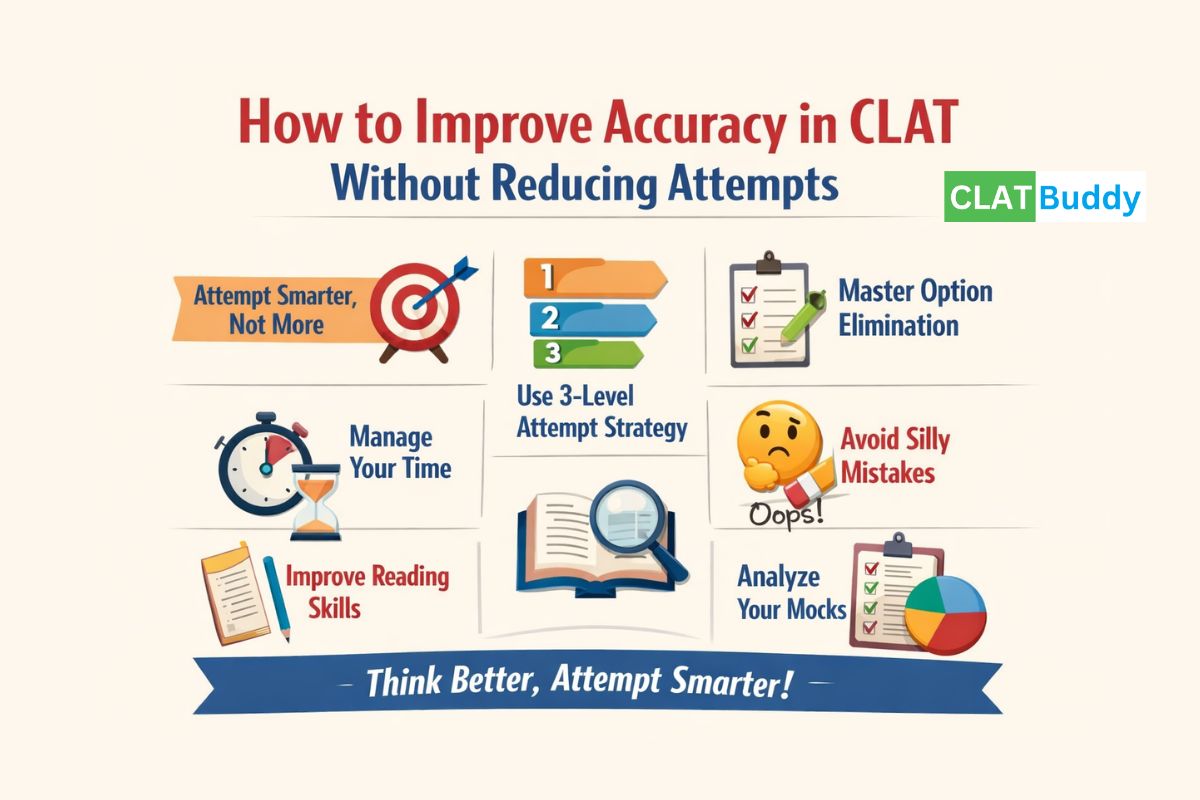
Preparing for CLAT can feel confusing at times. One mock test shows a great score, and the next one drops unexpectedly. Many students believe the solution is to attempt fewer questions to improve accuracy. But that is not the right approach.
If you reduce attempts, your score may still stay low. If you attempt too many questions without control, negative marking pulls you down.
The real solution lies in finding a balance. You need to maintain a good number of attempts while improving accuracy at the same time.
This guide will help you understand how to do exactly that with practical strategies used by top CLAT aspirants.
What Does Accuracy Really Mean in CLAT?
Accuracy in CLAT is not just about getting questions right. It is about making correct decisions under pressure.
In simple terms:
- Accuracy means how many questions you get correct out of the ones you attempt
- It directly impacts your score because of negative marking
- Even a small drop in accuracy can reduce your rank significantly
For example, if you attempt 100 questions:
- 85 correct gives a strong score
- 70 correct with more wrong answers brings the score down
So the goal is clear. You should aim for high accuracy with stable attempts, not low attempts with fear.
Why Do Students Lose Accuracy Even After Studying Well?
Many CLAT aspirants work hard but still struggle with accuracy. The problem is usually not knowledge. It is strategy.
Common reasons for low accuracy:
- Guessing without elimination
- Rushing due to time pressure
- Getting confused between two close options
- Not reading the passage properly
- Making silly mistakes in easy questions
Accuracy drops when decisions are rushed or unclear. That is why improving accuracy is more about thinking clearly during the exam rather than studying more.
Can You Improve Accuracy Without Reducing Attempts?
Yes, and this is exactly what top rankers do.
They do not attempt fewer questions. Instead, they:
- Attempt questions with clarity
- Avoid blind guessing
- Use elimination techniques
- Manage time effectively
The goal is to increase the quality of attempts, not reduce the quantity.
You should aim to attempt as many questions as possible where you can logically justify your answer.
What Is the Ideal Attempt vs Accuracy Balance in CLAT?
There is no fixed number for everyone, but a general benchmark helps.
Ideal range:
- Attempts: 90 to 105
- Accuracy: 80 percent to 85 percent
If your attempts are high but accuracy is low, your score suffers due to negative marking.
If your accuracy is high but attempts are too low, you miss scoring opportunities.
The sweet spot lies in maintaining both.
How Can You Attempt More Questions Without Increasing Wrong Answers?
This is where strategy plays a major role. You need a structured approach to attempting questions.
Use the 3-Level Attempt Strategy
This method helps you decide quickly whether to attempt or skip.
Level 1: Direct Attempt
- You are confident about the answer
- The concept or passage is clear
These questions should be attempted immediately.
Level 2: Elimination-Based Attempt
- You are not fully sure
- You can eliminate one or two options
These are still good attempts because you are making a logical decision.
Level 3: Skip
- You cannot eliminate any option
- It feels like a complete guess
These questions should be left.
This method ensures that your attempts stay high, but unnecessary risks are avoided.
How Does Option Elimination Improve Accuracy?
Option elimination is one of the most powerful skills for CLAT.
Even if you are unsure of the correct answer, eliminating wrong options increases your chances.
Why elimination works:
- Reduces confusion
- Improves decision-making
- Increases probability of correct answers
Practical elimination tips:
- Remove options with extreme words like always or never
- Avoid options that introduce new information not given in the passage
- Focus on the option that directly answers the question
When you eliminate even two options, your chances improve significantly. This is how toppers maintain accuracy without reducing attempts.
How Should You Manage Time to Protect Accuracy?
Time management directly affects accuracy. When you rush at the end, mistakes increase.
Common mistake:
Spending too much time on one question and then rushing through the rest.
Better approach:
- Set a limit of around 60 to 90 seconds per question
- If stuck, move ahead and return later
- Do not let one difficult question affect the entire paper
Proper time management ensures that you stay calm and make better decisions throughout the exam.
How Does Reading Skill Affect Accuracy in CLAT?
CLAT is a comprehension-based exam. Strong reading skills automatically improve accuracy.
If reading is weak:
- You re-read passages
- You misinterpret questions
- You choose incorrect answers
If reading is strong:
- You understand the passage in one go
- You identify the correct option faster
- You make fewer mistakes
What you should do daily:
- Read editorials and legal articles
- Practice passage-based questions
- Focus on understanding the author’s tone and argument
Better reading leads to faster and more accurate attempts.
Why Do Students Get Confused Between Two Options?
This is one of the biggest challenges in CLAT.
Often, two options seem correct, but only one is completely accurate.
How to solve this:
- Choose the option that is fully supported by the passage
- Avoid options that go beyond the given information
- Do not rely on outside knowledge
CLAT tests your ability to stick to the passage, not your general awareness.
The correct answer is always the one that matches the passage exactly.
How Can You Reduce Silly Mistakes in CLAT?
Silly mistakes are hidden score killers. Many students lose marks in questions they actually know.
Common silly mistakes:
- Misreading the question
- Ignoring keywords like not or incorrect
- Marking the wrong option accidentally
How to fix this:
- Slow down slightly on easy questions
- Read the question carefully before answering
- Double-check tricky questions
Even a small improvement here can increase your score significantly.
How Should You Analyse Mocks to Improve Accuracy?
Mock analysis is where real improvement happens.
Giving mocks without analysing them will not help much.
After every mock, check:
- Total attempts
- Number of correct answers
- Accuracy percentage
Go deeper:
- Identify guess-based answers
- Find patterns in wrong answers
- Note down weak areas
Important rule:
Spend at least as much time analysing the mock as you spent writing it.
This helps you understand your mistakes and avoid repeating them.
What Daily Habits Help Improve Accuracy Over Time?
Accuracy does not improve overnight. It builds through consistent habits.
Daily habits to follow:
- Solve 2 to 3 passages from different sections
- Practice elimination consciously
- Revise mistakes from previous mocks
- Read quality content regularly
Weekly habits:
- Give at least one full-length mock
- Track your accuracy trend
- Focus on weak areas
Consistency is the key. Small improvements every day lead to big results.
What Are the Biggest Mistakes You Must Avoid?
Many students unknowingly reduce their accuracy by following wrong strategies.
Avoid these:
- Blind guessing just to increase attempts
- Leaving too many questions out of fear
- Ignoring mock analysis
- Rushing through passages
These mistakes prevent improvement and keep scores stagnant.
What Is the Right Mindset to Improve Accuracy?
Your mindset matters as much as your preparation.
Instead of thinking:
- I need to attempt more questions
Start thinking:
- I need to attempt better questions
The focus should be on quality decision-making.
Every question you attempt should have a reason behind it.
Final Takeaway for CLAT Aspirants
Improving accuracy without reducing attempts is not about working harder. It is about working smarter.
You need to:
- Attempt questions with clarity
- Use elimination instead of guessing
- Manage time effectively
- Analyse mocks deeply
If you follow this approach consistently, your accuracy will improve, and your score will rise naturally.
Calling all law aspirants!
Are you exhausted from constantly searching for study materials and question banks? Worry not!
With over 15,000 students already engaged, you definitely don't want to be left out.
Become a member of the most vibrant law aspirants community out there!
It’s FREE! Hurry!
Join our WhatsApp Groups (Click Here) and Telegram Channel (Click Here) today, and receive instant notifications.