

How to Improve Reading Speed Without Losing Comprehension for CLAT
Preparing for CLAT is not just about knowing the law or solving questions. It is about how efficiently you can read, process, and understand complex passages within limited time. Many students struggle with reading speed, and in an attempt to read faster, they end up losing comprehension. That is where most mistakes happen.
If you are preparing for CLAT 2027 or any other law entrance exam, this is something you must fix early. The good part is that reading speed is a skill. It can be improved with the right approach and consistent practice.
This guide will help you understand how to read faster without compromising your understanding, using practical and proven techniques.
Why Is Reading Speed Important for CLAT?
CLAT is heavily passage-based. Whether it is English, Legal Reasoning, or even Current Affairs, most sections require you to read long passages and answer questions based on them.
In the actual exam, you will face:
- Multiple passages of 400 to 450 words
- Limited time to read and solve
- Questions that test inference, tone, and reasoning
If your reading is slow, you will not be able to attempt enough questions. If your reading is fast but careless, your accuracy will drop.
That is why the goal is not just speed. The goal is balanced reading where speed and comprehension work together.
What Is the Ideal Reading Speed for CLAT?
Many students think they need to read extremely fast to perform well. That is not true.
For CLAT, an ideal reading speed is:
- Around 250 to 350 words per minute
- With strong comprehension and retention
Trying to read at unrealistic speeds will only harm your performance. Focus on clarity first, and speed will gradually improve.
Why Do You Lose Comprehension While Reading Faster?
Before fixing the problem, it is important to understand why it happens.
Common reasons include:
- Reading word by word instead of understanding ideas
- Lack of focus while reading
- Weak vocabulary
- No habit of reading complex texts
- Panic during timed practice
Once you identify these issues, you can start working on them systematically.
How Can You Train Your Brain to Read Faster Naturally?
Improving reading speed is not about shortcuts. It is about training your brain.
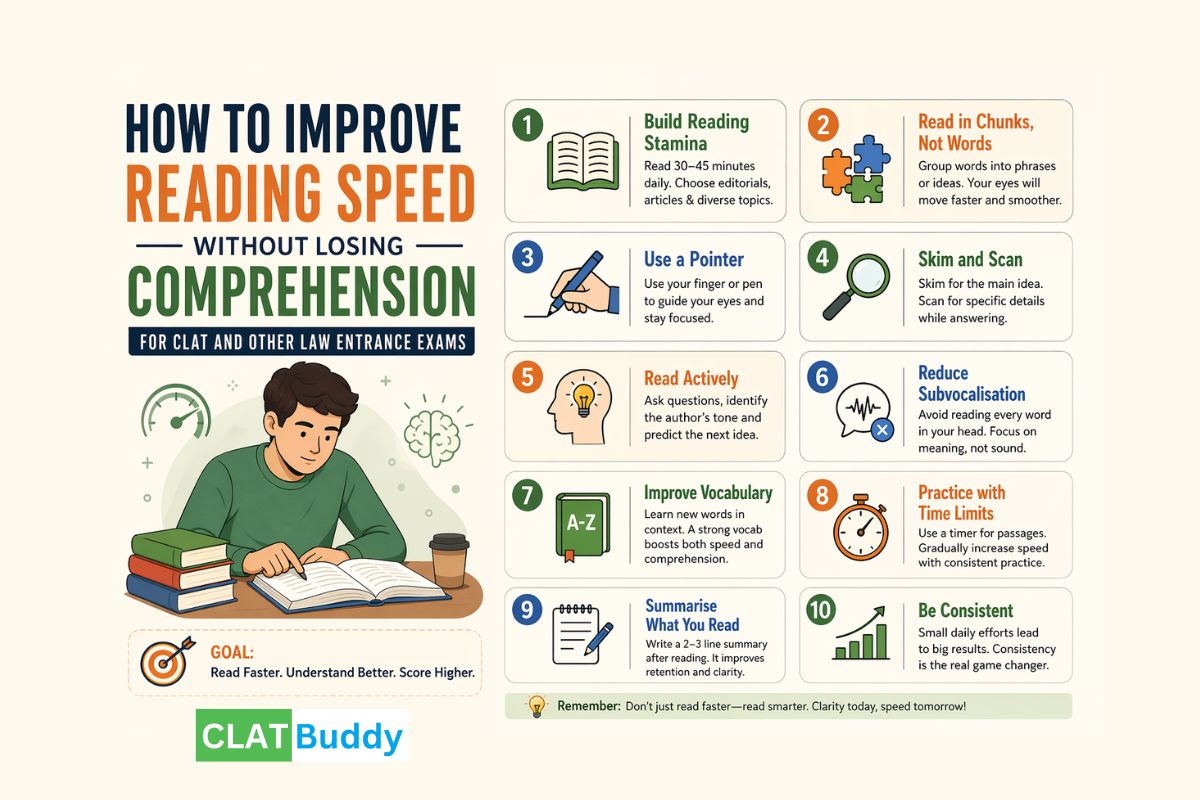
Start by building a daily reading habit. Read for at least 30 to 45 minutes every day. Include:
- Newspaper editorials
- Opinion pieces
- Legal blogs
- Articles on economics, science, and philosophy
When you expose yourself to different types of content, your brain becomes comfortable with complex language. Over time, reading feels easier and faster.
Consistency is more important than intensity. Even 30 minutes daily can create a big difference in a few weeks.
How Can You Stop Reading Word by Word?
One of the biggest mistakes students make is reading every single word individually. This slows you down.
Instead, you should train yourself to read in chunks. That means reading phrases or groups of words together.
How to Practice Chunking
- Focus on understanding the meaning of a full line instead of each word
- Move your eyes smoothly across the sentence
- Avoid stopping at every difficult word
With practice, your brain starts recognising patterns and ideas quickly. This improves both speed and comprehension.
Does Using a Pointer Really Help in Reading Faster?
Yes, it does, even though it sounds simple.
Using your finger or a pen while reading helps guide your eyes. It reduces unnecessary movement and keeps your focus steady.
Benefits of Using a Pointer
- Prevents going back to already read lines
- Improves concentration
- Maintains a steady reading pace
You can try this during practice sessions. Many students see improvement within a few days.
What Is the Role of Skimming and Scanning in CLAT?
Skimming and scanning are essential techniques for CLAT.
Skimming for Main Idea
When you first read a passage, your goal should be to understand:
- The main argument
- The author’s viewpoint
- The structure of the passage
You do not need to memorise every detail.
Scanning for Answers
While solving questions, you can go back and locate specific information.
How to Apply These Techniques
- Focus on the first and last lines of paragraphs
- Identify keywords and important phrases
- Avoid rereading the entire passage for every question
These techniques save time and improve accuracy.
How Can You Improve Active Reading Skills?
Active reading means engaging with the text instead of just looking at it.
While reading, ask yourself:
- What is the author trying to say?
- Is the tone critical or supportive?
- What is the conclusion?
When your brain is actively involved, you understand better and remember more.
Simple Active Reading Habits
- Pause briefly after each paragraph
- Mentally summarise what you read
- Predict what might come next
This improves comprehension without slowing you down significantly.
Should You Eliminate Subvocalisation Completely?
Subvocalisation means reading in your head using an inner voice.
Many students are told to remove it completely. That is not practical.
Instead, you should reduce it.
Why Not Eliminate It Completely?
- It helps in understanding complex ideas
- It improves retention
What You Should Aim For
- Avoid reading every word in your head
- Focus on understanding meaning instead
Balanced reading is the key.
How Does Vocabulary Affect Reading Speed?
Vocabulary plays a major role in reading speed.
If you keep encountering unfamiliar words, your reading slows down because you stop to think or guess meanings.
How to Improve Vocabulary Effectively
- Learn words in context, not by memorising lists
- Note down new words while reading
- Revise them regularly
Better vocabulary leads to smoother reading and better comprehension.
Why Is Timed Practice Important for CLAT?
Reading speed cannot improve without time pressure.
You must simulate exam conditions during practice.
How to Do Timed Practice
- Take a passage of around 400 words
- Set a timer for 2 to 3 minutes
- Try to read and understand within the time
Gradually, your speed will increase while maintaining comprehension.
How Can You Retain What You Read?
Reading fast is useless if you forget everything.
That is why retention is important.
The Best Technique for Retention
After reading a passage:
- Summarise it in 2 to 3 lines
- Do it without looking back
This strengthens your understanding and memory.
Over time, you will notice that you can recall information faster during the exam.
What Mistakes Should You Avoid While Improving Reading Speed?
Many students unknowingly slow down their progress by making common mistakes.
Avoid These Mistakes
- Trying to read extremely fast from the beginning
- Ignoring comprehension while focusing only on speed
- Skipping daily reading practice
- Not analysing mistakes in RC questions
- Reading only easy topics
Improvement happens when you challenge yourself and stay consistent.
What Should Your Daily Reading Routine Look Like?
A simple and effective routine can help you improve steadily.
Suggested Daily Plan
- 20 minutes of editorial reading
- 20 minutes of RC practice
- 10 minutes of vocabulary revision and summary writing
This routine is realistic and sustainable.
Final Thoughts
Improving reading speed for CLAT is a gradual process. It does not happen overnight, and it cannot be forced.
If you focus only on speed, you will lose accuracy. If you focus only on understanding, you may not finish the paper on time.
The real skill lies in balancing both.
Build a strong reading habit, practise consistently, and track your progress. Over time, your reading will become faster, smoother, and more effective.
Remember, CLAT is not testing how fast you can read. It is testing how well you can understand.
And that is where your real advantage lies.
Calling all law aspirants!
Are you exhausted from constantly searching for study materials and question banks? Worry not!
With over 15,000 students already engaged, you definitely don't want to be left out.
Become a member of the most vibrant law aspirants community out there!
It’s FREE! Hurry!
Join our WhatsApp Groups (Click Here) and Telegram Channel (Click Here) today, and receive instant notifications.