

Identifying Repeating Mistakes Through Mock Analysis
Many CLAT aspirants feel productive after attempting a mock test. It feels like progress. But here is the reality that most students realise late.
Mocks do not improve your score. Analysis does.
If you give 20 mocks without proper analysis, your score may stay the same. But if you analyse even 5 mocks deeply, your score can jump significantly. The difference lies in identifying what is going wrong repeatedly.
Mock tests are only a tool. Analysis is where real learning happens.
What does “repeating mistakes” actually mean in CLAT preparation?
Repeating mistakes are not random errors. They are patterns.
These are mistakes that:
- Keep happening across multiple mocks
- Occur in similar topics or sections
- Happen due to the same reason like rushing or confusion
For example:
- Misreading questions in Logical Reasoning again and again
- Getting assumption-based questions wrong repeatedly
- Making errors in the last 20 minutes due to panic
If a mistake happens once, it is normal. If it happens three times, it is a pattern. And patterns are what you need to fix.
How should you start analysing a CLAT mock properly?
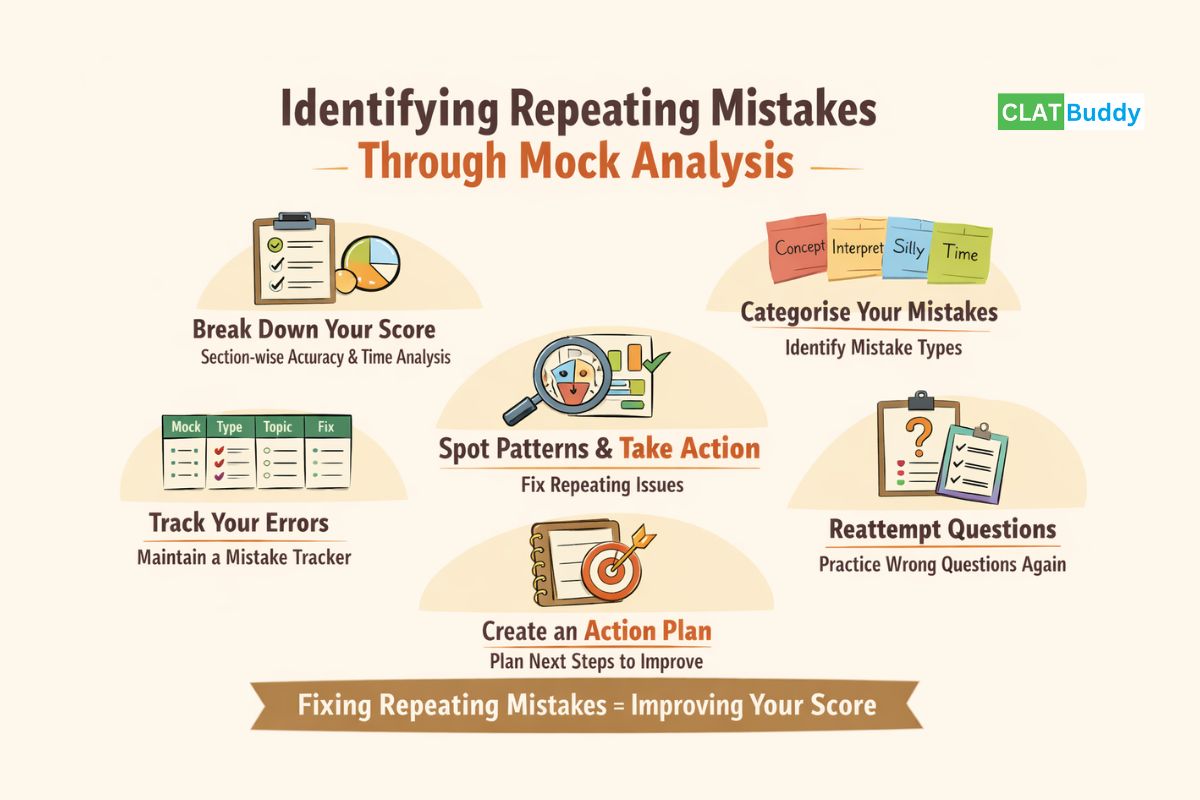
Before jumping into mistakes, you need to first break your mock into meaningful parts.
Instead of looking at your score, focus on:
- Section-wise marks
- Accuracy percentage
- Number of attempts vs correct answers
- Time spent per section
This gives you clarity. For example, you may realise that your Legal section score is low not because you lack knowledge, but because your accuracy is poor.
This is the first step towards identifying repeating mistakes.
How can you categorise your mistakes effectively?
Not all mistakes are the same. If you treat them the same, you will not fix them properly.
Divide your mistakes into these categories:
Conceptual Mistakes
These happen when you do not know the concept or apply it incorrectly.
Examples:
- Not understanding a legal principle
- Weakness in critical reasoning concepts like assumptions or inference
These mistakes require learning and revision.
Interpretation Mistakes
These are very common in CLAT.
Examples:
- Misreading the passage
- Ignoring keywords like “not” or “incorrect”
- Choosing an option that feels right but is not supported by the passage
These mistakes are not about knowledge. They are about attention and reading skills.
Silly Mistakes
These are frustrating because you knew the answer.
Examples:
- Marking the wrong option
- Making a basic calculation error in Quant
- Changing the correct answer at the last moment
These mistakes are often due to lack of focus or overconfidence.
Time Pressure Mistakes
These happen when you rush.
Examples:
- Guessing questions randomly
- Leaving easy questions due to poor time management
- Panicking in the last section
These mistakes are directly linked to your test strategy.
How do you track mistakes across multiple mocks?
If you do not track mistakes, you will forget them. And if you forget them, you will repeat them.
Create a simple mistake tracker.
What should your tracker include?
- Mock number
- Section
- Type of mistake
- Topic
- Reason for mistake
- Action to fix it
For example:
- Mock 3 | Logical | Interpretation | Assumptions | Misread passage | Practice 10 assumption questions
After 3 to 5 mocks, patterns will start appearing clearly.
You will see things like:
- Same topic getting repeated
- Same mistake type happening again
- Same section dragging your score down
This is where real improvement begins.
How can you identify repeating mistakes clearly?
After analysing a few mocks, pause and reflect.
Ask yourself:
- Am I making the same mistake again in Logical Reasoning?
- Is my accuracy low in a particular section every time?
- Do I panic in the last 15 minutes consistently?
- Am I over-attempting and losing marks due to negative marking?
You need to be honest here. Do not justify mistakes. Identify them.
Repeating mistakes are often hidden in habits. And habits need conscious correction.
What should you do after identifying repeating mistakes?
Identifying mistakes is only half the job. The real work starts after that.
Turn mistakes into action steps
Each mistake should lead to a specific action.
For example:
- Weak in assumptions → Practice 20 assumption questions daily
- Misreading passages → Slow down reading and underline key points
- Time pressure → Fix section-wise time limits
Without action, analysis is useless.
Focus on one or two problems at a time
Do not try to fix everything together.
If you try to improve:
- Accuracy
- Speed
- Reading
- Time management
all at once, you will get overwhelmed.
Instead:
- Pick 1 to 2 repeating mistakes
- Work on them for the next 3 to 5 days
This focused approach gives faster results.
Why is reattempting questions important in mock analysis?
Most students analyse and move on. That is a mistake.
Reattempt your wrong questions after 1 or 2 days.
Why does this help?
- It checks whether the concept is actually clear
- It prevents memorising answers
- It builds confidence in similar questions
If you still get the same question wrong, it means the concept is not fixed yet.
What are the most common repeating mistakes CLAT aspirants make?
You may relate to many of these.
Misreading questions
This is one of the biggest score killers.
Students read fast but miss important details.
Over-attempting questions
Attempting too many questions leads to negative marking.
Accuracy matters more than attempts in CLAT.
Ignoring weak areas
Students keep practising what they are good at and ignore weak sections.
This creates a gap in performance.
Poor time management
Spending too much time on one section affects the rest of the paper.
Not analysing mocks properly
This is the root cause of all repeating mistakes.
Without analysis, mistakes keep repeating silently.
How can you build a strong mock analysis routine?
Consistency matters more than intensity.
After every mock, follow this routine:
- Take a short break
- Analyse each question carefully
- Categorise mistakes
- Update your mistake tracker
- Write down 2 to 3 action points
This entire process may take 2 to 3 hours. But it is worth it.
How long should mock analysis take ideally?
A good rule is:
If your mock takes 2 hours, your analysis should take at least 2 to 3 hours.
Quick analysis is not effective.
Deep analysis is what helps in identifying patterns and improving performance.
How will identifying repeating mistakes improve your CLAT score?
When you fix repeating mistakes:
- Accuracy improves
- Confidence increases
- Silly errors reduce
- Time management becomes better
Most importantly, your score becomes more stable.
Instead of random scores, you start seeing consistent improvement.
Final advice: What should you always remember during mock analysis?
Think of mock analysis like a feedback system.
Every mock is telling you something.
If you ignore it, you will stay at the same level. If you listen to it, you will improve.
Remember this simple rule:
- One mock should teach one lesson
- If mistakes repeat, analysis is weak
- If mistakes reduce, strategy is working
CLAT is not about how many mocks you give. It is about how well you learn from each one.
Stay consistent. Stay honest with your mistakes. Improvement will follow.
Calling all law aspirants!
Are you exhausted from constantly searching for study materials and question banks? Worry not!
With over 15,000 students already engaged, you definitely don't want to be left out.
Become a member of the most vibrant law aspirants community out there!
It’s FREE! Hurry!
Join our WhatsApp Groups (Click Here) and Telegram Channel (Click Here) today, and receive instant notifications.