

Why Do Your CLAT Mock Scores Fluctuate and How Should You Respond?
Preparing for CLAT often feels like a rollercoaster. One day you score 85, and the next day it drops to 68. It is frustrating, confusing, and sometimes even demotivating. Many aspirants start doubting their preparation when this happens.
But here is the truth that every serious CLAT aspirant must understand. Mock score fluctuation is normal and expected.
What matters is not the fluctuation, but how you respond to it.
This article will help you understand:
- Why CLAT mock scores fluctuate
- What these fluctuations actually mean
- How to analyse mocks properly
- How to improve consistency over time
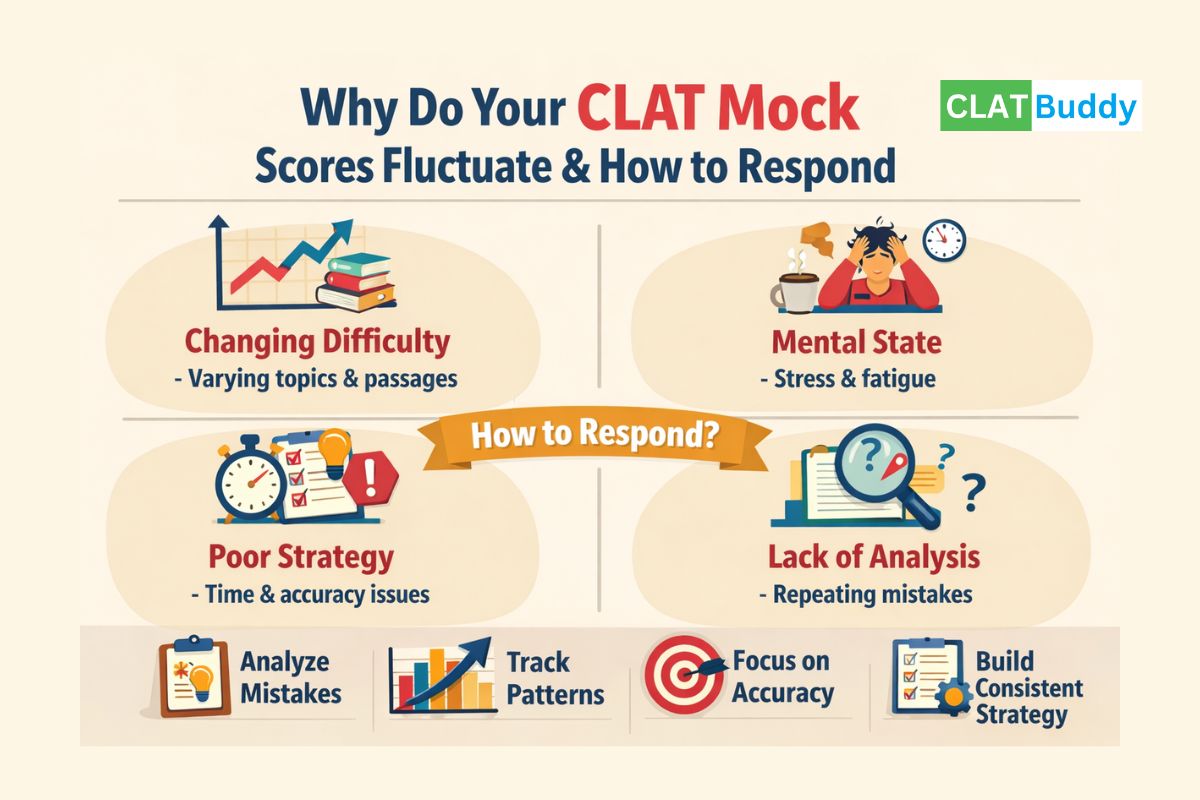
Why Do CLAT Mock Scores Fluctuate So Much?
Mock scores do not fluctuate randomly. There are clear reasons behind every rise and fall. Once you understand these reasons, you will stop panicking and start improving.
Variation in Mock Difficulty
Not all mocks are created equal. Some mocks are easier, while others are intentionally difficult.
In CLAT, passages can vary in:
- Length and complexity
- Familiarity of topics
- Question framing
If a mock has more passages from topics you are comfortable with, your score naturally increases. If it includes unfamiliar or dense passages, your score may drop.
This does not mean your preparation has gone down. It simply means the paper tested different skills.
Changes in Attempt Strategy
Even a small change in strategy can impact your score.
For example:
- Spending too much time on Legal Reasoning
- Ignoring easy questions in Logical Reasoning
- Attempting too many risky questions
CLAT is not just about knowledge. It is about decision making under time pressure.
One wrong decision can cost 5 to 10 marks easily.
Accuracy vs Attempts Imbalance
Many students focus only on increasing attempts. But CLAT rewards accuracy over blind attempts.
If you:
- Increase attempts but reduce accuracy, your score drops
- Attempt fewer but accurate questions, your score improves
Fluctuations often happen because this balance keeps changing.
Mental State and Focus
Your performance is directly linked to your mental condition.
On some days:
- You feel fresh and focused
- You read faster and understand better
On other days:
- You feel tired or distracted
- You misread questions or lose concentration
This leads to score variation, even if your preparation level is the same.
Lack of Proper Mock Analysis
This is the biggest reason behind repeated fluctuations.
If you are:
- Giving mocks but not analysing them deeply
- Ignoring your mistakes
- Not tracking patterns
Then your score will keep going up and down without stability.
Mocks without analysis are just practice tests. They do not lead to improvement.
What Do Fluctuating Scores Actually Mean?
Before trying to fix the problem, you need to interpret it correctly.
Fluctuation does not mean failure. It means your preparation is still stabilising.
You Are Still Exploring Your Strategy
In the early and middle stages of preparation, your strategy is not fixed.
You are experimenting with:
- Attempt order
- Time allocation
- Section prioritisation
This naturally leads to inconsistent scores.
Your Preparation Has Gaps
Score drops often highlight weak areas.
For example:
- Low marks in GK means poor revision
- Errors in Legal Reasoning mean weak comprehension
- Time issues indicate poor reading speed
Each fluctuation is actually feedback.
You Are Within a Score Range
Every aspirant has a score band.
For example:
- One student may fluctuate between 65 to 80
- Another may fluctuate between 80 to 95
Your real level is your average score, not your highest score.
How Should You Respond to Low Mock Scores?
Now comes the most important part. What should you do when your score drops?
The way you respond determines your final CLAT rank.
Should You Panic After a Low Score?
No.
A single mock does not define your preparation. Even toppers have bad mocks.
Instead of reacting emotionally, start asking:
- What went wrong?
- Where did I lose marks?
- Which section caused the drop?
This shift in mindset is the first step towards improvement.
How to Analyse CLAT Mocks Properly?
Mock analysis is where real learning happens.
Step 1: Break Down Your Score
Divide your performance into:
- Section wise marks
- Number of attempts
- Accuracy percentage
This helps you identify where the problem lies.
Step 2: Categorise Your Mistakes
Every wrong question should fall into one of these categories:
Conceptual Mistakes
You did not know the concept or information.
Fix by:
- Revising topics
- Strengthening fundamentals
Application Mistakes
You knew the concept but applied it incorrectly.
Fix by:
- Practising similar questions
- Improving interpretation skills
Silly Mistakes
You made avoidable errors like:
- Misreading the question
- Marking the wrong option
- Calculation errors
Fix by:
- Slowing down slightly
- Improving focus
Strategy Mistakes
You made poor decisions like:
- Spending too much time on one passage
- Attempting difficult questions first
- Leaving easy questions
Fix by:
- Adjusting your attempt strategy
Step 3: Identify Patterns
Look for repeated issues.
For example:
- Losing marks in GK every time
- Low accuracy in Logical Reasoning
- Time pressure in the last section
Patterns tell you exactly what to improve.
How Can You Improve Consistency in CLAT Mocks?
Consistency is what gets you into top NLUs. Not one high score.
Here is how you can build it.
Build a Strong Attempt Strategy
Do not randomly attempt questions.
A simple strategy could be:
- First round: Attempt easy questions
- Second round: Attempt moderate questions
- Skip very difficult ones
This reduces unnecessary negative marking.
Focus on Accuracy First
Instead of chasing 100 attempts, aim for:
- 80 to 90 attempts with high accuracy
Accuracy ensures stable scores.
Improve Reading Skills Daily
CLAT is a reading intensive exam.
Work on:
- Reading speed
- Comprehension
- Retention
Daily newspaper reading and passage practice will help.
Maintain a Mistake Notebook
This is one of the most powerful tools.
Write down:
- Repeated errors
- Weak topics
- Strategy mistakes
Revise this notebook regularly. It prevents you from repeating the same mistakes.
Simulate Real Exam Conditions
Always give mocks in a realistic environment:
- Fixed time
- No distractions
- Proper sitting posture
This improves focus and reduces variability.
Track Your Progress Smartly
Do not just track marks.
Track:
- Accuracy percentage
- Section wise improvement
- Time spent
This gives a clearer picture of progress.
What Is a Healthy Mock Score Pattern?
Many students expect linear improvement, but that rarely happens.
A realistic pattern looks like this:
- Initial phase: High fluctuations
- Middle phase: Gradual improvement
- Final phase: Stable score range
If your average score is increasing, you are on the right track.
Final Thoughts: What Should Be Your Focus?
CLAT preparation is not about scoring high in one mock. It is about becoming consistent.
Remember:
- Fluctuation is normal
- Analysis is everything
- Consistency is the goal
Every mock is an opportunity to learn something new about your preparation.
Instead of getting discouraged, start treating mocks like a feedback system. Over time, your scores will stabilise, your confidence will improve, and your chances of cracking CLAT will increase.
Calling all law aspirants!
Are you exhausted from constantly searching for study materials and question banks? Worry not!
With over 15,000 students already engaged, you definitely don't want to be left out.
Become a member of the most vibrant law aspirants community out there!
It’s FREE! Hurry!
Join our WhatsApp Groups (Click Here) and Telegram Channel (Click Here) today, and receive instant notifications.