

Descriptive vs Informative Tone [With Practice Questions]
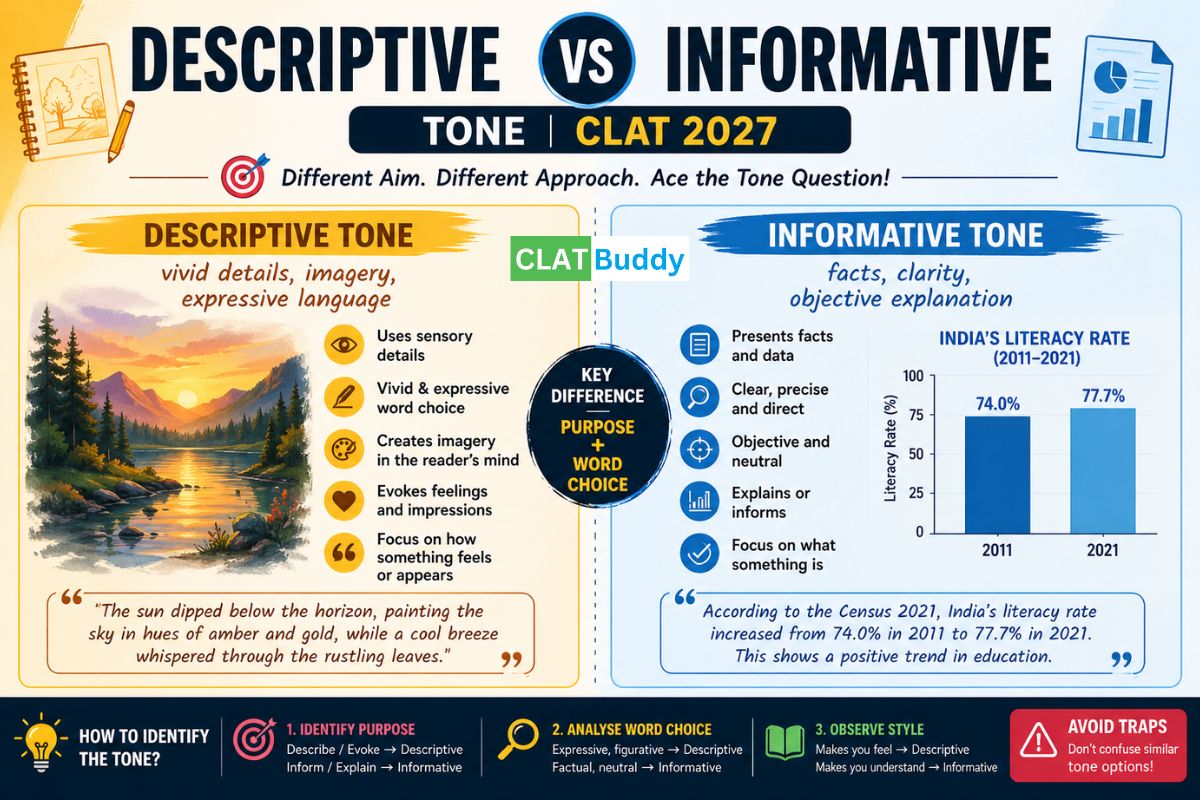
Understanding tone is an essential skill for the CLAT Legal Reasoning and Reading Comprehension sections. Among the commonly tested tone types, descriptive and informative tones often confuse students because both can appear neutral at first glance. However, the key difference lies in the purpose of the passage and the language used.
What is Descriptive Tone?
A descriptive tone is used when the writer aims to paint a picture in the reader’s mind. The focus is not merely on giving information, but on creating an experience. Such passages rely heavily on imagery, sensory details, and expressive language.
The writer may describe a place, situation, person, or event in a way that allows the reader to visualise, feel, or imagine it. Words are often chosen for their emotional or sensory impact rather than just factual clarity.
For example, instead of simply stating that a courtroom was crowded, a descriptive passage may say that the courtroom buzzed with restless whispers, its air thick with anticipation. This adds depth and creates a vivid scene.
Key Features of Descriptive Tone:
- Use of adjectives and adverbs
- Sensory details (sight, sound, smell, touch, taste)
- Figurative language (metaphors, similes, imagery)
- Emotional or expressive wording
- Focus on how something feels or appears
What is Informative Tone?
An informative tone, on the other hand, is used when the writer’s goal is to provide clear, factual, and objective information. The emphasis is on clarity, accuracy, and understanding, not on creating imagery.
Such passages are common in textbooks, legal explanations, news reports, and academic writing. The language is usually neutral, precise, and straightforward, avoiding unnecessary embellishments.
For example, instead of describing a courtroom dramatically, an informative passage would state: The courtroom was filled with attendees waiting for the proceedings to begin. The sentence conveys information without emotional or sensory influence.
Key Features of Informative Tone:
- Focus on facts and data
- Clear and direct language
- Objective and neutral expression
- Logical structure and explanation
- Absence of emotional or imaginative elements
How to Identify the Tone in CLAT Passages?
In CLAT, identifying tone is not about spotting a single word but about understanding the overall purpose of the passage.
Step 1: Identify the Purpose
- If the passage aims to describe or evoke imagery, it is descriptive.
- If it aims to inform or explain, it is informative.
Step 2: Analyse Word Choice
- Look for expressive words → likely descriptive
- Look for neutral, factual language → likely informative
Step 3: Observe the Writing Style
- Is the passage trying to make the reader feel something? → descriptive
- Is it trying to make the reader understand something? → informative
Common Traps in CLAT
CLAT often includes options that are very close in meaning, such as:
- Descriptive vs Narrative
- Informative vs Analytical
- Objective vs Factual
This is where many students lose marks.
Trap 1: Descriptive vs Informative
A passage may include facts but still be descriptive if the presentation is vivid and expressive. Focus on how the information is conveyed.
Trap 2: Informative vs Analytical
An informative passage gives facts, while an analytical passage interprets or evaluates them. Do not confuse explanation with analysis.
Trap 3: Neutral Language Misleading You
Sometimes descriptive passages use simple words but still create imagery. Do not rely only on “difficult” words—focus on purpose.
Quick Comparison
| Feature | Descriptive Tone | Informative Tone |
| Purpose | Create imagery | Provide information |
| Language | Expressive, vivid | Clear, precise |
| Emotion | Present | Absent or minimal |
| Focus | Experience | Facts |
Final Tip for CLAT
Always remember: Tone = Purpose + Language.
If the passage makes the reader see and feel, it is descriptive.
If it makes the reader learn and understand, it is informative.
Avoid rushing to conclusions based on a few words. Read the passage holistically and choose the tone that best captures the writer’s overall intention.
Practice Questions: Descriptive vs Informative Tone
Read each question carefully and identify the tone of the passage.
Q1. “The narrow street was lined with flickering lamps, their golden light dancing on rain-soaked cobblestones, while the distant hum of conversations created a soothing rhythm.”
A. Informative
B. Analytical
C. Descriptive
D. Critical
Q2. “The Indian Constitution came into force on 26 January 1950 and establishes the framework for governance, fundamental rights, and duties of citizens.”
A. Descriptive
B. Informative
C. Narrative
D. Persuasive
Q3. “The author outlines various reasons for judicial delay and evaluates their impact on access to justice.”
A. Informative
B. Descriptive
C. Analytical
D. Narrative
Q4. “The writer strongly criticises the policy, arguing that it disproportionately harms marginalised communities and lacks proper justification.”
A. Informative
B. Descriptive
C. Narrative
D. Critical
Q5. “The courtroom was silent, the tension almost palpable as every eye turned toward the judge awaiting the verdict.”
A. Descriptive
B. Informative
C. Analytical
D. Persuasive
Q6. “The report explains the process of filing a Public Interest Litigation and lists the essential requirements needed for its acceptance.”
A. Narrative
B. Analytical
C. Informative
D. Descriptive
Q7. “The passage examines both sides of the debate on data privacy laws and weighs their implications for individual rights.”
A. Narrative
B. Informative
C. Descriptive
D. Analytical
Q8. “The author condemns the misuse of power by authorities and calls for immediate reforms to ensure accountability.”
A. Descriptive
B. Informative
C. Critical
D. Analytical
Q9. “The lake shimmered under the moonlight, its surface reflecting the quiet beauty of the night sky.”
A. Informative
B. Analytical
C. Persuasive
D. Descriptive
Q10. “The article provides statistics on cybercrime rates in India and explains the legal remedies available to victims.”
A. Narrative
B. Informative
C. Critical
D. Descriptive
Q11. “The speaker urges the government to adopt stricter environmental laws and persuades citizens to take collective action.”
A. Persuasive
B. Descriptive
C. Analytical
D. Informative
Q12. “The passage narrates the sequence of events leading to the landmark judgment, focusing on the chronological development of the case.”
A. Critical
B. Analytical
C. Informative
D. Narrative
Answer Key with Explanations
Q1 – C (Descriptive)
Uses imagery like “flickering lamps” and “golden light,” creating a visual scene.
Q2 – B (Informative)
Provides factual information about the Constitution in a clear, objective manner.
Q3 – C (Analytical)
Focuses on evaluating reasons and their impact, indicating analysis.
Q4 – D (Critical)
The tone is judgmental and expresses strong criticism.
Q5 – A (Descriptive)
Creates a vivid image of the courtroom using expressive language.
Q6 – C (Informative)
Explains a process with clarity and facts.
Q7 – D (Analytical)
Weighs both sides of an issue, indicating evaluation.
Q8 – C (Critical)
Condemns actions, showing disapproval.
Q9 – D (Descriptive)
Uses imagery like “shimmered” and “moonlight.”
Q10 – B (Informative)
Focuses on data and explanation.
Q11 – A (Persuasive)
Attempts to influence action and opinion.
Q12 – D (Narrative)
Focuses on sequence of events in chronological order.
Calling all law aspirants!
Are you exhausted from constantly searching for study materials and question banks? Worry not!
With over 15,000 students already engaged, you definitely don't want to be left out.
Become a member of the most vibrant law aspirants community out there!
It’s FREE! Hurry!
Join our WhatsApp Groups (Click Here) and Telegram Channel (Click Here) today, and receive instant notifications.