

Super El Nino Explained: Will India’s 2026 Monsoon Be Hit Again?
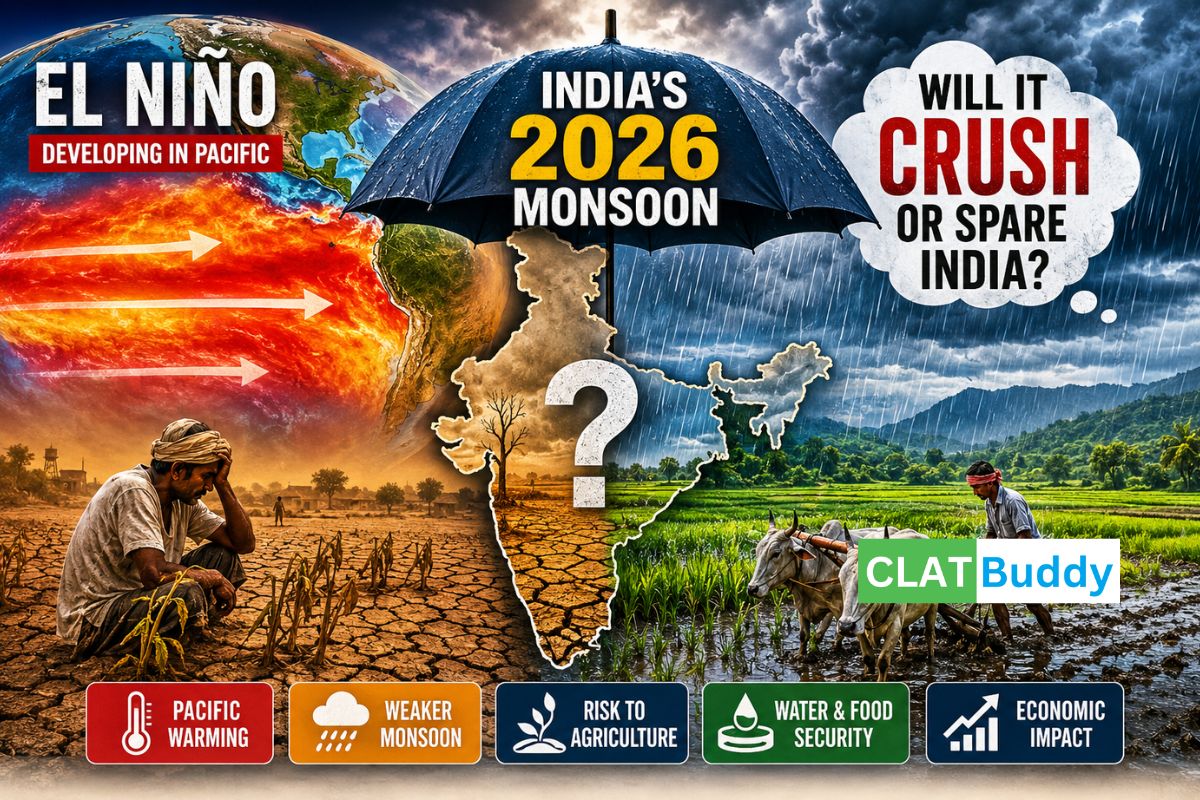
India is heading towards another uncertain monsoon season as climate experts closely track the possible return of El Nino in the Pacific Ocean. With heatwaves already affecting several parts of the country, concerns are rising over whether the developing weather pattern could weaken the 2026 southwest monsoon and affect crops, reservoirs, food prices, and rural livelihoods.
The southwest monsoon is extremely important for India because it contributes nearly 70% of the country’s annual rainfall between June and September. A weak or uneven monsoon can directly affect agriculture, drinking water supplies, electricity generation, and inflation. While forecasts suggest the El Nino pattern is gradually developing, scientists say it is still too early to conclude whether it will become a “Super El Nino” or severely damage India’s rainfall.
What Is El Nino?
El Niño–Southern Oscillation, commonly called ENSO, is a large-scale climate phenomenon linked to warming sea surface temperatures in the central and eastern Pacific Ocean. During an El Nino phase, trade winds weaken and ocean temperatures rise unusually in the Pacific, disrupting global weather systems.
For India, El Nino is often associated with weaker monsoon winds and below-normal rainfall. However, its impact is not always predictable. Some El Nino years have caused severe droughts, while others have surprisingly delivered normal or even above-normal rainfall.
Meteorologists say the current concern comes from the fact that ENSO conditions are shifting away from neutral levels. Even before the monsoon begins, changes in Pacific Ocean temperatures can influence atmospheric circulation patterns across Asia.
Why Is It Being Called “Super El Nino”?
Some international climate models are indicating that the warming in the Pacific may strengthen significantly later in 2026. Forecasts from agencies such as the National Oceanic and Atmospheric Administration suggest El Nino conditions may continue through the Northern Hemisphere winter of 2026-27.
There is also a possibility that the event could become “strong” or “very strong” by the end of the year. However, experts have cautioned against prematurely calling it a “Super El Nino.”
Earth System scientist Raghu Murtugudde noted that the warming pattern is still evolving and its final intensity remains uncertain. According to him, climate change is amplifying the effects of El Nino globally, especially by increasing heatwaves and weather instability.
Why El Nino Matters So Much For India
India’s agriculture remains heavily dependent on monsoon rainfall, especially for kharif crops such as rice, pulses, soybeans, sugarcane, and cotton. A weak monsoon can reduce crop output, increase food inflation, and hurt rural incomes.
Possible impacts include:
- Lower reservoir and groundwater levels
- Reduced agricultural productivity
- Rise in vegetable and food prices
- Increased heatwaves and forest fire risks
- Pressure on power demand and irrigation systems
- Economic stress in rural regions
Climate experts have also warned that uneven rainfall distribution may become a bigger problem than overall rainfall deficiency. Even if seasonal rainfall remains near average, long dry spells and sudden heavy rainfall events can damage crops and infrastructure.
The Role of the Indian Ocean Dipole
Another climate factor being watched closely is the Indian Ocean Dipole or IOD.
A positive IOD occurs when the western Indian Ocean becomes warmer than the eastern side. This often helps India by improving moisture flow towards the subcontinent and strengthening monsoon activity.
Historically, positive IOD phases have sometimes reduced the harmful effects of El Nino. In the famous 1997-98 El Nino event, India avoided severe monsoon damage largely because of a strong positive IOD.
Current forecasts suggest the IOD may gradually turn positive by July or August 2026. However, scientists caution that a positive IOD may not fully offset the effects of a strong El Nino if Pacific warming intensifies sharply.
Different Types of El Nino
Scientists also distinguish between different forms of El Nino because not all affect India in the same way.
Canonical or Traditional El Nino
This involves widespread warming across the eastern and central Pacific Ocean.
Modoki El Nino
El Niño Modoki is characterised by warming concentrated more in the central Pacific while eastern and western regions remain relatively cooler.
Meteorologists say the Modoki variant is often more damaging for the Indian monsoon because of the way it alters atmospheric circulation patterns over Asia.
History Shows El Nino Does Not Always Mean Drought
Although El Nino has earned a reputation as a “monsoon spoiler,” history shows that its effects are not uniform.
Between 1951 and 2022, around 60% of El Nino years witnessed below-normal rainfall in India. Major drought years have often coincided with El Nino conditions. However, several strong El Nino events did not produce severe monsoon failure.
The powerful 1997-98 event is one of the best examples where India still received above-average rainfall. Similar outcomes were seen in years like 1983 and 1994.
Climate scientists say this proves that monsoon behaviour depends on multiple interacting factors rather than El Nino alone.
A well-known 2006 study by climate scientist K. K. Kumar highlighted that while severe droughts are often linked to El Nino, not every El Nino results in drought. Some relatively weak El Nino years, such as 2002 and 2009, actually caused major rainfall deficits in India.
Climate Change Is Making Weather More Unpredictable
Experts believe global warming is changing the traditional relationship between El Nino and the Indian monsoon.
Warming over Eurasia and rising global temperatures are affecting land-sea temperature contrasts, which can influence monsoon circulation. This means older weather patterns may not always repeat in the same way.
Scientists also warn that climate change is increasing the frequency of extreme weather events, including:
- Intense heatwaves
- Sudden cloudbursts
- Long dry spells
- Erratic rainfall patterns
Pre-monsoon rainfall has already damaged crops in several regions this year, raising concerns over agricultural losses even before the full monsoon season begins.
Government Preparations And Economic Concerns
The possibility of weaker rainfall has already triggered discussions around food security and inflation management. Reports suggest the government is monitoring possible disruptions linked to weather conditions and geopolitical pressures.
Experts say decisions regarding:
- Water management
- Fertiliser supply
- Crop planning
- Food imports and exports
- Disaster response systems
will depend heavily on short-term and medium-range forecasts issued by the India Meteorological Department.
Forecasting technology has improved significantly in recent years, allowing governments and farmers more preparation time compared to previous decades.
What Can India Do?
While El Nino itself cannot be prevented, experts say preparation can reduce its impact considerably.
Suggested measures include:
- Promoting drought-resistant crop varieties
- Improving groundwater recharge systems
- Strengthening heat action plans
- Better reservoir and irrigation management
- Advising farmers on crop diversification and sowing schedules
- Expanding local disaster preparedness systems
Scientists stress that El Nino should be viewed as a warning sign rather than a certainty of disaster.
What Happens Next?
The coming weeks will be crucial as ocean temperatures and atmospheric conditions continue evolving across the Pacific. Meteorologists are expected to revise forecasts multiple times before the monsoon fully stabilises.
For millions of Indians dependent on rainfall, the uncertainty surrounding the 2026 monsoon remains a major concern. Whether the developing El Nino becomes severe or weakens over time could determine not only agricultural output, but also inflation, water security, and economic stability in the months ahead.
Calling all law aspirants!
Are you exhausted from constantly searching for study materials and question banks? Worry not!
With over 15,000 students already engaged, you definitely don't want to be left out.
Become a member of the most vibrant law aspirants community out there!
It’s FREE! Hurry!
Join our WhatsApp Groups (Click Here) and Telegram Channel (Click Here) today, and receive instant notifications.