


Digital Notes vs Handwritten Notes for CLAT: Which One Should You Actually Use?
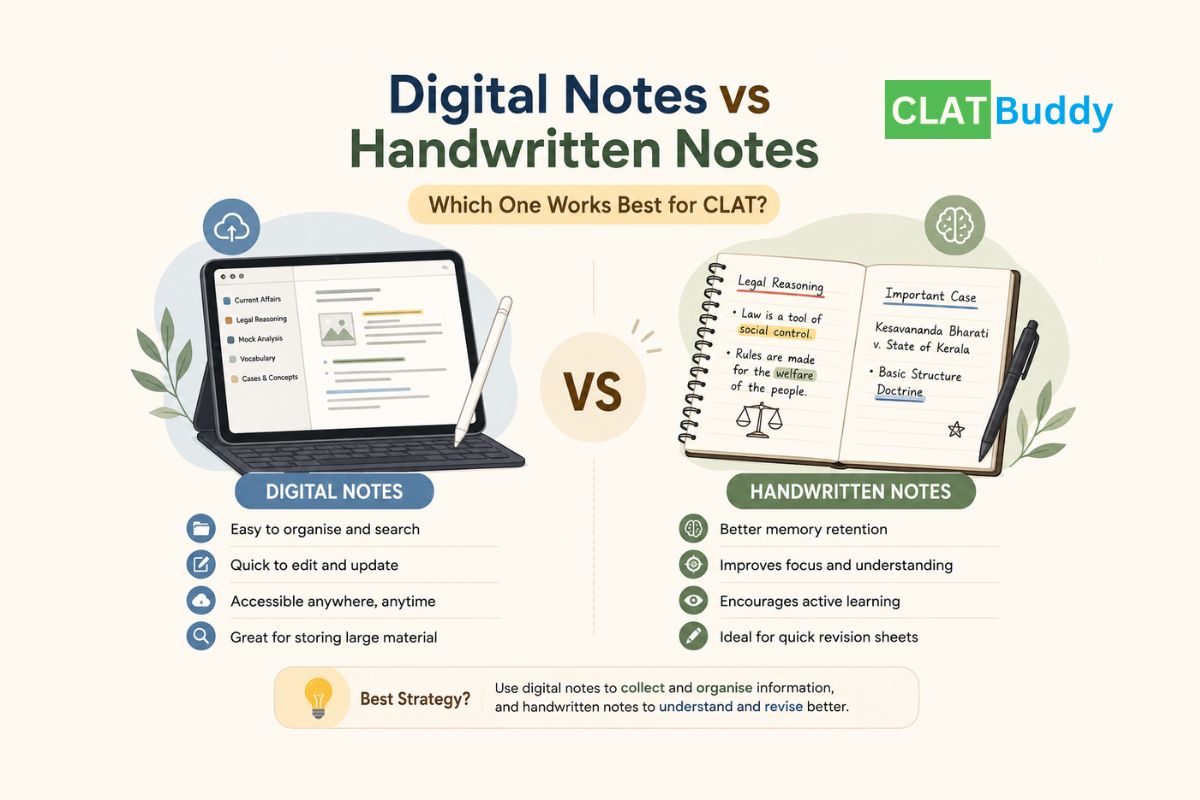
If you are preparing for CLAT, AILET, SLAT, or other law entrance exams, chances are you have already wondered whether you should make digital notes or handwritten notes. Some toppers use iPads and apps like Notion or OneNote, while others still rely on notebooks, sticky notes, and handwritten revision sheets.
This often creates confusion for aspirants. You may feel that digital notes look more organised and modern, while handwritten notes feel more natural and easier to remember. The truth is that both methods can work well if you use them correctly.
The real question is not “Which one is perfect?” The real question is “Which method helps you revise faster, retain better, and stay consistent during CLAT preparation?”
In this article, you will understand the advantages and disadvantages of both systems, what works best for different CLAT subjects, and how you can build a note-making strategy that actually helps you score better in mocks and the final exam.
Why Do Notes Matter So Much in CLAT Preparation?
CLAT preparation involves handling a huge amount of information. You read newspapers daily, solve mock tests, revise current affairs, learn legal concepts, improve vocabulary, and analyse mistakes regularly.
Without proper notes, revision becomes chaotic.
Good notes help you:
- revise quickly before mocks
- remember important concepts
- track mistakes
- organise current affairs
- reduce last-minute stress
- improve retention
But bad notes can waste hours every week. Many aspirants spend more time decorating notes than actually studying. That is why your note-making method matters.
What Are Handwritten Notes?
Handwritten notes are notes you make using pen and paper in notebooks, registers, loose sheets, flashcards, or sticky notes.
Most CLAT aspirants use handwritten notes for:
- legal reasoning concepts
- current affairs revision
- vocabulary
- static GK
- error logs
- formula-based quantitative techniques
Handwritten notes are traditional, but they are still extremely effective for competitive exam preparation.
Why Do Many CLAT Aspirants Prefer Handwritten Notes?
When you write by hand, your brain processes information more actively. You summarise concepts instead of copying them directly. This improves understanding and memory retention.
That is especially useful for CLAT because the exam is heavily comprehension-based. You are not simply memorising facts. You are understanding passages, identifying arguments, and applying logic under pressure.
Better Memory Retention
Most students remember handwritten content more easily because writing activates multiple learning processes together. You read, process, and write at the same time.
This helps during:
- legal reasoning revision
- current affairs recall
- vocabulary retention
- mock analysis
Fewer Distractions
When you study with notebooks, you are less likely to get distracted by notifications, YouTube, Instagram, or random browsing.
Digital distractions silently reduce productivity during long preparation phases.
Easier Active Revision
Handwritten notes often encourage active recall. You underline, circle, annotate, and rewrite important points naturally.
This improves long-term retention, especially during the final months before CLAT.
Stronger Focus During Study Sessions
Many students feel more focused while writing on paper because the brain associates notebooks with “study mode.”
This can improve concentration during:
- newspaper analysis
- legal concepts
- mock test reviews
What Are the Problems with Handwritten Notes?
Although handwritten notes are effective, they also have limitations.
They Take More Time
Writing everything by hand can become exhausting, especially for current affairs. If you try to write entire newspaper articles daily, you may waste too much time.
Notes Become Bulky
After a few months, notebooks pile up quickly. Managing multiple registers for different subjects becomes difficult.
Updating Notes Is Hard
CLAT current affairs keep changing. Digital systems allow easy editing, but handwritten notes often become messy after repeated updates.
Searching Information Is Difficult
If you want to revise one topic quickly before a mock, finding information inside multiple notebooks can take time.
What Are Digital Notes?
Digital notes are notes stored electronically using:
- Notion
- OneNote
- Google Docs
- Evernote
- Obsidian
- GoodNotes
- tablet note-making apps
Many CLAT aspirants now use digital systems because most preparation material already comes in digital form.
PDFs, online current affairs compilations, mock analysis sheets, and editorial articles are easier to store digitally.
Why Are Digital Notes Becoming Popular for CLAT?
Digital notes are highly organised and flexible. They help students manage large amounts of information efficiently.
This becomes useful during long-term preparation where revision speed matters a lot.
Easy Organisation
You can create folders, tags, categories, and subject-wise sections. This makes revision smoother.
For example:
- Current Affairs
- Legal Reasoning
- Vocabulary
- Important Supreme Court Cases
- Mock Mistakes
Everything stays organised in one place.
Faster Editing and Updating
Current affairs notes often need updates. Digital notes allow you to add information quickly without rewriting entire pages.
This saves time during preparation.
Search Function Saves Time
Suppose you want to revise “Parliamentary Committees” before a mock. Instead of flipping through pages, you can search the keyword instantly.
This feature becomes extremely useful during revision months.
Better Storage and Backup
Digital notes do not get lost easily. Cloud backups help you access notes from multiple devices.
This also helps students who travel or study outside coaching centres.
Helpful for Current Affairs
Digital notes work especially well for:
- newspaper summaries
- editorial analysis
- monthly current affairs
- legal news
- bookmarked articles
You can save screenshots, links, and PDFs together.
What Are the Problems with Digital Notes?
Digital notes also have drawbacks, especially for younger aspirants preparing for competitive exams.
Higher Distraction Risk
This is the biggest issue.
One notification can turn into:
- Instagram scrolling
- YouTube watching
- chatting
- random browsing
Many students lose productive hours without realising it.
Passive Learning Problem
Typing often becomes mechanical. Students copy information without processing it deeply.
This creates an illusion of preparation because the notes look complete, but retention remains weak.
Eye Strain and Fatigue
Long hours on screens can reduce focus and increase mental fatigue.
This becomes worse during intense preparation phases.
Over-Organising Notes
Many aspirants spend excessive time:
- choosing templates
- colour coding
- designing dashboards
- making aesthetic pages
Remember this clearly. Beautiful notes do not guarantee CLAT ranks.
Which Method Works Better for Different CLAT Subjects?
The smartest strategy is to use different systems for different tasks.
| CLAT Area | Better Option |
| Legal reasoning concepts | Handwritten |
| Vocabulary building | Handwritten |
| Current affairs storage | Digital |
| Newspaper summaries | Digital |
| Mock analysis | Handwritten |
| Error notebook | Handwritten |
| Monthly current affairs revision | Digital |
| Final revision sheets | Handwritten |
| Static GK compilation | Digital |
| Quant formulas | Handwritten |
Should You Use an iPad for CLAT Preparation?
Many students think buying an iPad automatically improves preparation. That is not true.
An iPad is only a tool. It helps only if:
- you already study consistently
- you avoid distractions
- you revise regularly
- you use it mainly for organisation
If you are easily distracted, traditional notebooks may work better.
Do not feel pressured to buy expensive devices just because other aspirants use them.
What Do Most CLAT Toppers Actually Do?
Most successful aspirants eventually follow a hybrid system.
They:
- consume information digitally
- organise resources digitally
- revise important concepts through handwritten notes
This combination works because it balances:
- speed
- flexibility
- retention
- revision efficiency
For example:
- newspaper reading may happen digitally
- but final revision notes are handwritten
That approach improves memory while saving time.
What Is the Biggest Mistake Students Make While Making Notes?
The biggest mistake is making notes for everything.
You do not need to rewrite:
- every editorial
- every current affairs article
- every coaching PDF
Your notes should help revision, not create extra workload.
Good CLAT notes are:
- short
- revision-friendly
- regularly updated
- easy to revisit
If your notes become too detailed, you may stop revising them altogether.
So, Which One Should You Choose for CLAT?
There is no universal answer because every student studies differently.
But for most aspirants, this system works best:
Read digitally. Revise through handwritten notes.
This gives you:
- faster information collection
- better organisation
- stronger retention
- more effective revision
And in CLAT preparation, revision quality matters far more than fancy note-making methods.
At the end of the day, your selection will not depend on whether your notes were digital or handwritten. It will depend on:
- how consistently you revised
- how seriously you analysed mocks
- how well you improved your weak areas
- how calm you stayed during preparation
Choose the system that helps you stay consistent for the next 12 to 18 months. That is the system that will actually work for you.
Calling all law aspirants!
Are you exhausted from constantly searching for study materials and question banks? Worry not!
With over 15,000 students already engaged, you definitely don't want to be left out.
Become a member of the most vibrant law aspirants community out there!
It’s FREE! Hurry!
Join our WhatsApp Groups (Click Here) and Telegram Channel (Click Here) today, and receive instant notifications.