


How to Deal With Low Scores and Self-Doubt During CLAT Preparation
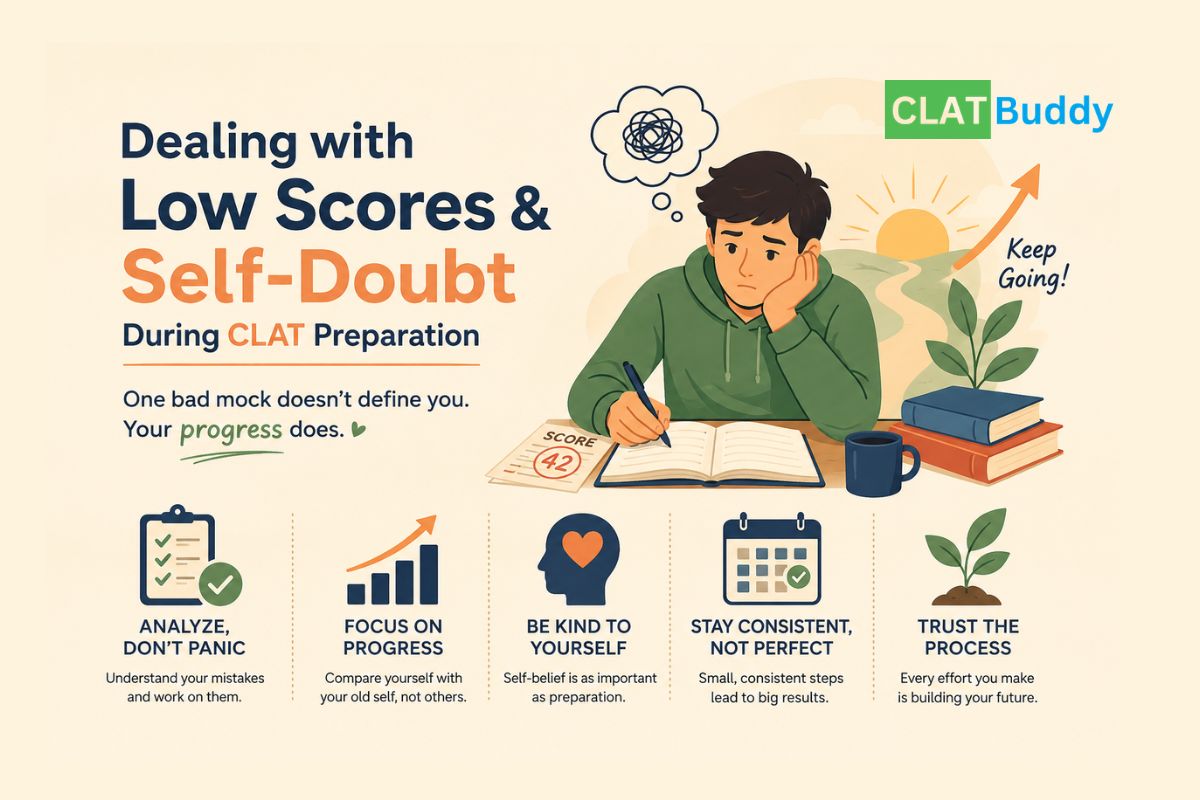
Preparing for CLAT is not just about studying Legal Reasoning, Current Affairs, English, Quantitative Techniques, and Logical Reasoning. It is also about handling pressure, disappointment, comparison, and self-doubt.
At some point during your CLAT preparation journey, you will probably face a low mock score that shakes your confidence. Maybe you studied hard but your marks still dropped. Maybe your friends are scoring higher than you. Maybe you feel like everyone else is improving while you are stuck.
If this sounds familiar, you are not alone.
Many students preparing for CLAT 2027 and other law entrance exams go through phases where they question themselves. The good thing is that low scores during preparation do not decide your final result. What matters more is how you respond after those difficult phases.
In this article, let’s understand how to deal with low scores, exam stress, and self-doubt during CLAT preparation in a healthy and practical way.
Why Do Low Scores Affect You So Emotionally?
CLAT preparation is deeply connected to your dreams. You are not just preparing for an exam. You are preparing for:
- A top NLU
- A better career
- A new city and college life
- Your future identity as a lawyer
Because of this emotional connection, one bad mock can feel much bigger than it actually is.
When students score low in CLAT mocks, they often start thinking:
- “Maybe I am not smart enough for CLAT.”
- “What if I never improve?”
- “Everyone else seems ahead of me.”
- “Am I wasting my time?”
These thoughts are common among CLAT aspirants, especially students in Classes 11 and 12 who are handling school pressure alongside entrance preparation.
The important thing to remember is this: your current score is only a snapshot of your preparation, not your final destination.
What Do Low CLAT Mock Scores Actually Mean?
A low mock score does not automatically mean you cannot crack CLAT.
Most of the time, low scores happen because of:
- Poor time management
- Weak reading stamina
- Panic during difficult passages
- Silly mistakes
- Guesswork
- Lack of revision
- Poor mock analysis
- Mental fatigue
These are preparation problems, not intelligence problems.
CLAT is a skill-based exam. Skills improve with practice, analysis, and consistency. Many students who eventually get top ranks spend months struggling with mocks before their scores finally improve.
So instead of emotionally reacting to a bad mock, try asking:
“What exactly went wrong here?”
That question changes your mindset from panic to problem-solving.
Why Is Comparing Yourself to Other Aspirants Dangerous?
One of the fastest ways to destroy confidence during CLAT preparation is constant comparison.
You may see:
- Someone scoring 90+ in mocks
- Someone finishing papers early
- Someone posting study hours online
- Someone claiming they completed the syllabus twice
But you never see the full picture behind those numbers.
Maybe they started preparation earlier.
Maybe they are weak in another section.
Maybe they are also struggling mentally.
Social media and peer discussions usually show only highlights, not struggles.
Your preparation journey is different.
Instead of comparing yourself with others, compare:
- Your current accuracy with last month’s accuracy
- Your reading speed with your older speed
- Your mock analysis quality with previous attempts
That is real progress.
How Should You React After a Bad CLAT Mock?
A bad mock feels terrible in the moment. But what you do after that mock matters much more than the score itself.
Avoid Emotional Reactions
Do not immediately say:
- “I will never crack CLAT.”
- “I am not made for law.”
- “Everything is over.”
One mock cannot decide your future.
Even top aspirants have bad test days.
Take a small break after the mock. Calm yourself before analysis.
Analyse the Mock Properly
This is where actual improvement begins.
Most students give mock tests regularly, but very few analyse them honestly and deeply.
Ask yourself:
- Which section consumed the most time?
- Where did accuracy fall?
- Did panic affect decision-making?
- Which passages should have been skipped?
- Were there repeated silly mistakes?
Create a personal error notebook and write:
- The mistake
- Why it happened
- The correct approach
Over time, you will start noticing patterns in your mistakes. That awareness helps you improve much faster.
Can Self-Doubt Ever Be Useful?
Surprisingly, yes.
A little self-doubt can actually help you become more aware and disciplined. The problem begins when self-doubt turns into hopelessness.
Healthy self-reflection sounds like:
- “I need better time management.”
- “My Current Affairs revision is weak.”
- “I need more sectional practice.”
Unhealthy self-doubt sounds like:
- “I am a failure.”
- “I can never improve.”
- “Others are naturally smarter.”
Always focus on improving your preparation strategy, not attacking your self-worth.
How Can You Rebuild Confidence During CLAT Preparation?
Confidence is not built through motivational videos alone. It is built through small wins repeated consistently.
Here are some practical ways to rebuild confidence:
Focus on Daily Targets Instead of Final Rank
Thinking about AIR 1 all day creates pressure.
Instead, focus on:
- Completing today’s revision
- Solving one sectional test properly
- Improving reading speed
- Reducing silly mistakes
Small goals make preparation manageable.
Celebrate Small Improvements
Not every victory will be dramatic.
Sometimes progress looks like:
- Getting 5 more questions correct
- Better accuracy in Legal Reasoning
- Completing mocks calmly
- Improving concentration
These improvements matter.
Reduce Negative Inputs
Too much comparison can mentally exhaust you.
Try limiting:
- Toxic rank discussions
- Negative Telegram groups
- Unrealistic study routine videos
- Constant score comparisons
Your mind needs focus, not unnecessary pressure.
Are You Studying Too Much Without Rest?
Many CLAT aspirants believe that success only comes from studying 12 to 14 hours daily.
That is not true for most students.
If you constantly feel:
- Irritated
- Mentally tired
- Unable to focus
- Emotionally exhausted
- Demotivated even after studying
Then burnout may already be affecting your preparation.
A tired brain performs poorly in mocks, even if you know the concepts.
What Helps Prevent Burnout?
Simple habits make a huge difference:
- Sleep properly
- Take short breaks
- Walk or exercise daily
- Eat properly
- Stay hydrated
- Keep one hobby alive
- Spend some time away from screens
You do not need to study every minute to prove seriousness.
Consistency matters more than extreme study hours.
What If Your Scores Are Not Improving for Months?
This is one of the most frustrating phases during CLAT preparation.
Sometimes students work very hard but their mock scores remain stuck within the same range.
When that happens, increasing study hours is not always the answer. Sometimes you need to change your approach.
Re-evaluate Your Preparation Strategy
Ask yourself:
- Are you revising regularly?
- Are you using too many resources?
- Are you analysing mocks deeply?
- Are you attempting questions strategically?
- Are you reading enough daily?
Many students improve after simplifying preparation.
For example:
- Fewer books
- Better revision
- Smarter practice
- Stronger fundamentals
- Better newspaper reading habits
Improvement in CLAT preparation is often delayed, not absent.
Why Is Consistency More Important Than Motivation?
Motivation changes daily.
Some mornings you will feel energetic.
Some days you will feel completely demotivated.
That is normal.
Students who crack CLAT are usually not the students who felt motivated every day. They are the students who continued preparing even on difficult days.
Consistency creates results.
Even studying sincerely for 5 to 6 focused hours daily for months can create huge improvement.
Do not wait to “feel motivated” before studying.
Start first. Motivation often comes after action.
How Should You Talk to Yourself During Preparation?
Your internal language matters a lot.
If your mind constantly says:
- “I am weak.”
- “I cannot do this.”
- “Others are better.”
Then preparation becomes emotionally heavy.
Instead, try saying:
- “I am improving slowly.”
- “One bad mock does not define me.”
- “I can work on my weak areas.”
- “This phase is temporary.”
Positive self-talk may sound simple, but it directly affects confidence and performance.
Final Thoughts
Low scores and self-doubt are a normal part of CLAT preparation. Almost every aspirant experiences them at some stage.
The difference between students who quit and students who succeed is not talent alone. It is resilience.
Your mock score today is not your final CLAT result.
Your current struggles are not permanent.
And one difficult phase does not mean you are incapable.
Keep learning from mistakes.
Keep analysing honestly.
Keep showing up consistently.
Some days your preparation will feel easy.
Some days it will feel exhausting.
But if you continue moving forward patiently, improvement will come.
And one day, the same mocks that once made you doubt yourself will become proof of how far you have come.
Calling all law aspirants!
Are you exhausted from constantly searching for study materials and question banks? Worry not!
With over 15,000 students already engaged, you definitely don't want to be left out.
Become a member of the most vibrant law aspirants community out there!
It’s FREE! Hurry!
Join our WhatsApp Groups (Click Here) and Telegram Channel (Click Here) today, and receive instant notifications.