


How Legal Reasoning Is Tested in CLAT
Every year, thousands of students prepare for CLAT by studying legal terms, landmark cases, and legal concepts. While legal awareness can certainly help, many students are surprised when they discover that CLAT Legal Reasoning is not really testing how much law they know. Instead, it is testing how well they can think like a lawyer.
If Legal Reasoning feels confusing or unpredictable, the problem is often not a lack of knowledge. It is usually a misunderstanding of what the exam is actually trying to assess. Once the real logic behind CLAT Legal Reasoning becomes clear, preparation becomes much more focused and effective.
What Does CLAT Actually Test in the Legal Reasoning Section?
The biggest myth about CLAT Legal Reasoning is that students need extensive legal knowledge to score well.
In reality, the exam focuses on your ability to:
- Read and understand legal passages
- Identify legal principles
- Apply those principles to new situations
- Analyse facts logically
- Draw conclusions based on the information provided
Think of it this way. CLAT is not asking whether you know the law. It is asking whether you can use legal reasoning to solve a problem.
This is exactly what lawyers, judges, and legal professionals do every day. They study facts, understand applicable rules, and then reach a logical conclusion.
Why Is Legal Reasoning Different from Legal Knowledge?
Many first-time aspirants confuse legal knowledge with legal reasoning.
Legal knowledge involves memorising facts such as:
- Constitutional Articles
- Important judgments
- Legal terminology
- Historical developments in law
Legal reasoning, on the other hand, focuses on applying a principle to a factual situation.
For example, a passage may explain a legal principle related to negligence. Even if you have never studied negligence before, you can still answer the question correctly if you understand the principle provided in the passage.
That is why students from science, commerce, and humanities backgrounds can all perform equally well in this section.
How Is a Typical CLAT Legal Reasoning Question Structured?
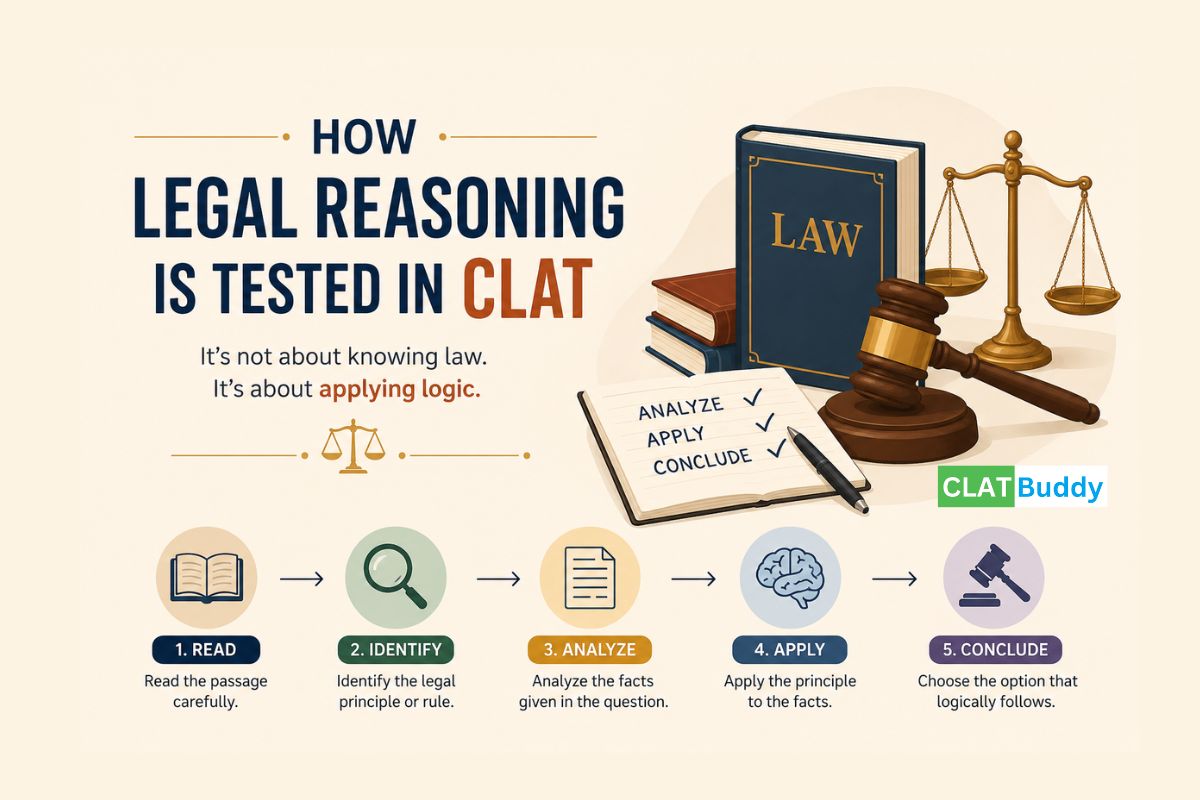
Almost every Legal Reasoning question follows a predictable structure.
Step 1: A Passage Is Provided
The passage may discuss:
- A legal principle
- A recent legal issue
- A court decision
- A constitutional debate
- A public policy issue
Step 2: A Rule or Principle Is Hidden Inside the Passage
Somewhere in the passage, a legal rule is explained.
Your job is to identify that rule.
Step 3: New Facts Are Introduced
The question presents a situation involving individuals, actions, or events.
Step 4: You Apply the Principle
You must determine whether the principle applies to those facts.
Step 5: You Choose the Best Conclusion
The answer is not based on personal opinion. It must be based entirely on the passage.
This simple structure forms the foundation of most Legal Reasoning questions in CLAT.
Why Do Students Often Struggle with Legal Reasoning?
Many students enter the exam hall believing they need to become experts in law.
As a result, they spend months memorising legal facts while neglecting reasoning skills.
The most common mistakes include:
Reading Too Quickly
Legal passages often contain important conditions and exceptions.
Missing a single word such as “intentionally,” “knowingly,” or “reasonable” can completely change the answer.
Using Outside Knowledge
Suppose the passage states a particular legal rule.
Even if real-world law says something different, you must follow the passage.
The passage becomes the law for that question.
Ignoring Exceptions
CLAT frequently includes exceptions to general rules.
Many students identify the rule but overlook the exception, leading to incorrect answers.
Allowing Personal Opinions to Interfere
Legal Reasoning is not about what feels fair.
It is about what logically follows from the legal principle provided.
What Types of Legal Reasoning Questions Appear in CLAT?
Understanding the different question types can help you prepare more effectively.
Principle and Fact Based Questions
These are the most common questions.
A legal principle is provided, followed by a factual situation.
Your task is to determine whether the principle applies.
These questions test pure application skills.
Exception Based Questions
A rule is explained, but an exception is also included.
Students who read carefully usually score well on these questions.
Students who rush often fall into traps.
Public Policy Questions
Modern CLAT papers frequently include discussions about:
- Privacy
- Free speech
- Technology regulation
- Artificial intelligence
- Environmental protection
- Gender rights
These questions require critical thinking rather than legal knowledge.
Court Decision Based Questions
Passages may summarise a judgment or legal development.
The questions then ask you to apply the court’s reasoning to a new scenario.
What Is the Actual Thought Process of a High Scorer?
Students who consistently score well in Legal Reasoning follow a systematic approach.
Instead of jumping to the answer, they think step by step.
Identify the Principle
The first task is always finding the legal rule.
Ask yourself:
“What is the passage trying to establish?”
Find the Conditions
Many legal rules have multiple requirements.
For example:
- Condition A must exist
- Condition B must exist
- Condition C must exist
If even one condition is missing, the answer may change.
Analyse the Facts
Next, compare the facts in the question with the conditions in the rule.
Look for similarities and differences.
Check for Exceptions
Before selecting an answer, check whether any exception applies.
Many CLAT questions are designed around exceptions.
Eliminate Wrong Options
Often two answer choices appear correct.
Elimination helps identify the option that most accurately follows the passage.
How Can You Improve Legal Reasoning for CLAT?
The good news is that Legal Reasoning is a skill.
Like any skill, it improves with practice.
Read Editorials and Opinion Pieces
Reading quality editorials helps develop analytical thinking.
It also improves reading speed and comprehension.
Practice Passage-Based Questions Daily
Legal Reasoning improves through regular exposure to passages.
Focus on understanding why an answer is correct rather than simply checking scores.
Learn to Read Actively
While reading a passage, ask:
- What is the main principle?
- Are there any exceptions?
- What facts are important?
- What facts are irrelevant?
Active reading develops strong reasoning habits.
Focus on Accuracy Before Speed
Many students worry about speed too early.
Initially, focus on understanding the logic behind each question.
Speed naturally improves with practice.
Analyse Mistakes Thoroughly
Every incorrect answer teaches something valuable.
After each practice session, identify:
- Why the answer was wrong
- Which part of the passage was missed
- Whether an exception was overlooked
- Whether assumptions influenced the decision
This reflection process accelerates improvement.
How Important Is Legal Knowledge for CLAT?
Legal knowledge is helpful but not essential.
Having some familiarity with topics such as:
- Fundamental Rights
- Criminal Law
- Contract Law
- Constitutional Law
- Recent legal developments
can make passages easier to understand.
However, legal knowledge alone will not guarantee a high score.
A student with strong reasoning skills often performs better than a student who simply knows more legal facts.
That is why preparation should focus primarily on comprehension, analysis, and application.
What Should CLAT 2027 Aspirants Focus on Right Now?
If CLAT 2027 is the target, focus on building the right foundation.
Spend more time developing:
- Reading comprehension
- Critical thinking
- Logical analysis
- Passage interpretation
- Principle application skills
- Current legal awareness
Avoid the temptation to memorise large amounts of legal theory without understanding how to apply it.
The exam rewards thinkers more than memorizers.
Final Thoughts
The Legal Reasoning section becomes much easier once its true purpose is understood. CLAT is not trying to turn students into lawyers before law school. It is trying to identify students who have the potential to think like lawyers.
Every passage, principle, and question is designed to test one core ability: applying a rule to a situation logically and objectively.
The students who succeed are not necessarily the ones who know the most law. They are the ones who can read carefully, identify principles, spot exceptions, analyse facts, and arrive at conclusions based on logic rather than assumptions.
Master that process, and Legal Reasoning can become one of the highest-scoring sections in the entire CLAT exam.
Calling all law aspirants!
Are you exhausted from constantly searching for study materials and question banks? Worry not!
With over 15,000 students already engaged, you definitely don't want to be left out.
Become a member of the most vibrant law aspirants community out there!
It’s FREE! Hurry!
Join our WhatsApp Groups (Click Here) and Telegram Channel (Click Here) today, and receive instant notifications.