


Last Six Months CLAT Preparation Strategy: How You Can Turn the Final Phase Into Your Biggest Advantage
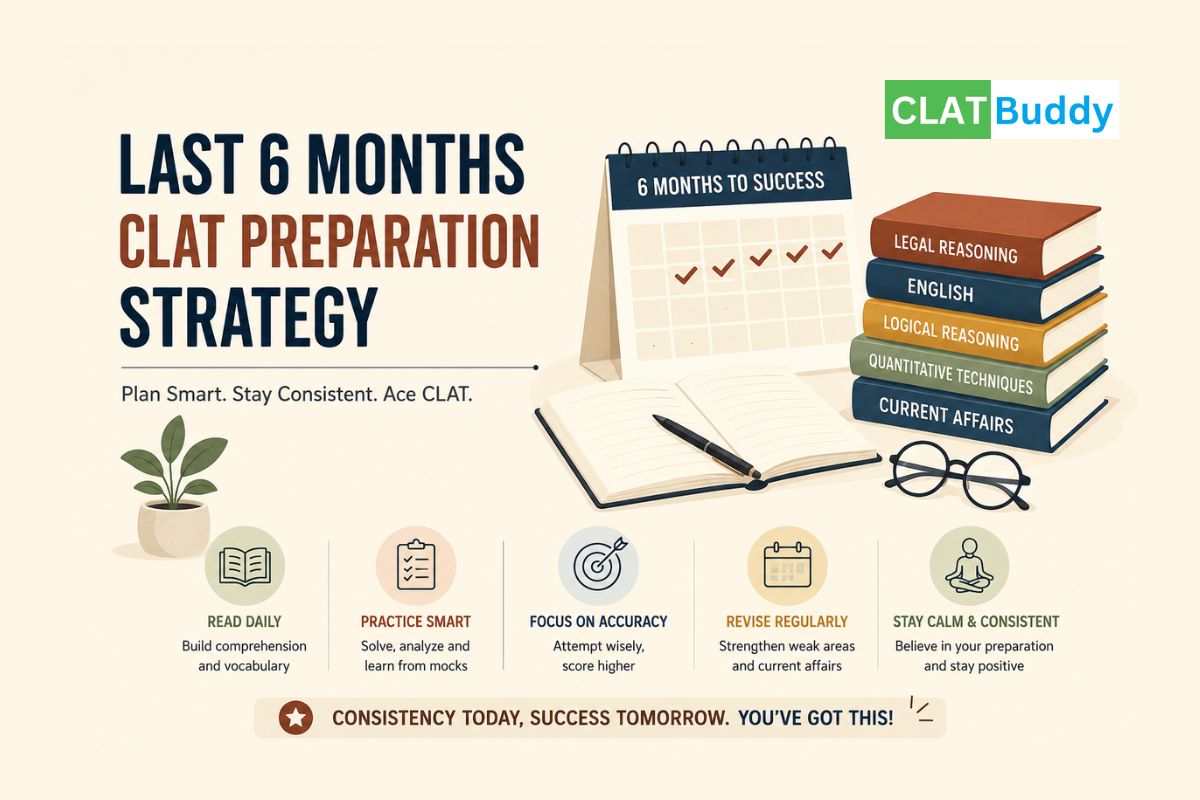
If you are preparing for CLAT and only six months are left, there is a high chance that you are feeling one of these things right now. Panic. Pressure. Confusion. Self doubt. Or maybe all of them together.
You may feel that others are already ahead. Some students have completed multiple mock tests, some are posting scores online, and some look extremely confident. But here is something important you need to understand. The last six months before CLAT can completely change your preparation if you use them smartly.
CLAT is not an exam where the student who studies the longest automatically wins. It is an exam where consistency, reading ability, mock analysis, and calm decision making matter the most.
So if you are serious about improving your score and getting into a good law school, this guide will help you understand exactly how you should approach the final six months before CLAT.
Why Are the Last Six Months So Important for CLAT Preparation?
The final six months are important because this is the phase where preparation slowly shifts from learning to performance.
Till now, you may have been:
- Learning concepts
- Watching lectures
- Collecting notes
- Solving practice questions randomly
But now your preparation needs structure.
In these six months, you need to:
- Improve reading speed
- Increase accuracy
- Build mock temperament
- Revise current affairs properly
- Learn time management
- Reduce silly mistakes
This is also the phase where many students either become very disciplined or completely lose consistency. The difference between these two groups becomes visible in the final CLAT score.
What Should Your Overall Goal Be in the Last Six Months?
Your goal should not be studying for 12 to 14 hours every day.
Your goal should be:
- Becoming consistent
- Solving mocks intelligently
- Improving weak areas
- Building confidence gradually
- Avoiding burnout
Many CLAT aspirants waste time searching for “secret strategies” instead of following a stable routine. The truth is that small daily improvements matter much more than dramatic study schedules.
How Should You Divide the Last Six Months Before CLAT?
Instead of preparing randomly, divide your preparation into phases.
First Two Months: Build Your Foundation Properly
The first two months should focus on strengthening basics and building habits.
At this stage, your focus should be on:
- Reading comprehension
- Legal reasoning basics
- Current affairs consistency
- Logical reasoning practice
- Basic Quantitative Techniques
This is also the best time to improve your reading stamina because CLAT passages can become mentally exhausting during the actual exam.
What should your daily routine include?
A balanced routine may look like this:
- Newspaper reading for 45 minutes
- Legal reasoning practice
- One English comprehension set
- Logical reasoning questions
- Quant practice for 30 to 45 minutes
- Current affairs revision
You do not need perfect schedules. You need realistic schedules that you can follow regularly.
How Can You Improve Your Reading Skills for CLAT?
Many students underestimate reading skills during CLAT preparation. But reading is actually the backbone of the exam.
CLAT tests your:
- Comprehension
- Analysis
- Speed
- Attention span
- Ability to identify arguments
This is why students who read regularly often perform better in:
- English Language
- Legal Reasoning
- Logical Reasoning
- Current Affairs
What should you read daily?
You can read:
- Newspaper editorials
- Legal news
- Opinion articles
- International affairs
- Explainer articles
While reading, do not just finish the article quickly. Train yourself to:
- Identify the main argument
- Understand tone
- Predict conclusions
- Spot assumptions
These are exactly the skills tested in CLAT passages.
How Should You Prepare for Current Affairs in the Final Six Months?
Current affairs preparation becomes dangerous when students try to cover everything from everywhere.
You do not need:
- Ten monthly magazines
- Endless PDFs
- Multiple Telegram channels
You need one structured source and regular revision.
What should you focus on?
Focus more on:
- Important Supreme Court judgments
- International events
- Constitutional developments
- Government schemes
- Reports and indices
- Awards and appointments
How should you revise current affairs?
A smart strategy is:
- Daily newspaper reading
- Weekly revision
- Monthly compilation revision
- Short notes for important events
Revision matters much more than collection.
Many students read current affairs once and never revise again. That creates panic before the exam.
When Should You Start Taking Mock Tests Seriously?
Mock tests should become an important part of your preparation from the third month onwards.
Initially, you can start with:
- One mock every two weeks
Then slowly increase it to:
- One mock every week
- Two mocks weekly in the final months
But here is the important part.
Mock analysis matters more than mock attempts.
How Should You Analyse Your CLAT Mock Tests?
A mock test is valuable only when you learn from it.
After every mock, spend time understanding:
- Why you got questions wrong
- Which section consumed extra time
- Which questions were guesswork
- Which passages affected your confidence
Maintain an error notebook
Your error notebook should include:
- Silly mistakes
- Repeated errors
- Weak concepts
- Time management issues
- Wrong assumptions during reasoning questions
This notebook becomes extremely useful during revision.
How Can You Improve Accuracy in CLAT?
Many students become obsessed with attempts.
But CLAT is not about attempting every question blindly.
Accuracy matters more than aggressive guessing.
What improves accuracy?
Accuracy improves when you:
- Read carefully
- Avoid panic
- Eliminate options logically
- Practice regularly
- Analyse mistakes honestly
A student attempting 95 questions with strong accuracy can easily outperform someone attempting 115 questions carelessly.
What Should Be Your Strategy for Legal Reasoning?
Legal Reasoning is one of the most important sections in CLAT.
But many students make one mistake. They try to memorise legal facts excessively.
CLAT Legal Reasoning is more about application than rote learning.
How should you prepare?
Focus on:
- Understanding legal principles
- Reading legal passages carefully
- Applying principles logically
- Practising passage based questions
You should also stay updated with:
- Important constitutional developments
- Landmark judgments
- Basic legal concepts
How Can You Prepare Quantitative Techniques Without Fear?
Many CLAT aspirants fear Quantitative Techniques because they think they are weak in maths.
But CLAT Quant is usually based on:
- Basic arithmetic
- Data interpretation
- Simple calculations
You do not need advanced mathematics.
Which topics should you prioritise?
Focus on:
- Percentages
- Ratio and proportion
- Average
- Profit and loss
- Time and work
- Data interpretation
Practice calculations regularly because speed matters in this section.
What Should You Do in the Final Two Months Before CLAT?
The final two months should focus heavily on:
- Revision
- Mock practice
- Accuracy
- Mental stability
This is not the time to:
- Buy new books
- Follow random strategies
- Compare yourself constantly
- Change your preparation style suddenly
Increase revision frequency
By this stage:
- Current affairs should be revised repeatedly
- Error notebooks should become your priority
- Weak areas should receive extra attention
Improve exam temperament
CLAT is also a mental game.
You need to learn:
- How to recover after difficult passages
- How to stay calm during mocks
- How to avoid panic after low scores
One bad mock score does not define your preparation.
How Many Hours Should You Study Daily for CLAT?
This depends on your schedule.
If you are in school:
- 4 to 6 focused hours can be enough
If you are a dropper:
- 6 to 8 productive hours are usually sufficient
But remember something important.
Studying with focus for six hours is much better than sitting with books for twelve distracted hours.
What Are the Biggest Mistakes Students Make in the Last Six Months?
Here are some common mistakes:
- Resource overload
- Ignoring mock analysis
- Not revising current affairs
- Taking burnout lightly
- Comparing scores constantly
- Avoiding Quant completely
- Studying without a proper plan
Avoiding these mistakes can itself improve your preparation significantly.
Can You Still Crack CLAT in Six Months?
Yes, absolutely.
Many students improve drastically in the last six months because this is when preparation becomes serious and focused.
You do not need perfection right now.
You need:
- Consistency
- Smart revision
- Reading discipline
- Proper mock analysis
- Confidence
Some days will feel productive. Some days will feel frustrating. That is completely normal during CLAT preparation.
The important thing is that you keep moving forward.
Final Thoughts
The last six months before CLAT can either become your biggest stress period or your strongest comeback phase. That depends entirely on how you approach this time.
Do not waste energy worrying about what others are doing.
Focus on:
- Your consistency
- Your reading habits
- Your revision
- Your mock performance
- Your mindset
Small improvements every day create massive results over time.
And remember this clearly. You do not have to become perfect before CLAT. You only have to become better than your previous version, week after week.
Calling all law aspirants!
Are you exhausted from constantly searching for study materials and question banks? Worry not!
With over 15,000 students already engaged, you definitely don't want to be left out.
Become a member of the most vibrant law aspirants community out there!
It’s FREE! Hurry!
Join our WhatsApp Groups (Click Here) and Telegram Channel (Click Here) today, and receive instant notifications.