

Managing Mental Fatigue During Long Passages in CLAT
Preparing for CLAT is not just about knowledge. It is about how long you can stay mentally sharp while solving demanding comprehension passages. Many students start strong but feel exhausted halfway through the paper, especially when dealing with dense Legal Reasoning or Reading Comprehension passages.
If you have ever felt your eyes moving across the passage but your brain not processing anything, that is mental fatigue. The good news is that this is normal and manageable. With the right strategies, it is possible to stay focused, reduce burnout, and perform consistently across the entire paper.
This guide breaks down practical ways to manage mental fatigue during long passages so that your performance does not drop in the second half of the exam.
What is Mental Fatigue in CLAT and Why Does It Happen?
Mental fatigue in CLAT refers to the gradual decline in focus, comprehension, and decision making ability while solving long passages. It usually shows up after solving a few sections or reading multiple dense passages back to back.
This happens because CLAT demands simultaneous use of multiple cognitive skills. While reading a passage, the brain is trying to understand the argument, retain information, eliminate options, and make logical choices. Over time, this continuous effort drains mental energy.
Common reasons include:
- Continuous reading without breaks
- High pressure due to time constraints
- Overthinking difficult questions
- Re reading entire passages repeatedly
- Poor reading habits developed during preparation
Understanding this is important because fatigue is not a sign of weak preparation. It is a sign that your brain needs better management.
How Does Mental Fatigue Affect Your CLAT Score?
Mental fatigue does not just slow you down. It directly impacts accuracy and decision making. Many students lose marks not because they do not know the answer, but because they are mentally drained.
Here is how it affects your performance:
- You start misreading questions and options
- You struggle to understand even simple lines
- Your speed drops significantly
- You second guess correct answers
- You make more negative marking errors
The biggest danger is that fatigue spreads. One difficult passage can disturb your rhythm and affect the next few passages as well.
How Can You Recognise Mental Fatigue During the Exam?
Most students realise they are tired only after it starts affecting their performance. Instead, learn to recognise early signs so you can act quickly.
Look out for:
- Reading the same line multiple times without understanding
- Feeling mentally blank while solving questions
- Losing interest in the passage
- Random guessing instead of logical elimination
- Feeling irritated or restless
Once you notice these signs, do not ignore them. That is your signal to reset.
How Should You Approach a Long Passage to Avoid Fatigue?
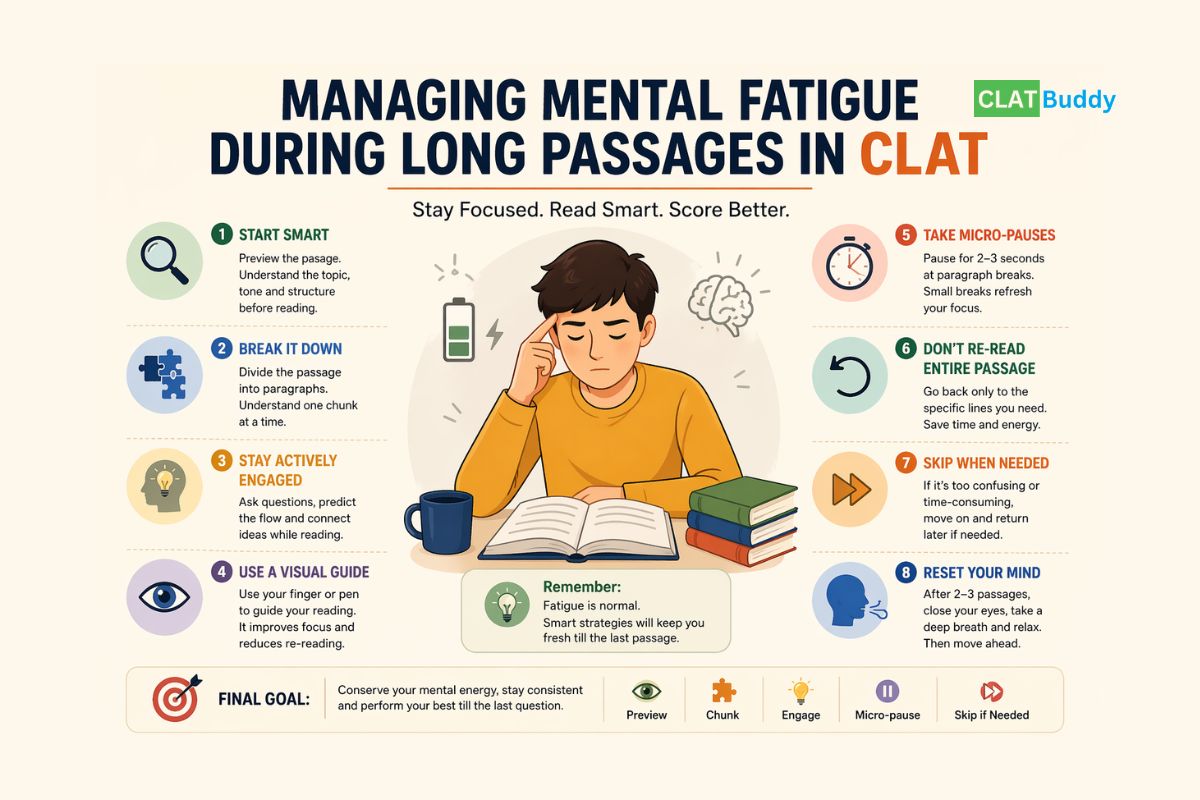
The way you start a passage determines how much energy you will spend on it. If you jump in without a strategy, you will tire faster.
Before reading the passage:
- Spend 10 to 15 seconds scanning the topic and tone
- Identify whether it is factual, argumentative, or analytical
- Set a simple goal such as understanding the author’s main argument
This small step prepares your brain and reduces unnecessary effort while reading.
What is the Best Way to Read Long Passages Without Getting Tired?
Most students try to read continuously until the passage ends. This leads to mental overload. Instead, break the reading process into manageable parts.
Use Chunking to Reduce Load
Divide the passage into paragraphs and treat each one as a separate unit. After reading each paragraph, pause briefly and ask yourself what it was about.
This helps in:
- Improving retention
- Reducing confusion
- Preventing information overload
Stay Actively Engaged While Reading
Passive reading is one of the biggest reasons for fatigue. If you just read without thinking, your brain loses focus quickly.
While reading, keep asking:
- What is the author trying to prove?
- Why is this paragraph included?
- What could come next?
This keeps your mind engaged and reduces the chances of drifting.
Should You Take Breaks While Solving Passages?
Yes, but they should be controlled and very short. Long breaks are not possible in CLAT, but micro pauses can make a big difference.
After every paragraph or after every one to two minutes:
- Pause for 2 to 3 seconds
- Relax your eyes briefly
- Take a quick breath
These micro breaks help your brain reset without affecting your time.
How Can You Avoid Re Reading the Entire Passage?
One of the biggest mistakes students make is re reading the full passage when they do not understand something. This wastes time and increases fatigue.
Instead:
- Go back only to the specific lines related to the question
- Use keywords in the question to locate the relevant part
- Focus only on that section
This targeted approach saves both time and mental energy.
When Should You Skip a Passage in CLAT?
Knowing when to skip is a crucial skill. Not every passage is worth your time, especially if it starts draining your energy early.
You should consider skipping when:
- You do not understand the passage even after one proper reading
- The language feels too technical or unfamiliar
- You feel mentally stuck after attempting one or two questions
Skipping is not a failure. It is a strategic decision to protect your overall score.
How Can You Reset Your Mind During the Exam?
Even with the best strategies, fatigue will build up. The key is to reset your mind at the right time.
After every two to three passages:
- Close your eyes for a few seconds
- Take a slow, deep breath
- Relax your shoulders
This quick reset improves concentration and helps you start fresh with the next passage.
How Should You Train Your Brain to Handle Fatigue?
Managing fatigue is not just an exam day skill. It must be trained during preparation.
Practice Full Length Mocks Regularly
Solving section wise questions is not enough. Full length mocks help your brain adapt to long periods of concentration.
Simulate Exam Conditions
While attempting mocks:
- Avoid distractions
- Follow strict time limits
- Sit for the entire duration without breaks
This builds endurance and prepares you for real exam pressure.
Gradually Increase Difficulty
Start with moderate passages and then move to more complex ones. This improves both reading ability and mental stamina.
What Daily Habits Help in Reducing Mental Fatigue?
Your preparation outside mocks also plays a role in how well you handle fatigue.
Focus on:
- Reading editorials and long articles daily
- Improving vocabulary to reduce effort in understanding
- Getting proper sleep before study sessions
- Staying hydrated during study and mocks
These small habits make a noticeable difference over time.
What is the Ideal Mindset for Handling Mental Fatigue in CLAT?
The biggest mistake is thinking that toppers do not feel tired. Everyone experiences fatigue. The difference lies in how they manage it.
Adopt this mindset:
- Fatigue is normal and expected
- It does not mean you are underprepared
- It can be controlled with strategy and practice
Instead of fighting fatigue, learn to work around it.
Conclusion
Managing mental fatigue during long passages in CLAT is not about pushing yourself harder. It is about using smarter strategies to conserve energy and maintain focus.
When you preview the passage, break it into chunks, stay actively engaged, take micro pauses, and know when to skip, you reduce unnecessary mental load. Over time, with consistent mock practice, your brain becomes more resilient.
CLAT is as much a test of endurance as it is of knowledge. If you can stay mentally fresh till the last passage, you will have a significant advantage over most aspirants.
Calling all law aspirants!
Are you exhausted from constantly searching for study materials and question banks? Worry not!
With over 15,000 students already engaged, you definitely don't want to be left out.
Become a member of the most vibrant law aspirants community out there!
It’s FREE! Hurry!
Join our WhatsApp Groups (Click Here) and Telegram Channel (Click Here) today, and receive instant notifications.