

Option Elimination Techniques for CLAT: How to Improve Accuracy and Score Higher
Preparing for CLAT is not just about knowing the right answer. It is about identifying the best answer under pressure. If you have been attempting mocks regularly, you would have noticed that many questions feel confusing even when you understand the passage. This is where option elimination becomes a game-changing skill.
In CLAT, you are rarely expected to find a perfect answer instantly. Instead, you are expected to think logically, reject incorrect options, and narrow down to the most accurate choice. Mastering option elimination can significantly improve your accuracy, reduce negative marking, and help you manage time better during the exam.
This guide explains practical, easy-to-apply techniques that can help you use option elimination effectively in CLAT 2027 and other law entrance exams.
What is Option Elimination in CLAT and Why is It Important?
Option elimination is a strategy where instead of searching for the correct answer directly, you begin by identifying and removing incorrect options. This approach simplifies decision-making and increases your chances of selecting the right answer even when you are unsure.
In CLAT, passages are lengthy and options are often closely worded. Many students lose marks not because they do not understand the passage, but because they get confused between similar options. Option elimination helps you deal with this confusion.
Why does this technique work so well?
- It reduces the number of choices you need to evaluate
- It prevents overthinking
- It improves accuracy even in difficult questions
- It saves time during the exam
If used consistently in mocks, option elimination can become an automatic habit that boosts your overall score.
Why Do CLAT Questions Feel Confusing?
Before learning elimination techniques, it is important to understand why options in CLAT are tricky.
CLAT examiners design questions in a way that tests your reading and reasoning skills, not just your knowledge. This means:
- Options are intentionally similar
- Some options are partially correct
- Some options are attractive but irrelevant
- Some options use extreme or misleading language
Understanding these patterns is the first step to eliminating them confidently.
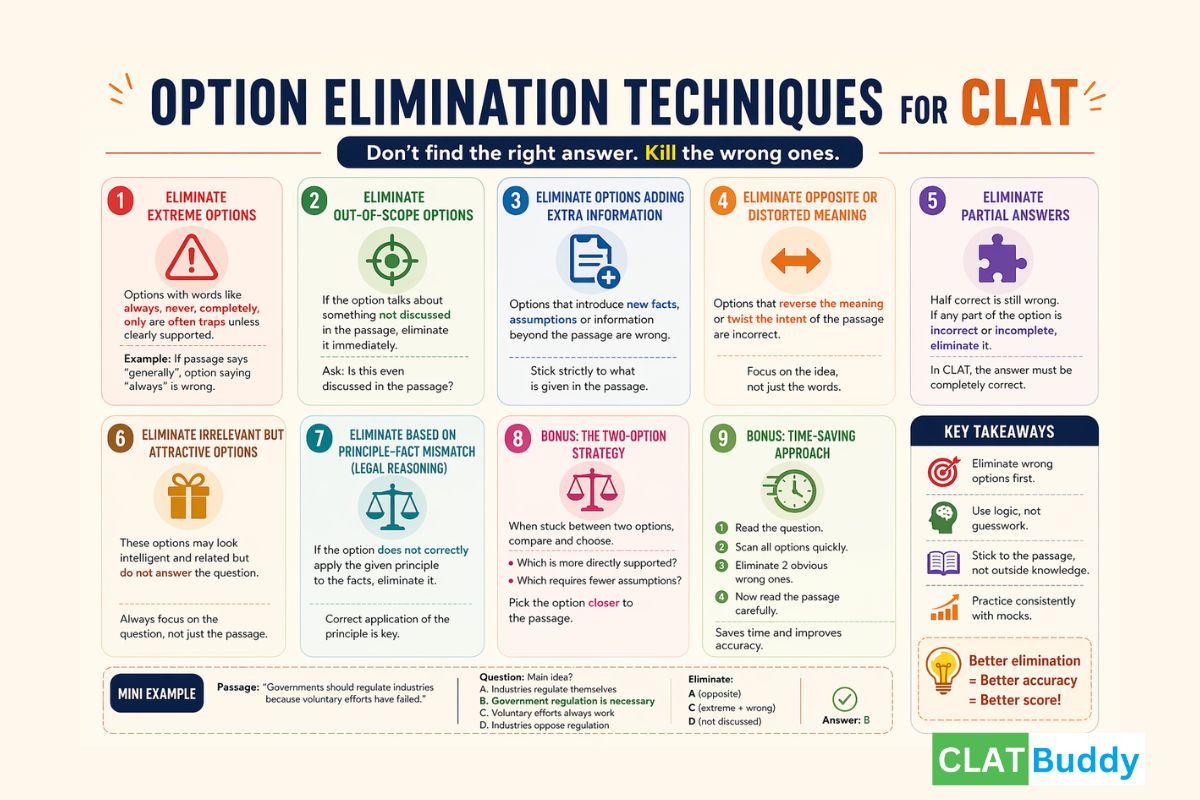
How Can You Eliminate Extreme Options in CLAT?
One of the easiest ways to eliminate options is by identifying extreme language.
Options that use words like always, never, completely, only, or entirely are often incorrect unless the passage clearly supports such strong claims.
Why are extreme options risky?
CLAT passages usually present balanced arguments. Extreme statements rarely match the tone of the passage.
Example approach
If the passage says “in most cases” and the option says “always,” the option becomes exaggerated and can be eliminated.
What should you look for?
- Absolute words without support
- Overgeneralised statements
- Strong claims not justified in the passage
How Do You Identify Out-of-Scope Options?
Out-of-scope options are those that introduce ideas not discussed in the passage.
These options may look intelligent or relevant, but if the passage does not mention them, they are incorrect.
How to eliminate them?
Ask yourself one simple question
Is this idea present in the passage?
If the answer is no, eliminate the option immediately.
Common signs of out-of-scope options
- Introduction of new topics
- Shifting focus away from the main idea
- Bringing external knowledge into the answer
Remember, CLAT does not test outside knowledge in comprehension-based questions. Staying within the passage is key.
What Are Options That Add Extra Information?
Some options go beyond the passage and include additional facts or assumptions. These are different from out-of-scope options because they may partly relate to the passage but still include extra content.
Why are they wrong?
Because CLAT answers must be strictly based on the passage. Any additional information makes the option unreliable.
How to deal with them?
- Compare each statement with the passage
- If even one part is not supported, eliminate the option
This is especially important in legal reasoning and logical reasoning sections.
How Can You Spot Opposite or Distorted Options?
Another common trap is options that reverse or distort the meaning of the passage.
These options may use similar words but change the intent completely.
Example
If the passage supports regulation, an option saying regulation is unnecessary is clearly opposite and can be eliminated.
What should you focus on?
- Check whether the option matches the tone of the passage
- Look for subtle changes in meaning
- Avoid assuming similarity based on keywords alone
Always focus on the idea, not just the words.
What Are Partial Correct Options and How Do You Handle Them?
Partial correct options are among the most confusing.
They contain some correct information but are incomplete or slightly inaccurate.
Why are they dangerous?
Because they seem correct at first glance and can mislead you into choosing them.
How to eliminate them?
- Break the option into parts
- Verify each part with the passage
- If any part is incorrect or missing, eliminate it
In CLAT, an answer must be completely correct, not partially correct.
How Do You Avoid Attractive but Irrelevant Options?
Some options are designed to look correct but do not actually answer the question.
These are called attractive distractors.
Why do students fall for them?
Because they relate to the passage and sound logical.
How to eliminate them?
Focus on the question, not just the passage.
Ask yourself
Does this option answer what the question is asking?
If not, eliminate it.
Example
If the question asks for the main idea, and the option gives a minor detail, it is irrelevant and should be eliminated.
How Does Option Elimination Help in Legal Reasoning?
Legal reasoning questions in CLAT follow a principle-fact format.
You are given a principle and a set of facts. Your task is to apply the principle correctly.
How can elimination help here?
- Eliminate options that do not apply the principle
- Eliminate options that ignore key elements of the principle
- Eliminate options that add assumptions not given in the question
Key tip
Always stick to the given principle, even if it seems unrealistic. Do not apply real-world logic unless the question allows it.
What Is the Two-Option Strategy in CLAT?
Sometimes, even after elimination, you are left with two options. This is where most students get confused.
How to choose between two options?
Ask yourself the following:
- Which option is more directly supported by the passage?
- Which option requires fewer assumptions?
- Which option matches the tone and intent better?
The option that is closer to the passage and requires less interpretation is usually correct.
How Should You Use Option Elimination During Mocks?
Learning techniques is not enough. You need to practice them in real exam conditions.
Step-by-step approach
- Read the question first
- Quickly scan all options
- Eliminate obvious wrong ones
- Read the passage carefully
- Compare remaining options
Why does this method work?
Because it gives you a clear direction while reading the passage. You are not reading blindly. You are reading with a purpose.
What Are Common Mistakes Students Make in Option Elimination?
Even after learning the technique, mistakes can happen.
Avoid these errors
- Trying to find a perfect answer instead of eliminating wrong ones
- Using outside knowledge
- Ignoring keywords in the question
- Changing answers unnecessarily after elimination
- Spending too much time on one question
Consistency and discipline are important while applying this strategy.
How Can You Practice Option Elimination Effectively?
Practice is the only way to master this skill.
What should your practice include?
- Daily CLAT mock tests
- Sectional tests for legal and logical reasoning
- Analysis of wrong answers
- Identifying why an option was wrong
Smart practice tip
After every mock, review at least 10 questions where you were confused. Try to eliminate options again and understand your mistakes.
Final Thoughts: Why Option Elimination Can Change Your CLAT Score
Option elimination is not just a technique. It is a mindset.
Instead of chasing the right answer, you train yourself to reject the wrong ones. This shift in thinking can significantly improve your performance in CLAT.
If used correctly, this strategy can:
- Increase accuracy
- Reduce negative marking
- Improve time management
- Build confidence during the exam
Start applying these techniques in your next mock test. With consistent practice, option elimination will become a natural part of your problem-solving process.
Calling all law aspirants!
Are you exhausted from constantly searching for study materials and question banks? Worry not!
With over 15,000 students already engaged, you definitely don't want to be left out.
Become a member of the most vibrant law aspirants community out there!
It’s FREE! Hurry!
Join our WhatsApp Groups (Click Here) and Telegram Channel (Click Here) today, and receive instant notifications.