

Weekly Revision Frameworks for CLAT That Actually Help You Improve
Preparing for CLAT is not only about studying new topics every day. The real challenge is remembering what you studied last week, last month, or even three months ago. Many students work hard but still struggle in mocks because their revision process is random.
If you often feel like:
- “I studied this already, but I forgot it”
- “My mock scores are fluctuating”
- “I don’t know what to revise daily”
- “Current affairs are piling up”
then the problem is probably not effort. It is your revision system.
A proper weekly revision framework can completely change your CLAT preparation. It helps you stay organised, reduces stress, improves retention, and makes your preparation feel more controlled.
In this article, you will learn practical weekly revision frameworks for CLAT that actually work for law aspirants preparing for CLAT, AILET, SLAT, and other law entrance exams.
Why Is Weekly Revision So Important for CLAT Preparation?
CLAT is a retention-based exam. You are expected to remember legal principles, current affairs, vocabulary, logical patterns, and quantitative techniques over a long period of time.
If revision is weak, even good preparation starts fading.
Weekly revision helps you:
- Strengthen memory
- Improve accuracy in mocks
- Reduce silly mistakes
- Identify weak areas early
- Build confidence gradually
- Avoid last-minute panic
The students who improve consistently are usually not the ones studying for 12 hours daily. They are the ones revising consistently every week.
What Makes a Good Weekly Revision Framework?
Before choosing a revision system, you should understand what makes revision effective.
A good CLAT revision framework should:
- Be realistic and sustainable
- Include all subjects regularly
- Have space for mock analysis
- Focus on weak areas
- Include active recall
- Prevent burnout
Your revision plan should support your preparation, not exhaust you.
How Can You Structure Your Week for CLAT Revision?
The biggest mistake students make is revising randomly. A structured weekly plan helps your brain build routine and consistency.
Here are some practical revision frameworks you can follow.
What Is the 5-1-1 Weekly Revision Method?
This is one of the easiest and most effective systems for CLAT aspirants, especially if you are balancing school or coaching.
5 Days for Learning and Practice
From Monday to Friday, focus on:
- Learning new concepts
- Reading editorials
- Practising passages
- Daily current affairs
- Sectional exercises
You do not need heavy revision on these days. Just spend 20 to 30 minutes revising older concepts daily.
1 Day for Revision
Use Saturday for:
- Revising weekly notes
- Revising legal principles
- Revising current affairs
- Solving weak topic questions
- Updating your error notebook
1 Day for Mock and Analysis
Use Sunday for:
- Attempting one full CLAT mock
- Analysing every mistake
- Tracking accuracy
- Reviewing time management
This system works because revision becomes part of your weekly routine instead of a postponed task.
Why Should You Use Subject Rotation for Weekly Revision?
Sometimes students revise only their favourite subjects and ignore weaker sections. Subject rotation prevents that problem.
What Does a Subject Rotation Plan Look Like?
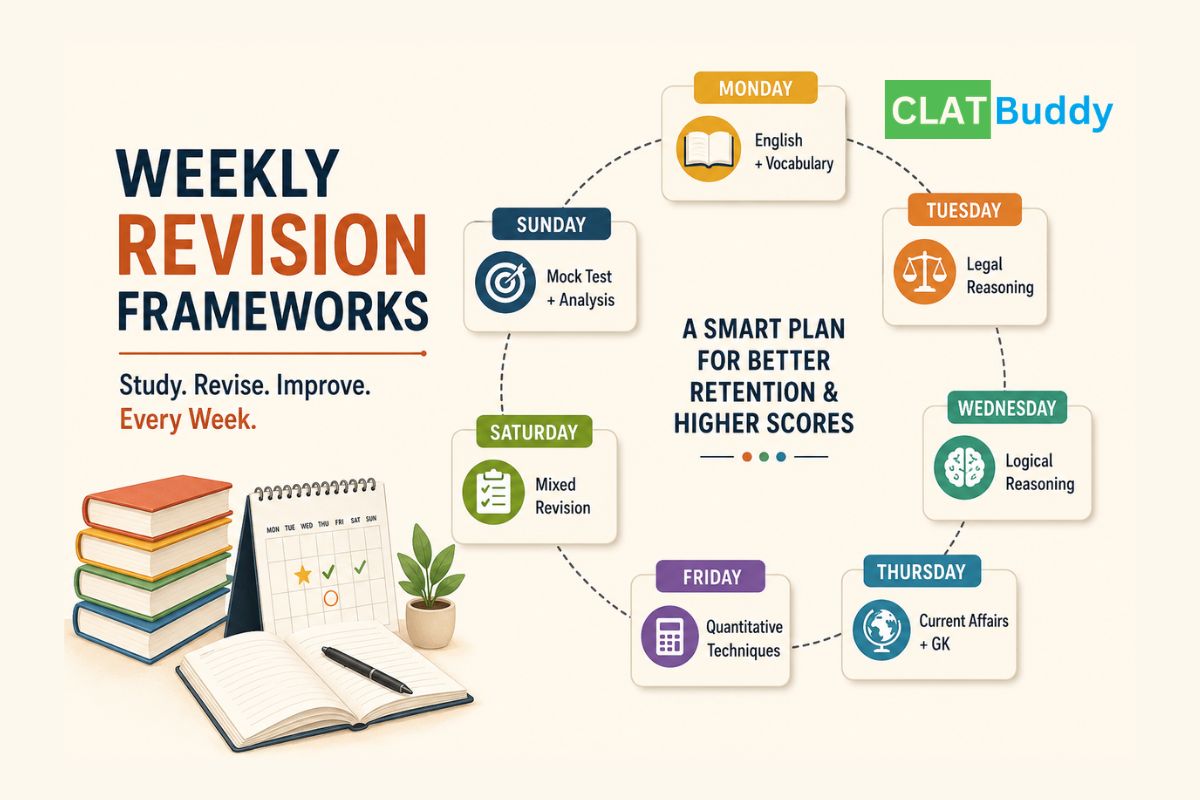
| Day | Revision Focus |
| Monday | English Language |
| Tuesday | Legal Reasoning |
| Wednesday | Logical Reasoning |
| Thursday | Current Affairs and GK |
| Friday | Quantitative Techniques |
| Saturday | Mixed Revision |
| Sunday | Mock Test and Analysis |
This system gives every subject regular attention.
How Does Subject Rotation Help?
It helps you:
- Avoid neglecting weak sections
- Build consistency
- Reduce boredom
- Divide workload properly
- Improve long-term retention
This framework is especially useful for students who feel overwhelmed by the CLAT syllabus.
How Should You Revise Current Affairs Every Week?
Current affairs is one of the most difficult sections to manage because it keeps increasing every day.
If you do not revise regularly, you will keep forgetting older news.
What Is the Best Weekly Current Affairs Revision Method?
Daily Revision
Spend 20 to 30 minutes revising:
- Important news
- Supreme Court judgments
- International events
- Government schemes
- Important appointments
Weekly Revision
At the end of the week:
- Revise all weekly current affairs
- Solve weekly quizzes
- Highlight important facts
- Revise important static GK connected to news
Monthly Revision
At the end of every month:
- Revise monthly compilations
- Solve GK mock tests
- Create short summary notes
This layered revision method improves retention significantly.
How Can Mock Analysis Become Your Weekly Revision Tool?
Many students attempt mocks regularly but do not analyse them properly.
Mock analysis is one of the strongest forms of revision because it directly shows your mistakes.
What Should You Analyse After Every Mock?
Divide mistakes into categories:
- Conceptual mistakes
- Silly mistakes
- Guesswork errors
- Time management issues
- Reading mistakes
How Should You Use Mock Analysis in Weekly Revision?
If your mock shows weakness in:
- Legal application questions, revise legal passages
- Reading comprehension, practise inference questions
- GK retention, increase weekly CA revision
- Quant speed, practise timed DI sets
Your next week’s revision should depend on your previous mock performance.
That is how serious CLAT aspirants improve consistently.
Why Is Active Recall Better Than Passive Revision?
Most students revise by rereading notes repeatedly. That feels productive, but retention remains weak.
Active recall forces your brain to retrieve information instead of just recognising it.
How Can You Use Active Recall for CLAT?
For Current Affairs
Close your notes and try writing:
- Important events
- Important judgments
- Key personalities
- Reports and organisations
Then compare with actual notes.
For Legal Reasoning
After reading a principle:
- Create your own factual situation
- Apply the principle yourself
- Predict the answer before checking explanations
For English and Logical Reasoning
- Explain arguments aloud
- Predict conclusions
- Identify assumptions without help
For Quantitative Techniques
- Solve calculations mentally
- Recall formulas without notes
- Practise quick approximations
Active recall improves memory much faster than passive reading.
Should You Maintain an Error Notebook for Revision?
Yes. An error notebook is one of the most underrated tools in CLAT preparation.
What Should You Write in an Error Notebook?
You should include:
- Mock mistakes
- Frequently forgotten concepts
- Vocabulary errors
- Logical reasoning traps
- Quant shortcuts
- Time management observations
How Often Should You Revise It?
Revise your error notebook:
- Before every mock
- During weekly revision sessions
- During monthly revision
This helps you avoid repeating the same mistakes again and again.
How Can You Avoid Burnout During Weekly Revision?
Many students create unrealistic revision plans and quit within a few days.
Your revision framework should be sustainable.
What Can Help You Stay Consistent?
Keep Revision Sessions Short
Instead of revising for 5 continuous hours:
- Use smaller focused sessions
- Take proper breaks
- Avoid multitasking
Keep One Flexible Day
Sometimes school work, coaching, or family events disturb your schedule.
Keep some flexibility instead of expecting perfection every week.
Focus on Progress, Not Perfection
Some weeks will be more productive than others. That is normal.
Consistency over months matters more than one perfect week.
How Many Hours Should You Spend on Weekly Revision?
There is no fixed number for everyone.
But generally:
- Daily revision can take 30 to 45 minutes
- Weekly revision sessions can take 3 to 4 hours
- Mock analysis may take 2 to 3 hours
The quality of revision matters much more than the number of hours.
Which Weekly Revision Framework Is Best for You?
Different students need different systems.
If You Are a Beginner
Use:
- 5-1-1 revision framework
- Subject rotation plan
If You Are Taking Regular Mocks
Use:
- Mock-based revision
- Error notebook system
If You Forget Current Affairs Quickly
Use:
- Layered current affairs revision
- Active recall techniques
If You Feel Overwhelmed
Use:
- Short daily revision sessions
- Weekly reset planning
You can also combine different frameworks and customise them according to your schedule.
Final Thoughts
CLAT preparation becomes stressful when revision is unplanned.
A good weekly revision framework gives your preparation direction. Instead of constantly worrying about what to study next, you already know:
- What to revise
- When to revise
- How to track improvement
That clarity reduces anxiety and improves consistency.
Remember this clearly. In CLAT, revision is not separate from preparation. Revision is preparation.
The students who revise smartly every week usually perform better than students who keep studying new things without strengthening older concepts.
Calling all law aspirants!
Are you exhausted from constantly searching for study materials and question banks? Worry not!
With over 15,000 students already engaged, you definitely don't want to be left out.
Become a member of the most vibrant law aspirants community out there!
It’s FREE! Hurry!
Join our WhatsApp Groups (Click Here) and Telegram Channel (Click Here) today, and receive instant notifications.