
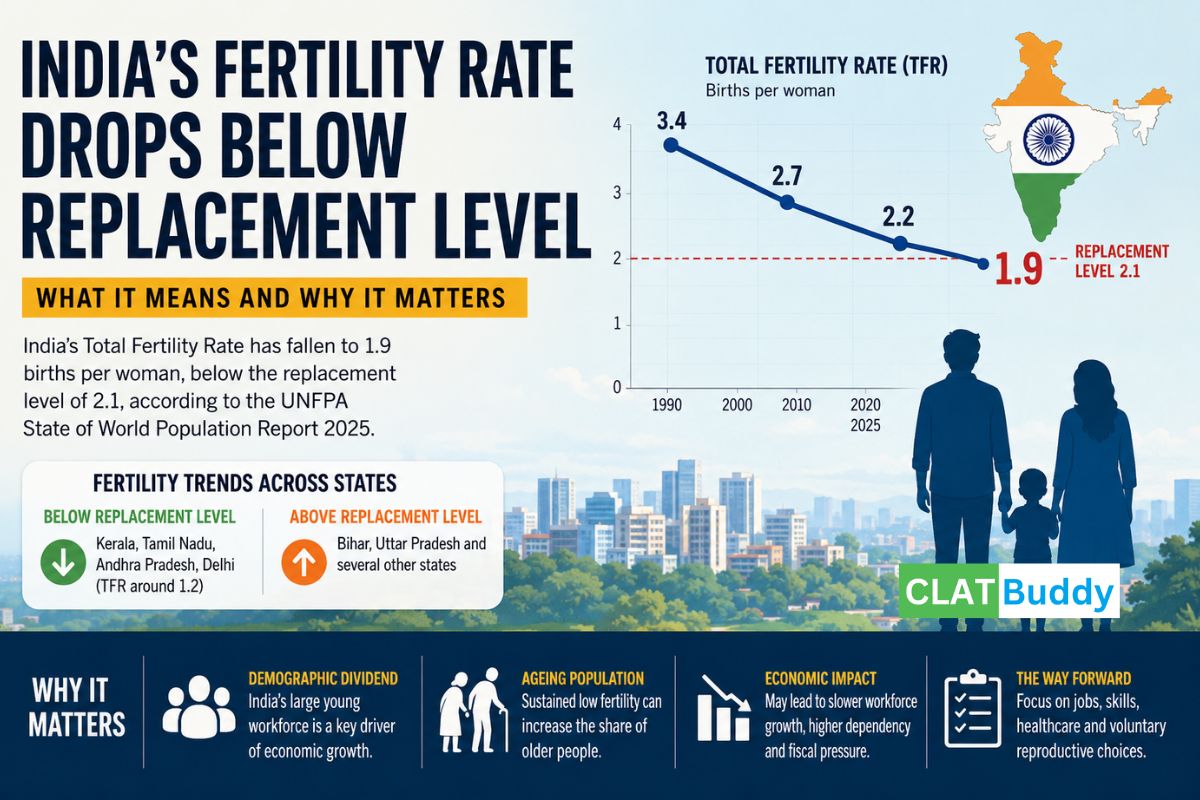
India’s total fertility rate (TFR) has fallen to 1.9 births per woman, below the replacement level of 2.1, according to the United Nations Population Fund (UNFPA) State of World Population Report 2025. This development has sparked discussions about India’s demographic future, workforce strength and long-term economic growth.
What Is Total Fertility Rate?
Total Fertility Rate (TFR) refers to the average number of children a woman is expected to have during her reproductive years.
Replacement Level Fertility
A fertility rate of 2.1 births per woman is generally considered the replacement level. It ensures that a population can replace itself from one generation to the next without significant growth or decline.
Why Has India’s Fertility Rate Declined?
Several factors have contributed to the decline in fertility rates:
- Increased access to education, particularly for women.
- Better healthcare and lower infant mortality rates.
- Greater urbanisation and changing lifestyles.
- Increased participation of women in the workforce.
- Improved access to family planning and contraception.
- Rising costs associated with raising and educating children.
Uneven Fertility Trends Across India
Fertility rates vary significantly among states:
Done Reading? Now Put It into Practice.
Continue your CLAT preparation with practice questions, question banks and exam-focused learning resources.
Explore Practice Resources →- Higher Fertility States: Bihar and Uttar Pradesh continue to record fertility rates above the national average.
- Lower Fertility States: Kerala, Tamil Nadu, Andhra Pradesh and Delhi have remained below replacement level for several years.
- Delhi’s TFR: Estimated to be around 1.2, among the lowest in the country.
Does This Mean India’s Population Will Start Falling?
Not immediately.
India’s population is expected to continue growing for several decades because of population momentum. A large proportion of the population is still young and entering reproductive age.
According to demographic projections:
- India’s population is currently around 1.46 billion.
- It may continue to increase before stabilising.
- Population decline, if it occurs, is expected only in the long term.
Why Is This Important for the Economy?
India currently enjoys a demographic dividend, which refers to a large working-age population supporting economic growth.
A sustained decline in fertility may eventually result in:
- A smaller workforce.
- Slower labour-force growth.
- Increased dependency on working-age individuals.
- Higher pension and social security burdens.
- Rising healthcare expenditure for elderly citizens.
What Challenges Could India Face in the Future?
If fertility rates remain low for a prolonged period, India may face:
- Population ageing.
- Labour shortages in certain sectors.
- Increased demand for elderly care services.
- Greater fiscal pressure on welfare programmes.
- Slower economic expansion.
Many developed countries, including Japan and South Korea, are currently facing similar demographic challenges.
Key Takeaway
India’s fertility rate falling below replacement level marks an important stage in the country’s demographic transition. While it reflects progress in education, healthcare and family planning, it also highlights the need for long-term planning. The focus for policymakers will be on maximising the benefits of India’s demographic dividend today while preparing for the economic and social challenges of an ageing population in the future.
Calling all law aspirants!
Are you exhausted from constantly searching for study materials and question banks? Worry not!
With over 15,000 students already engaged, you definitely don't want to be left out.
Become a member of the most vibrant law aspirants community out there!
It’s FREE! Hurry!
Join our WhatsApp Groups (Click Here) and Telegram Channel (Click Here) today, and receive instant notifications.
Need More Than Just Written Content?
Explore recorded lessons, structured learning resources and practice material to strengthen your CLAT preparation.
Explore Learning Resources →