

Applying Principles Without Personal Opinions in CLAT Legal Reasoning

In CLAT Legal Reasoning, your answer should not depend on what you personally feel is right or wrong. This section tests whether you can read a legal principle, understand the facts and reach a logical conclusion. The official CLAT UG syllabus says that legal reasoning passages are around 450 words and may involve legal matters, public policy questions or moral philosophical enquiries, but prior legal knowledge is not required. The focus is on applying the given principles to the facts.
This means your personal morality, emotions and outside knowledge should stay outside the question. If the principle says a person is liable, then the person is liable, even if you feel sympathy for that person. If the principle says a contract is invalid, then it is invalid, even if the arrangement looks fair in real life.
What Does Applying A Principle Actually Mean?
Applying a principle means checking whether the facts satisfy the conditions given in the rule. You are not creating a new rule. You are not improving the rule. You are simply using the rule exactly as it is given.
For example:
Principle: A person who intentionally damages another person’s property is liable to pay compensation.
Facts: Rohan gets angry and breaks his neighbour’s window.
Now, do not think, “Maybe the neighbour provoked him” or “Rohan should be forgiven because he was angry.” Instead, ask:
- Did Rohan damage property?
- Was it someone else’s property?
- Was the damage intentional?
If the answer is yes, the principle applies. So, Rohan is liable.
This is the basic method behind principle and fact questions in CLAT legal reasoning.
Why Do Students Bring Personal Opinions Into Legal Reasoning?
Many students make this mistake because CLAT passages often feel like real-life situations. The facts may involve a poor person, a careless company, an emotional family dispute, a student, a victim or a public issue. Naturally, your mind may start judging who deserves sympathy.
But CLAT is not asking you to become a judge based on emotions. It is asking you to behave like a logical reader.
Personal opinions usually enter when:
- You feel one party is morally right.
- You already know something about the law.
- You think the given principle is unfair.
- You assume extra facts that are not written.
- You choose the option that “sounds good” instead of the option that follows the principle.
This is dangerous because CLAT options are often designed to trap students who answer emotionally.
How Is Legal Reasoning Different From Moral Reasoning?
Legal reasoning and moral reasoning may look similar, but they are not the same in CLAT.
Moral reasoning asks, “What is the fair thing to do?” Legal reasoning asks, “What result follows from the given principle?”
For example:
Principle: A minor cannot enter into a valid contract.
Facts: A 17-year-old student signs an agreement to buy a laptop and understands all the terms clearly.
Morally, you may think the agreement should be valid because the student understood everything. But legally, according to the given principle, the student is a minor. So, the contract is not valid.
That is why you must train your mind to separate feelings from legal application.
How Should You Read The Principle In A CLAT Question?
The principle is the heart of the question. If you misunderstand the principle, you will almost always pick the wrong answer.
Read the principle slowly and identify its conditions. Many legal principles have two or three parts. Your job is to break them into smaller checks.
For example:
Principle: A person is liable for negligence if they owe a duty of care, breach that duty and cause damage to another person.
This principle has three conditions:
- There must be a duty of care.
- There must be a breach of that duty.
- There must be damage caused because of the breach.
If even one condition is missing, the answer may change. Do not jump to the conclusion just because one part is satisfied.
How Can You Use The PFC Method In Legal Reasoning?
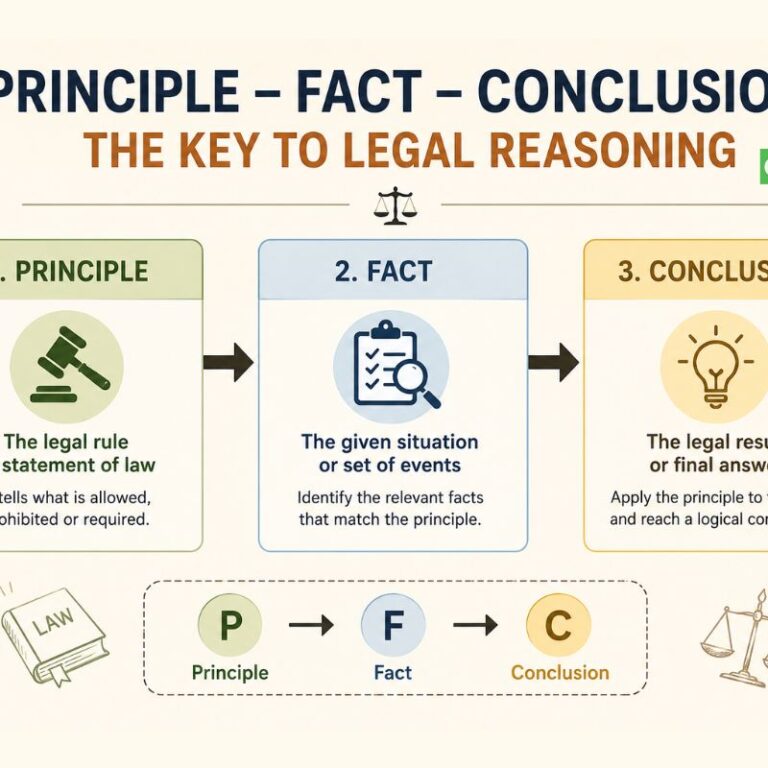
The PFC method is one of the simplest ways to solve CLAT legal reasoning questions.
P stands for Principle.
F stands for Facts.
C stands for Conclusion.
First, read the principle and underline the conditions. Then, read the facts and match them with those conditions. Finally, reach the conclusion that logically follows.
For example:
Principle: A person is guilty of theft if they dishonestly take movable property out of another person’s possession without consent.
Facts: A takes B’s phone from B’s bag without asking and sells it.
Now apply PFC:
Principle: Dishonest taking of movable property from another’s possession without consent is theft.
Facts: A took B’s phone without consent and sold it.
Conclusion: A is guilty of theft.
This method prevents emotional thinking because your answer is based only on rule plus facts.
What Are Common Personal Opinion Traps In CLAT Legal Reasoning?
CLAT options are often written in a way that sounds convincing. Many wrong options are not completely foolish. They may sound morally correct, socially fair or practically reasonable. That is what makes them dangerous.
Some common traps are:
Sympathy Trap: Choosing an option because one party looks helpless or innocent.
Fairness Trap: Choosing what seems fair instead of what the principle says.
Outside Knowledge Trap: Applying what you learned from YouTube, coaching notes or school discussions, even when the passage gives a different principle.
Assumption Trap: Adding facts that are not mentioned in the question.
Extreme Option Trap: Choosing words like “always”, “never” or “completely” without checking whether the principle supports such a strong conclusion.
When you spot these traps, pause and return to the principle.
Should You Use Outside Legal Knowledge In CLAT Legal Reasoning?
Usually, no. CLAT legal reasoning does not require prior legal knowledge. The official syllabus also makes it clear that prior knowledge of law is not needed, though general awareness of legal and moral issues may help in understanding the passage better.
This means your knowledge can help you read faster, but it should not override the given principle.
Suppose the actual law says something different, but the passage gives a simplified principle. In that question, you must follow the passage. CLAT is testing application, not your memory of actual law.
A simple rule is this: use outside knowledge only to understand the context, not to decide the answer.
How Can You Eliminate Options Without Using Personal Opinion?
Option elimination is very useful in CLAT legal reasoning, but it must be done logically.
Start by removing options that:
- Go beyond the principle.
- Ignore an important condition.
- Add facts that are not given.
- Give a conclusion based on sympathy.
- Use outside legal knowledge.
- Contradict the facts in the passage.
After eliminating these, compare the remaining options with the exact wording of the principle. The best answer is usually the one that applies all conditions of the rule without adding anything extra.
Do not choose the most dramatic option. Choose the most legally consistent option.
How Can You Train Yourself To Think Objectively?
Objective thinking is a habit. You will not build it in one day, but you can improve it with regular practice.
After every legal reasoning practice set, review your wrong answers and ask:
- Did I miss a keyword in the principle?
- Did I assume an extra fact?
- Did I choose based on fairness?
- Did I ignore one condition of the rule?
- Did I apply outside knowledge?
- Did I get confused between similar options?
This kind of review is more valuable than simply solving 100 questions. CLAT preparation is not only about practice. It is about correcting the way you think while practising.
What Is A Good Example Of Principle-Based Thinking?
Let us take one more example.
Principle: A person is liable for defamation if they publish a false statement about another person that harms that person’s reputation.
Facts: Meera tells her classmates that Ananya cheated in an exam. This statement is false and Ananya’s reputation suffers.
Now check the conditions:
- Was there a statement about another person? Yes.
- Was it published or communicated to others? Yes, classmates heard it.
- Was it false? Yes.
- Did it harm reputation? Yes.
So, Meera is liable for defamation.
Do not think, “Maybe Meera heard it from someone else” unless the facts say so. Do not think, “Ananya must prove more damage” unless the principle says so. Stay within the question.
How Should You Handle Ambiguous Legal Principles?
Sometimes, CLAT gives a principle that is not very direct. It may include words like reasonable, good faith, public interest, intention, consent or negligence. These words require careful reading.
In such cases, do not panic. Ask what the passage means by that word. Many times, the passage itself gives clues. If the principle talks about “reasonable care”, look at the facts and ask whether the person acted like an ordinary careful person in that situation.
When the principle is ambiguous, your job is not to create your own definition. Your job is to choose the option that is most consistent with the passage.
How Can You Avoid Emotional Answers During The Exam?
During the exam, time pressure makes students careless. To avoid emotional answers, use a small mental checklist before marking the option:
- What is the exact principle?
- What are the required conditions?
- Which facts match those conditions?
- Am I adding any fact from my side?
- Am I choosing this because it feels fair or because it follows the rule?
This checklist may take only a few seconds, but it can save you from many wrong answers.
Why Is This Skill Important Beyond CLAT?
Learning to apply principles without personal opinions will not only help you in CLAT. It will also help you later in law school. Law students are expected to read rules, cases and facts carefully. Lawyers also need to separate emotions from legal arguments.
Of course, justice and fairness matter in law. But in legal reasoning questions, the first step is always disciplined application of the rule. Once you learn this, you become sharper not only as a CLAT aspirant but also as a future law student.
What Should You Remember While Solving CLAT Legal Reasoning Questions?
The golden rule is simple: do not ask, “What do I think is right?” Ask, “What does the principle say?”
Your answer must come from the passage, the principle and the facts. Not from sympathy. Not from anger. Not from personal morality. Not from outside law.
If you can train yourself to follow this approach, your accuracy in CLAT legal reasoning will improve. You will also start seeing patterns in questions more clearly. Legal reasoning becomes much easier when you stop debating with the question and start applying the rule given in it.
For CLAT and other law entrance exams, this is one of the most important habits you can build early. Read the principle. Match the facts. Eliminate emotional options. Mark the conclusion that follows logically.
Calling all law aspirants!
Are you exhausted from constantly searching for study materials and question banks? Worry not!
With over 15,000 students already engaged, you definitely don't want to be left out.
Become a member of the most vibrant law aspirants community out there!
It’s FREE! Hurry!
Join our WhatsApp Groups (Click Here) and Telegram Channel (Click Here) today, and receive instant notifications.