

Principle–Fact–Conclusion: Structure Explained In Legal Reasoning
Legal Reasoning in CLAT is not about knowing hundreds of laws. It is about reading a legal principle, connecting it with the facts given in the question and choosing the most logical conclusion. This is called the Principle–Fact–Conclusion structure. Once you understand this method, legal reasoning questions become easier, clearer and less confusing.
What Is The Principle–Fact–Conclusion Structure In CLAT Legal Reasoning?
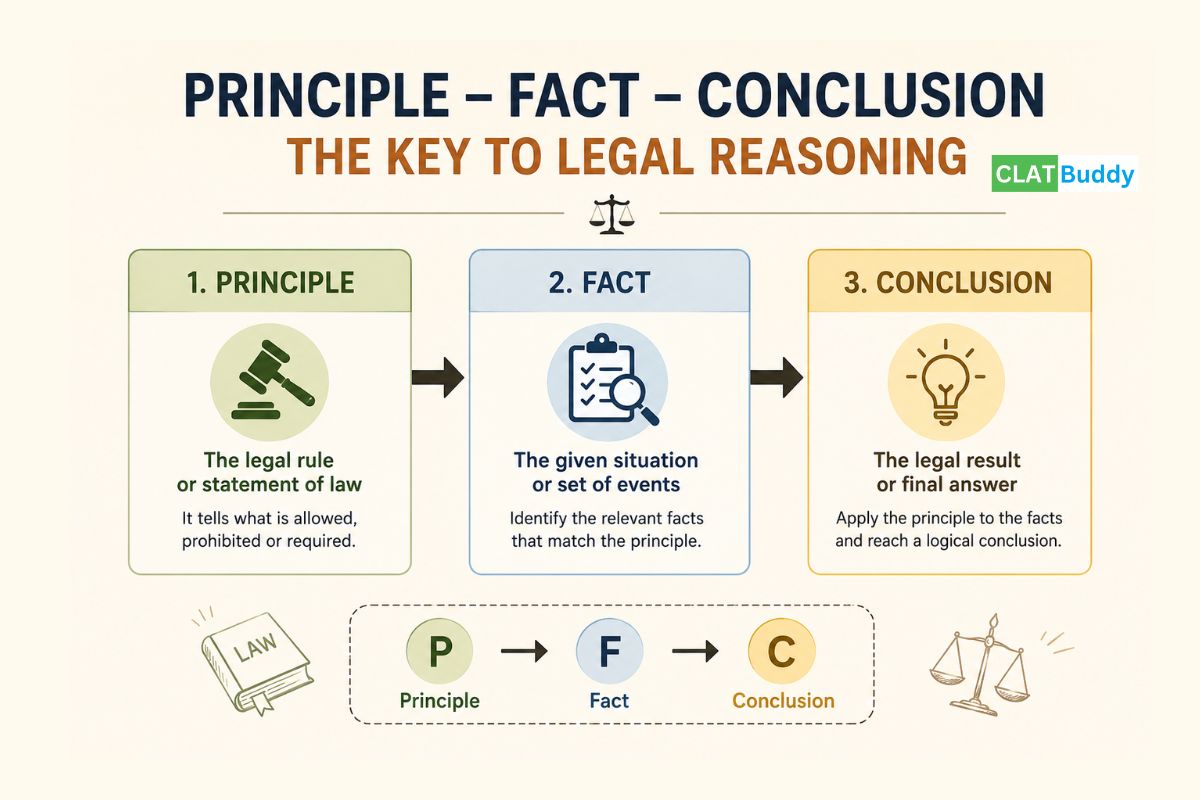
The Principle–Fact–Conclusion structure is a simple way to solve legal reasoning questions. It has three parts.
The principle is the legal rule given in the question or passage. The facts are the situation or story given after the principle. The conclusion is the final answer you reach after applying the principle to the facts.
In CLAT Legal Reasoning, your job is not to decide what feels morally correct. Your job is to check whether the facts satisfy the legal principle given in the question.
For example, if the principle says that a person is liable only when there is intention, then you must look for intention in the facts. If intention is missing, the person may not be liable, even if the result looks unfair.
Why Is This Structure Important For CLAT Aspirants?
This structure is important because CLAT tests your ability to apply law-like rules to real situations. Many students lose marks because they read the facts emotionally and select the option that sounds fair. But legal reasoning is not based on emotion.
When you follow the Principle–Fact–Conclusion method, you become more accurate because you move step by step.
You first understand the rule. Then you identify the relevant facts. After that, you reach the conclusion. This saves time and reduces confusion.
It also helps you avoid common traps such as:
- Using outside legal knowledge
- Making assumptions not given in the passage
- Ignoring words like “intentionally”, “negligently”, “knowingly” and “without consent”
- Choosing an answer because it sounds morally right
- Getting confused between two close options
How Do You Identify The Principle In A Legal Reasoning Question?
The principle is the rule that tells you when a legal result will follow. It may be written in one sentence or explained in a paragraph.
When you read the principle, do not read it like a normal sentence. Break it into conditions.
For example:
“A person is liable for negligence if he fails to take reasonable care and causes harm to another person.”
This principle has three parts:
- A person must have failed to take reasonable care
- Harm must have been caused
- The harm must be connected to the careless act
If all three parts are present in the facts, liability may arise. If one part is missing, the conclusion may change.
This is why slow reading of the principle is more important than fast reading of the facts. Many students read the facts carefully but ignore the exact wording of the principle. That is a mistake.
How Should You Read The Facts In CLAT Legal Reasoning?
The facts are the story given in the question. They may involve people, actions, promises, injuries, property, contracts, crimes or disputes.
Your task is to separate important facts from extra details. CLAT often gives unnecessary information to distract you. You should focus only on facts that are connected to the principle.
Suppose the principle is about theft. The relevant facts may include:
- Whether the property belonged to someone else
- Whether it was taken without consent
- Whether there was dishonest intention
- Whether the property was movable
But facts like the person’s age, profession or friendship with the owner may not matter unless the principle makes them relevant.
A good habit is to ask: “Which facts help me prove or disprove the principle?”
How Do You Reach The Correct Conclusion?
The conclusion is the answer you choose after applying the principle to the facts. It should not be based on guesswork.
Use this simple formula:
Principle says this. Facts show this. Therefore, the result is this.
For example:
Principle: A person who intentionally causes bodily harm to another is liable.
Facts: A pushes B during a fight with the intention of hurting him. B falls and suffers an injury.
Conclusion: A is liable because he intentionally caused bodily harm to B.
Now change the facts slightly.
Facts: A accidentally slips on a wet floor and falls on B. B suffers an injury.
Conclusion: A may not be liable under this principle because intention is missing.
This is how one word in the facts can completely change the answer.
What Is A Simple Example Of Principle–Fact–Conclusion In Legal Reasoning?
Let us take a CLAT-style example.
Principle: A person commits trespass when he enters another person’s land without permission.
Facts: Rohan enters Meera’s garden without asking her permission to collect a cricket ball.
Now apply the PFC method.
Principle: Entry into another person’s land without permission is trespass.
Facts: Rohan entered Meera’s garden. The garden belongs to Meera. Rohan did not take permission.
Conclusion: Rohan committed trespass.
Now see another version.
Facts: Meera allowed Rohan to enter the garden and collect the cricket ball.
Conclusion: Rohan did not commit trespass because permission was given.
The legal result changes because the fact of permission changes.
How Can You Break A Principle Into Elements?
This is one of the most useful legal reasoning skills. Whenever you see a principle, divide it into small parts.
Example:
“A contract is valid when both parties give free consent for a lawful object.”
Elements:
- There must be a contract
- Both parties must give consent
- Consent must be free
- The object must be lawful
Now, check the facts against each element.
If the facts show that one party was forced to agree, then free consent is missing. So the contract may not be valid.
This method helps you avoid confusion when the question looks lengthy. You do not need to understand every legal term deeply. You only need to match the facts with the elements of the principle.
Why Should You Avoid Personal Opinions In CLAT Legal Reasoning?
Many CLAT aspirants make this mistake. They think, “This person should be punished” or “This result feels unfair.” But CLAT Legal Reasoning does not test your personal opinion.
The correct answer depends only on the given principle and facts.
For example, the facts may describe someone behaving badly. But if the principle requires intention and intention is absent, you cannot select an option that imposes liability only because the conduct looks wrong.
Similarly, if your coaching notes say something different from the principle in the question, follow the principle given in the question. In legal reasoning, the given principle is your final rule for that question.
What Are The Common Traps In Principle–Fact–Conclusion Questions?
CLAT options are designed to test careful reading. Sometimes two options may look correct, but only one will match the principle completely.
Common traps include:
- One option applies the principle only partly
- One option adds a fact that is not given
- One option uses moral reasoning instead of legal reasoning
- One option ignores an important condition
- One option gives the correct result but wrong reason
Always remember that the best answer must have both the correct conclusion and the correct reasoning.
For example, if the answer says “A is liable because he is a bad person,” it is not a proper legal conclusion. The correct answer should say “A is liable because he intentionally caused harm,” if intention is required by the principle.
How Can You Use PFC To Eliminate Wrong Options?
The PFC method is also useful for option elimination.
First, remove options that directly go against the principle. Then remove options that depend on facts not mentioned in the question. After that, compare the remaining options and choose the one that applies the principle most accurately.
Ask these questions while eliminating options:
- Does this option follow the given principle?
- Is this option adding extra information?
- Is this option ignoring any condition?
- Is the reasoning legally connected to the facts?
- Is the conclusion too broad or too emotional?
This method is very helpful when you are stuck between two options.
How Should You Practise PFC For CLAT Legal Reasoning?
You can improve this skill only through regular practice. But practice should not mean solving questions randomly. You should review every question using the PFC method.
After every legal reasoning question, write or think:
- What was the principle?
- What were the important facts?
- Which fact matched which part of the principle?
- Why was the correct option correct?
- Why were the other options wrong?
This review will train your mind to think like the exam expects.
You can also practise by underlining keywords in the principle. Words like “only if”, “unless”, “intentionally”, “reasonably”, “without consent”, “dishonestly”, “good faith” and “negligently” are very important.
What Should You Do When The Principle Looks Confusing?
Sometimes, the principle may look long or difficult. Do not panic. CLAT does not expect you to be a lawyer. It expects you to read carefully.
When the principle looks confusing, do this:
- Read it once for general meaning
- Read it again slowly
- Break it into conditions
- Identify the result or consequence
- Then move to the facts
Do not jump to the facts before understanding the principle. If you do not understand the rule, you will not apply it correctly.
Also, avoid overthinking. The answer is usually hidden in the language of the principle and facts.
How Can PFC Improve Your Speed In Legal Reasoning?
Many students think this method will take more time. In the beginning, yes, it may feel slow. But after practice, it actually increases your speed.
This is because you stop reading everything again and again. You know exactly what to look for.
Once you identify the elements of the principle, the facts become easier to scan. You start noticing relevant words quickly. You also eliminate wrong options faster.
Speed in CLAT does not come from rushing. It comes from having a clear method.
What Is The Best Way To Remember The PFC Method?
Remember this simple line:
Read the rule, match the facts, choose the result.
That is the complete logic of Principle–Fact–Conclusion.
Before choosing any answer, ask yourself:
“What does the principle say?”
“What do the facts prove?”
“Which option connects both correctly?”
If you follow this habit, your legal reasoning accuracy will improve with time.
Conclusion
The Principle–Fact–Conclusion structure is the backbone of CLAT Legal Reasoning. It teaches you to read the legal rule carefully, pick the relevant facts and reach the correct legal result. You do not need advanced legal knowledge to use this method. You need patience, accuracy and practice.
For every legal reasoning question, follow one order: principle first, facts next and conclusion last. Once this becomes your natural approach, you will stop guessing and start solving questions with confidence.
Calling all law aspirants!
Are you exhausted from constantly searching for study materials and question banks? Worry not!
With over 15,000 students already engaged, you definitely don't want to be left out.
Become a member of the most vibrant law aspirants community out there!
It’s FREE! Hurry!
Join our WhatsApp Groups (Click Here) and Telegram Channel (Click Here) today, and receive instant notifications.