

How To Identify The Legal Principle In Long Passages For CLAT Legal Reasoning

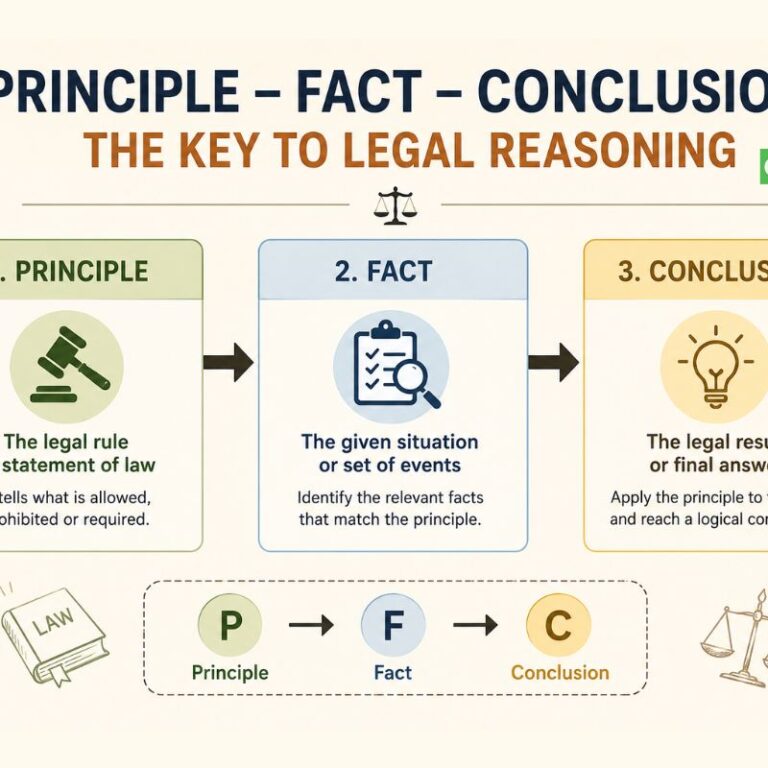
In CLAT Legal Reasoning, a legal principle means the rule that you have to apply to the facts given in the question. It may be about a right, duty, liability, restriction, exception, punishment, responsibility or condition.
The official CLAT pattern expects you to read passages of around 450 words and identify or infer the rules and principles given in them. It also tests whether you can apply those principles to new fact situations.
This means you do not need to know every law in advance. You need to understand the rule given in the passage and use it logically.
For example, if a passage says, “A person is liable for negligence when he breaches a duty of care and causes harm,” the legal principle is not the full paragraph. The principle is:
A person becomes liable for negligence when there is duty, breach and harm.
Your job is to find this rule quickly.
Why Do Students Struggle To Find The Legal Principle In Long Passages?
Many students read legal reasoning passages like a story. They remember the example, the case, the incident or the background, but they miss the actual rule.
This usually happens because long CLAT passages contain many layers, such as:
- Background information
- Legal issue
- Rule or principle
- Exception to the rule
- Example or case reference
- Moral or public policy discussion
- Question-based factual situation
The problem is not that the passage is too difficult. The problem is that you may be reading everything with equal importance. In CLAT Legal Reasoning, every line is not equally important. Some lines explain the context, but only a few lines give the principle.
Your target is to find the line that answers this question:
“What is the rule that I need to apply?”
Once you find that, the passage becomes much easier.
How Can You Spot The Legal Principle In A Long Passage?
The easiest way is to look for rule-indicating words. These are words that usually show that the passage is giving a legal rule.
You should pay special attention to words like:
- shall
- must
- may
- liable
- responsible
- duty
- right
- prohibited
- permitted
- unlawful
- valid
- invalid
- exception
- unless
- however
- subject to
- provided that
For example, read this sentence:
“A person who intentionally causes harm to another person may be held liable for damages.”
The keyword is “liable”. The principle is:
If a person intentionally causes harm, then that person may have to pay damages.
Now read another sentence:
“A minor cannot enter into a valid contract, except for necessities.”
Here, “cannot”, “valid contract” and “except” are important. The principle is:
A minor’s contract is generally not valid, but there may be an exception for necessities.
This is how you need to read CLAT passages. Do not just read for meaning. Read for rules.
How Can You Convert A Legal Principle Into An If-Then Rule?
This is one of the best tricks for CLAT Legal Reasoning.
Whenever you find a principle, convert it into an IF-THEN format.
For example:
Original principle: “A person is guilty of theft if he dishonestly takes movable property out of another person’s possession without consent.”
IF-THEN format:
If a person dishonestly takes movable property from another person’s possession without consent, then it is theft.
This helps you check the facts step by step.
You can break the rule into conditions:
- Was there movable property?
- Was it in another person’s possession?
- Was it taken without consent?
- Was there dishonest intention?
If all conditions are present, the answer will usually support theft. If one major condition is missing, the answer may go the other way.
This method saves time because you do not keep rereading the passage again and again.
How Do You Separate The Principle From The Facts?
A CLAT passage may give a legal rule and then explain it through examples. Many students confuse the example with the principle.
Remember this simple difference:
The principle is the general rule.
The facts are the specific situation.
For example:
“Defamation occurs when a false statement harms the reputation of another person. For instance, if A falsely says that B has committed a crime, and others believe it, B’s reputation may be harmed.”
Here, the principle is:
Defamation occurs when a false statement harms someone’s reputation.
The example is:
A falsely says B committed a crime.
In the exam, CLAT may change the facts completely. It may talk about a social media post, a classroom statement, a newspaper report or a WhatsApp message. But the principle remains the same.
So while reading, always ask:
“Is this line giving me a general rule, or is it only giving me an example?”
How Important Are Exceptions In CLAT Legal Reasoning?
Exceptions are extremely important. Many wrong answers in CLAT are created by ignoring exceptions.
A passage may first give a general rule and then modify it.
For example:
“Freedom of speech is protected, but reasonable restrictions may be imposed in the interest of public order.”
If you only remember “freedom of speech is protected”, you may choose the wrong answer. The complete principle is:
Freedom of speech is protected, but it can be restricted for public order.
Words like “but”, “however”, “unless”, “except” and “provided that” often change the entire answer.
When you see such words, slow down. Mark that sentence mentally. It may be the key to the question.
How Should You Read A 450-Word Legal Passage In CLAT?
You should not read a legal passage randomly. Use a fixed reading method.
First, read the passage to understand the broad topic. Is it about negligence, contract, privacy, free speech, crime, environment, consumer rights or constitutional law?
Second, identify the rule. Look for the sentence that explains what is allowed, prohibited, valid, invalid or punishable.
Third, identify the exception. Check whether the rule has any condition or limitation.
Fourth, move to the questions and apply the rule strictly.
A good reading sequence looks like this:
- Topic: What area is the passage about?
- Rule: What is the main legal principle?
- Conditions: What must be proved?
- Exception: When will the rule not apply?
- Application: Which option matches the rule best?
This approach helps you stay calm even when the passage looks long.
How Can You Apply The Principle To A Fact Situation?
Once you identify the principle, do not bring your personal opinion into the answer. CLAT is not asking what feels morally right. It is asking what follows from the passage.
Suppose the principle says:
“A person is liable for negligence only when damage is caused due to breach of duty.”
Now the fact says:
“A driver was using his phone while driving, but no accident or injury happened.”
Many students may think the driver is careless, so he must be liable. But the principle requires damage. If no damage is caused, negligence may not be established under that principle.
This is why legal reasoning is not emotional reasoning. You must match facts with the rule.
Ask these three questions:
- What does the principle require?
- Are those requirements present in the facts?
- Which option applies the principle without adding extra assumptions?
What Are The Common Traps While Identifying Legal Principles?
CLAT options are often tricky. They are designed to test whether you have understood the exact rule.
Some common traps are:
Overgeneralisation: The passage gives a limited rule, but the option makes it too broad.
Ignoring exceptions: The passage gives an exception, but the option applies only the general rule.
Using outside knowledge: You may know something about law, but the passage gives a different rule. For CLAT, follow the passage.
Moral answer trap: One option may sound fair or emotional, but it may not follow the principle.
Extreme words trap: Options using words like “always”, “never”, “completely” or “in all cases” are risky unless the passage clearly supports them.
To avoid these traps, keep returning to the exact principle. The best answer is usually the one that applies the given rule most directly.
How Can You Practise Identifying Legal Principles Daily?
You can build this skill with a simple daily routine.
Take one legal reasoning passage every day and do this:
- Read the passage once.
- Write the main principle in one line.
- Convert it into an IF-THEN format.
- List the conditions required for the rule to apply.
- Note any exception.
- Solve the questions.
- Check whether your mistake was in reading, principle identification or application.
This type of review is more useful than solving many passages without analysis.
For example, after solving a question, do not only ask, “Was my answer right?” Ask:
“Did I correctly identify the rule?”
“Did I miss any exception?”
“Did I add my own assumption?”
“Did I choose an emotional answer instead of a legal answer?”
This is how you improve accuracy.
How Can You Improve Speed Without Missing The Principle?
Speed comes from structure, not from rushing.
If you read too fast without understanding the principle, you will waste more time on questions. Instead, spend slightly more time finding the rule and then solve the questions faster.
A good method is:
- Read the first few lines to understand the topic.
- Scan the middle part for the main rule.
- Slow down near words like “however”, “unless” and “except”.
- Do not memorise examples.
- Write the principle mentally in simple words.
- Start solving only after you know the rule.
With practice, you will start noticing that most passages have only one main principle and one important exception.
What Should You Remember Before The Exam?
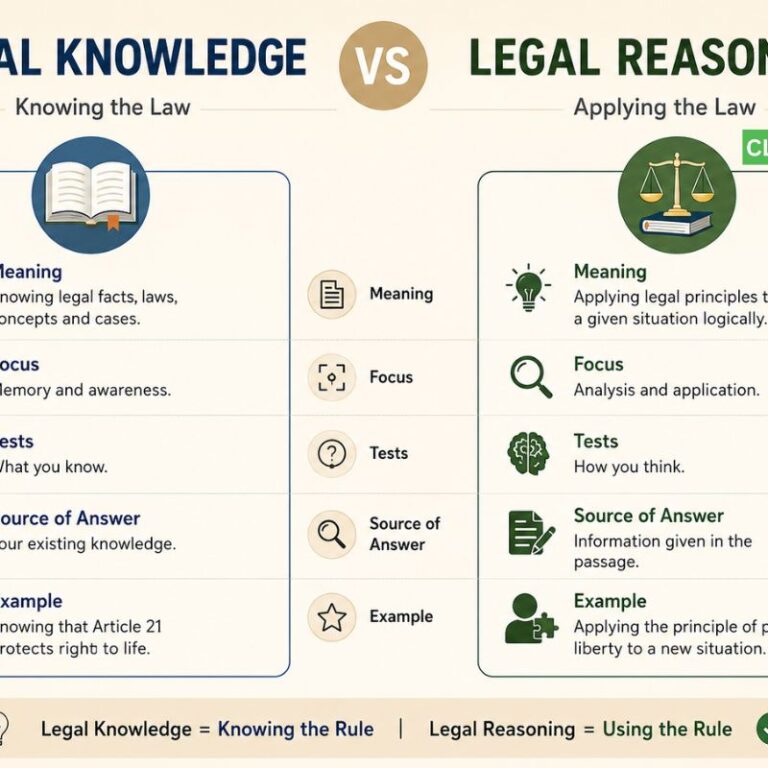
Before the exam, remember one thing clearly: CLAT Legal Reasoning is not about showing how much law you know. It is about showing how well you can read, understand and apply a rule.
Whenever you see a long passage, do not panic. Your job is simple:
Find the rule. Find the exception. Apply it to the facts.
If you keep this process fixed, even unfamiliar legal topics will become manageable. Whether the passage is about torts, contracts, constitutional rights, criminal law or public policy, the method remains the same.
The legal principle is always the heart of the passage. Once you identify it, the questions become much easier.
Conclusion
Identifying the legal principle in long CLAT passages is a skill that improves with regular practice. You do not have to read like a lawyer. You have to read like a smart exam candidate.
Focus on rule words, convert principles into IF-THEN statements, separate examples from rules, watch exceptions carefully and apply the passage without personal opinion.
Once this becomes your habit, Legal Reasoning will feel less confusing and more logical. For CLAT and other law entrance exams, this skill can directly improve both your speed and accuracy.
Calling all law aspirants!
Are you exhausted from constantly searching for study materials and question banks? Worry not!
With over 15,000 students already engaged, you definitely don't want to be left out.
Become a member of the most vibrant law aspirants community out there!
It’s FREE! Hurry!
Join our WhatsApp Groups (Click Here) and Telegram Channel (Click Here) today, and receive instant notifications.