
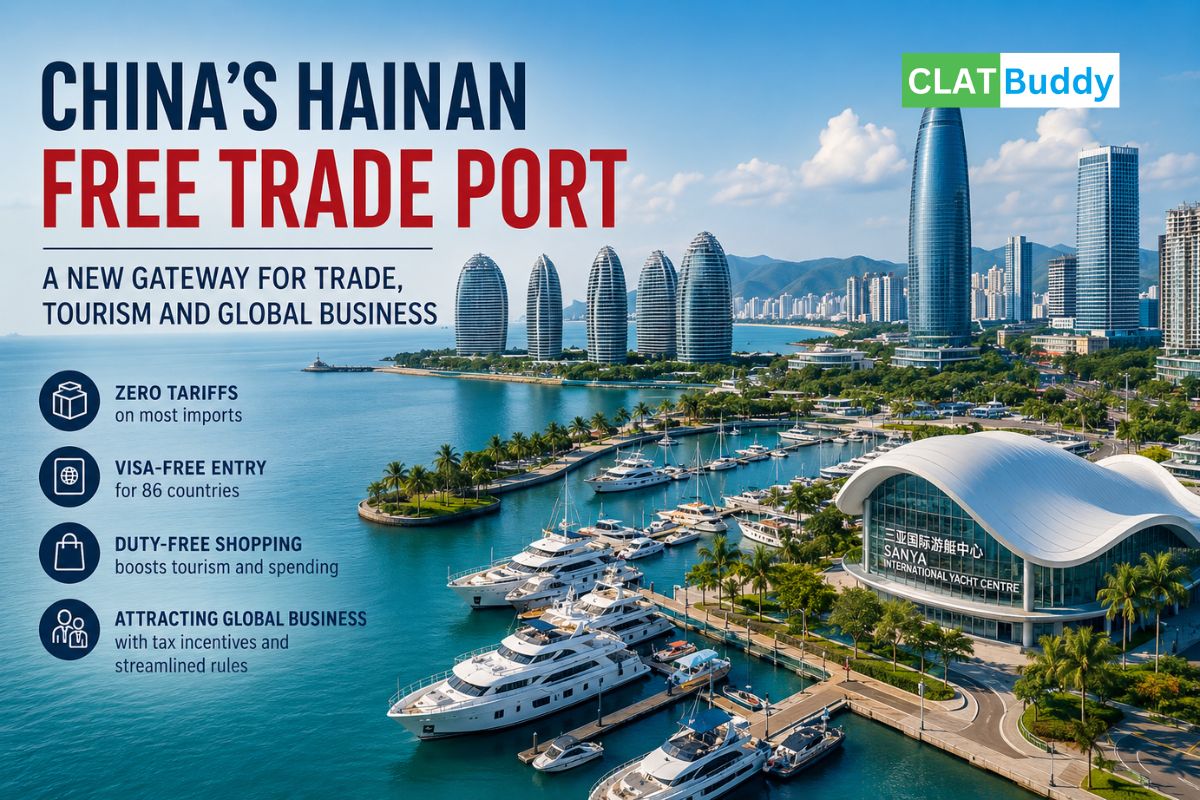
China’s southern island province of Hainan has emerged as one of the country’s biggest economic experiments through the launch of the Hainan Free Trade Port (FTP). Positioned in the strategically important South China Sea, the initiative is aimed at transforming Hainan into a global business, tourism and trade hub with relaxed customs rules, zero tariffs on many products, low taxation and simplified movement of people and data.
The project officially entered a major phase in December 2025 when China implemented island-wide special customs operations. The initiative is being presented by Beijing as a major step in its modern-era “opening up” policy and as an attempt to create a business-friendly international trade zone comparable in influence to global commercial hubs.
What Is the Hainan Free Trade Port?
The plan for the Hainan FTP was first announced on June 1, 2020. It formally began large-scale implementation on December 18, 2025. Under the system, Hainan operates with a distinct customs framework that allows easier import of goods and smoother trade operations.
China describes the model as “freer access at the first line, regulated access at the second line, and free flow within the island.” In practical terms, this means imported goods can enter Hainan with far fewer tariff restrictions, while normal Chinese customs duties continue to apply when products move from Hainan into mainland China.
Although Hainan remains fully under Chinese legal and constitutional control, the island now functions as a partially customs-free international trade zone. The government has also introduced visa-free entry for citizens from 86 countries in an effort to attract global tourists, investors and businesses.
Chinese officials say the FTP is expected to reduce tariff costs significantly while creating fresh investment opportunities for Chinese and foreign enterprises.
Need More Than Just Written Content?
Explore recorded lessons, structured learning resources and practice material to strengthen your CLAT preparation.
Explore Learning Resources →How Has the FTP Changed Trade Rules?
The FTP has dramatically expanded tariff exemptions and simplified trade procedures. Since its launch, tariff-free product categories reportedly increased from around 1,900 to nearly 6,600. The share of goods eligible for zero tariffs has also risen sharply.
The policy has encouraged companies to use Hainan as an import-processing and manufacturing base. Businesses importing goods into the island can avoid many mainland duties, provided certain value-addition conditions are met before products enter mainland China.
The new customs framework has also accelerated foreign investment activity. Thousands of foreign-invested enterprises reportedly registered in Hainan shortly after the FTP’s operational launch, reflecting growing international interest in the project.
Chinese authorities view the FTP as a tool to deepen economic reforms, increase high-quality development and strengthen China’s integration with global trade networks at a time of increasing geopolitical and economic competition.
Why Are Businesses Moving to Hainan?
The combination of low tariffs, tax incentives and easier trade access is attracting industries ranging from manufacturing and food processing to tourism and luxury retail.
One example is the M1 Coffee Dream Factory in Wanning, which imports premium coffee beans at significantly lower costs compared to mainland China due to reduced import duties. Businesses operating inside the FTP are able to cut logistics and customs-related expenses, making operations more profitable.
Another major enterprise operating in the FTP is Hainan Ausca International Oils and Grains Co. Ltd., which invested billions of yuan into production facilities under the tariff exemption policy. The company reportedly benefits from importing raw materials duty-free and processing them within Hainan before supplying markets.
These advantages are helping Hainan position itself as a manufacturing and processing centre linked to international trade routes.
Tourism and Duty-Free Shopping Drive Consumption
Apart from trade and manufacturing, Hainan is also becoming a major tourism and consumption hub.
The province’s city of Sanya has emerged as a centre for duty-free shopping. Large retail complexes, including the China Duty Free (CDF) shopping centres, offer luxury global brands and domestic products to tourists and mainland consumers.
Mainland Chinese visitors can purchase duty-free goods under specific annual shopping limits, while international tourists are also being targeted through relaxed visa policies and improved air connectivity.
Authorities say offshore duty-free shopping in Hainan has already crossed billions of yuan since the FTP’s expansion. The number of shoppers and inbound flight bookings to cities such as Haikou and Sanya has also increased rapidly.
Officials and businesses believe the visa-free policy and duty-free retail ecosystem will help Hainan become a global tourism destination while simultaneously promoting Chinese cultural and consumer brands.
China’s Strategic Objectives Behind Hainan
Beyond economics, Hainan carries significant geopolitical and strategic importance for China.
Located in the South China Sea, the island gives China a major economic and tourism gateway in one of the world’s most contested maritime regions. The FTP also provides Beijing with an opportunity to test economic liberalisation policies while retaining full political and legal control over the territory.
Unlike Hong Kong, which operates under a separate legal and financial system, Hainan remains directly integrated into China’s governance structure. This makes it both a complement and a possible long-term competitor to Hong Kong as a regional business hub.
China appears to be positioning Hainan as a modern economic experiment capable of supporting its larger ambition of achieving advanced economic modernisation in the coming decade. The success or failure of the FTP could therefore influence the future direction of China’s trade and investment policies.
A Growing Global Experiment
The Hainan FTP remains in its early stages, but the island is already drawing attention from businesses, tourists and policymakers worldwide. Through tariff reductions, simplified customs systems, visa-free access and aggressive investment incentives, China is attempting to create a globally connected commercial zone within its own territory.
Whether Hainan eventually develops into a global trade and financial powerhouse comparable to major international hubs remains uncertain. However, the initiative has already become one of China’s most closely watched economic experiments and a major symbol of its evolving global trade strategy.
Calling all law aspirants!
Are you exhausted from constantly searching for study materials and question banks? Worry not!
With over 15,000 students already engaged, you definitely don't want to be left out.
Become a member of the most vibrant law aspirants community out there!
It’s FREE! Hurry!
Join our WhatsApp Groups (Click Here) and Telegram Channel (Click Here) today, and receive instant notifications.
Need More Than Just Written Content?
Explore recorded lessons, structured learning resources and practice material to strengthen your CLAT preparation.
Explore Learning Resources →