

Difference Between Legal Knowledge And Legal Reasoning For CLAT
What Is The Difference Between Legal Knowledge And Legal Reasoning?
Many CLAT aspirants confuse legal knowledge with legal reasoning. They feel that they must know many laws, sections, articles and landmark cases before they can score well in the Legal Reasoning section. But that is not completely true.
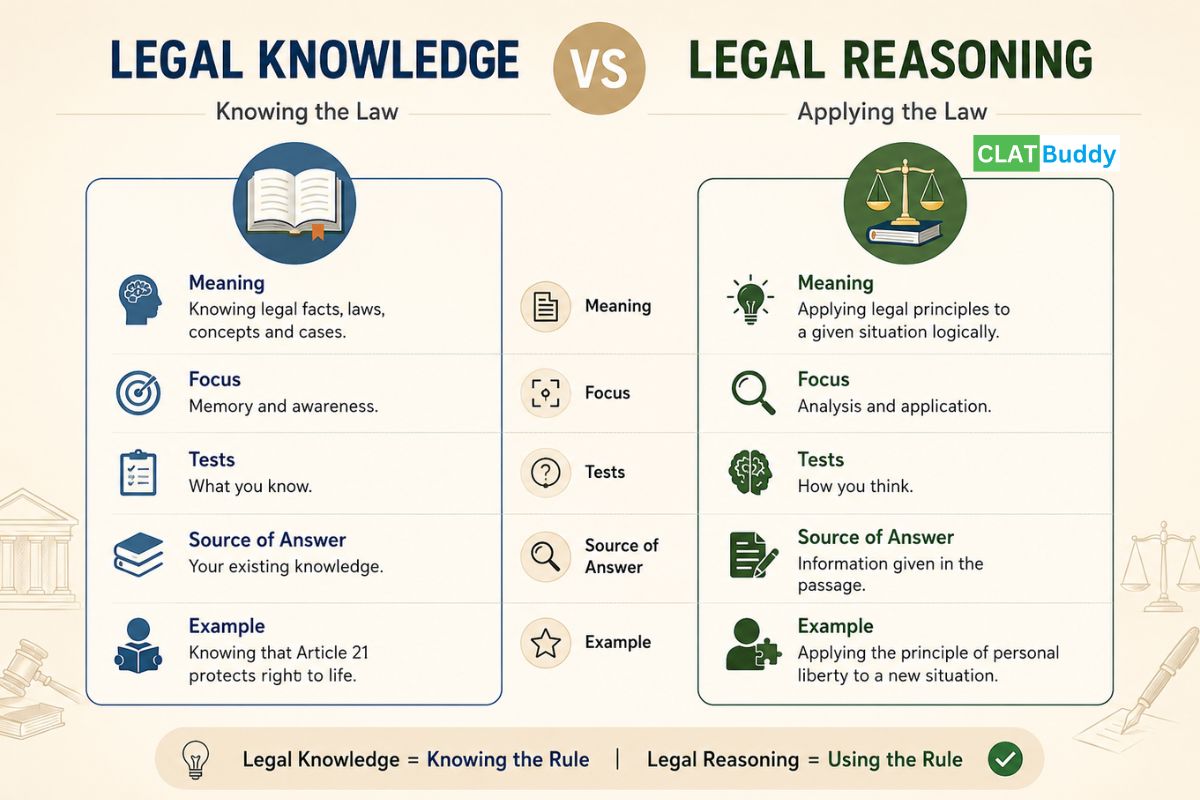
Legal knowledge means knowing legal facts. Legal reasoning means using a legal rule and applying it to a given situation. CLAT mainly tests your ability to understand a passage, identify the rule and apply it logically. The official CLAT syllabus also says that you do not need prior legal knowledge to attempt Legal Reasoning questions, though general awareness of legal and moral issues can help you understand passages better.
For example, knowing that Article 21 deals with the right to life and personal liberty is legal knowledge. But reading a passage on personal liberty and deciding whether a person’s rights were violated in a new situation is legal reasoning.
Why Do Students Get Confused Between Legal Knowledge And Legal Reasoning?
This confusion happens because both terms sound very similar. Also, many legal reasoning passages are based on topics like contracts, crimes, torts, constitutional rights, privacy, equality, environment and public policy. So, students feel that they must already know these topics deeply.
But CLAT does not expect you to study law like a law college student. You are not expected to memorise Bare Acts or read full judgments. Instead, you are expected to read like a smart problem-solver.
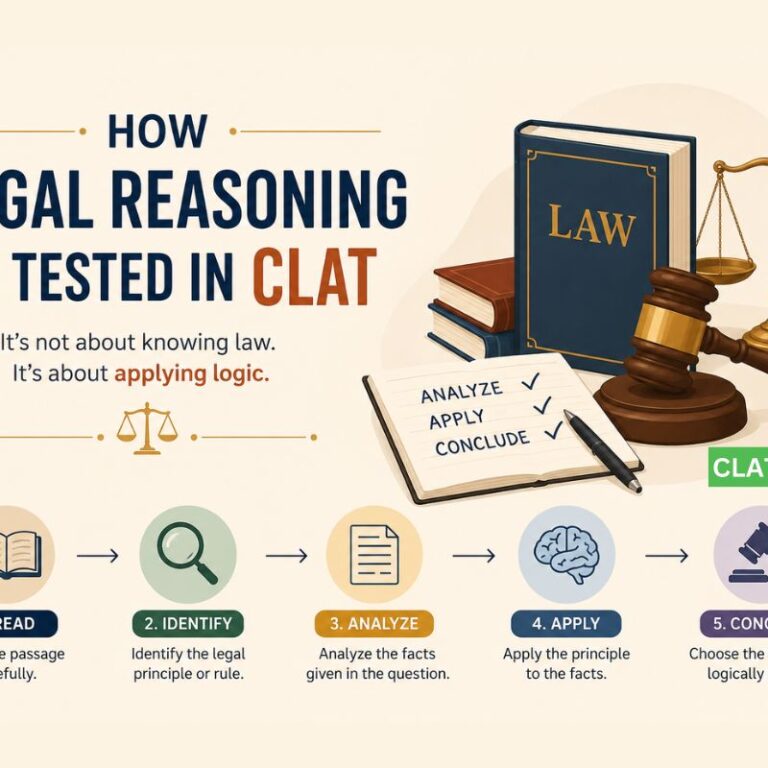
In CLAT Legal Reasoning, the passage usually gives you the basic rule, idea or principle. Your job is to:
- Understand what the rule says
- Identify the important facts
- Apply the rule without adding personal opinion
- Choose the option that follows most logically
This is why legal reasoning is closer to reading comprehension plus logical application, not pure legal studies.
What Is Legal Knowledge In CLAT Preparation?
Legal knowledge is your awareness of basic legal ideas, terms and developments. It may include:
- Important constitutional articles
- Basic legal maxims
- Landmark judgments
- Current legal issues
- Common legal concepts like negligence, contract, consent, liability and rights
- Basic understanding of courts and legal institutions
For example, if someone asks, “Which court is the highest court in India?”, the answer is the Supreme Court of India. This is legal knowledge.
Legal knowledge can help you feel more comfortable while reading legal passages. If a passage is about defamation and you already know the basic meaning of defamation, you may read the passage faster. But even if you do not know the topic, you can still answer the question if you understand the rule given in the passage.
So, legal knowledge is useful, but it is not the main skill tested in CLAT Legal Reasoning.
What Is Legal Reasoning In CLAT?
Legal reasoning is the skill of applying a legal principle to a set of facts. It is not about what you already know. It is about how well you can use what is given to you.
A typical legal reasoning question may have:
- A legal principle
- A factual situation
- Four options
- One option that best follows from the principle
For example:
Principle: A person is liable if they intentionally cause harm to another person.
Facts: A throws a stone at B because he wants to injure B. B gets hurt.
Question: Is A liable?
Answer: Yes, because A intentionally caused harm to B.
Here, you do not need to know any section of law. You only need to apply the principle to the facts.
This is what CLAT wants to test. Can you read carefully? Can you separate relevant facts from irrelevant facts? Can you apply a rule exactly as given? Can you avoid emotional or moral assumptions?
Why Is Legal Reasoning More Important Than Legal Knowledge For CLAT?
Legal reasoning is more important because the CLAT Legal Reasoning section is passage-based. The official syllabus says that students must identify and infer rules and principles from the passage, apply them to fact situations and understand how changes in rules may change their application.
This means CLAT is not asking, “How many laws do you know?”
It is asking, “Can you think like a law student?”
A law student is trained to read facts, understand rules and reach a logical conclusion. CLAT tests the beginning of that skill.
You may know many legal facts, but if you cannot apply a principle properly, you may still get the answer wrong. On the other hand, even with limited legal knowledge, you can solve many questions if your reasoning is strong.
How Can You Identify A Legal Knowledge Question?
A legal knowledge question usually depends on memory. The answer is fixed and does not require much application.
Examples of legal knowledge questions are:
- Who is the current Chief Justice of India?
- Which Article deals with equality before law?
- What is the meaning of habeas corpus?
- Which case recognised the basic structure doctrine?
- What is the full form of PIL?
These questions test awareness. You either know the answer or you do not.
In older law entrance exams, direct legal knowledge had more importance. But in the current CLAT pattern, direct memory-based legal questions are not the main focus. You still need basic awareness, especially for current affairs and legal developments, but you should not make memorisation your full strategy.
How Can You Identify A Legal Reasoning Question?
A legal reasoning question usually gives you a rule and asks you to apply it.
You can identify it through words like:
- Principle
- Facts
- Apply
- Which of the following is correct?
- Who is liable?
- Which conclusion follows?
- What would happen if the facts change?
For example:
Principle: A contract with a minor is void.
Facts: Rohan is 17 years old. He signs an agreement to sell his bicycle to Aman.
Question: Is the contract valid?
Answer: No, because Rohan is a minor and the principle says that a contract with a minor is void.
This is legal reasoning because the answer comes from applying the given rule to the facts.
What Mistake Do Students Make In Legal Reasoning?
The biggest mistake students make is using outside knowledge when the passage gives a different rule.
Suppose you have studied a topic before. In the exam, the passage gives a simplified or slightly different rule. Many students ignore the passage and answer from memory. This is risky.
In CLAT, the rule given in the passage is your main authority. Even if your outside knowledge says something else, you should follow the passage unless the question clearly asks for general awareness.
Another common mistake is using moral judgement. For example, a student may think, “This person behaved badly, so they must be liable.” But legal reasoning does not work like that. Liability depends on whether the legal principle applies, not on whether the person seems good or bad.
How Should You Approach Legal Reasoning Passages?
Your approach should be simple and disciplined.
First, read the passage to understand the central issue. Do not panic if the topic is unfamiliar. CLAT passages may deal with law, public policy or moral philosophy. The syllabus itself says that prior legal knowledge is not required, so the answer will usually come from the passage.
Second, identify the rule or principle. Ask yourself: What is the passage actually saying? Is there an exception? Is there a condition? Is there a specific test?
Third, read the facts in the question carefully. Do not assume extra facts. If the question does not say that a person intended to cause harm, do not imagine intention.
Fourth, match the rule with the facts. This is the most important step.
Fifth, eliminate options that go beyond the passage, use emotional reasoning or add facts not given in the question.
How Much Legal Knowledge Is Enough For CLAT?
You do not need advanced legal knowledge for CLAT. But you should have basic familiarity with common legal topics because it helps in speed and confidence.
You can focus on:
- Constitution basics
- Fundamental rights
- Directive principles
- Basic criminal law concepts
- Law of torts basics
- Contract law basics
- Important legal maxims
- Recent legal news
- Important Supreme Court judgments in current affairs
- Basic public policy issues
The goal is not to become a lawyer before the exam. The goal is to become comfortable with legal language.
For example, if you know the basic meaning of “negligence”, “consent”, “defamation”, “privacy” and “liability”, you will not feel lost when these words appear in passages.
Should You Memorise Legal Maxims And Landmark Cases?
Yes, but only in a limited and smart way.
Legal maxims and landmark cases can help in current affairs, legal awareness and sometimes in understanding passages. But they should not replace practice.
For example, knowing “actus reus” and “mens rea” may help you understand criminal law-based passages. Knowing cases like Kesavananda Bharati, Maneka Gandhi and Vishaka may help in constitutional law-based current affairs.
But do not spend all your preparation time memorising hundreds of maxims and cases. CLAT rewards application more than collection of facts.
A better strategy is:
- Learn only frequently used legal terms
- Understand the meaning, not just the Latin phrase
- Connect cases with the legal issue
- Revise through short notes
- Practise passage-based questions regularly
How Can You Improve Legal Reasoning For CLAT?
Legal reasoning improves with practice, review and patience. You should not just solve questions and count your score. You should also analyse why you got a question wrong.
After every practice set, ask yourself:
- Did I miss a condition in the principle?
- Did I ignore an exception?
- Did I use outside knowledge?
- Did I assume facts?
- Did I choose a morally correct answer instead of a legally correct answer?
- Did I misread the question?
This analysis is more valuable than simply solving many questions.
You should also practise reading editorials and legal news. This builds your comfort with long passages. Since CLAT passages can be around 450 words in the Legal Reasoning section, your reading stamina matters.
What Is A Simple Example To Understand The Difference?
Let us take one topic: negligence.
Legal knowledge means knowing that negligence generally means failure to take reasonable care.
Legal reasoning means applying this idea to a situation.
Example:
Principle: A person is negligent if they fail to take reasonable care and this failure causes harm to another person.
Facts: A shopkeeper leaves water on the floor and does not put any warning sign. A customer slips and gets injured.
Question: Is the shopkeeper negligent?
Answer: Yes, because the shopkeeper failed to take reasonable care and that caused injury.
Now, if the facts change, the answer may also change.
Facts: The shopkeeper cleaned the floor, put a warning sign and blocked the wet area. A customer ignored the warning and entered the area.
Here, the answer may be different because the shopkeeper took reasonable care.
This is legal reasoning. You are not just remembering the meaning of negligence. You are applying it to changing facts.
What Should Be Your Preparation Strategy?
Your preparation should balance both legal knowledge and legal reasoning, but legal reasoning should get more time.
A practical plan can look like this:
- Spend 70 percent of your Legal Reasoning preparation on passage practice
- Spend 20 percent on understanding basic legal concepts
- Spend 10 percent on legal current affairs, maxims and landmark cases
This balance keeps you exam-focused. If you only read legal theory, you may feel knowledgeable but still struggle in the actual paper. If you only solve questions without understanding basic legal terms, you may feel slow and confused. So, both matter, but reasoning matters more.
Why Should You Not Fear Legal Reasoning?
You should not fear legal reasoning just because you have not studied law in school. CLAT is designed for students from different streams. Whether you are from humanities, commerce or science, you can build legal reasoning with regular practice.
The section is not asking you to argue like a senior advocate. It is asking you to read carefully, think clearly and apply rules logically.
If you can train yourself to slow down while reading the principle, avoid assumptions and compare every option with the passage, your accuracy will improve.
Conclusion
The difference between legal knowledge and legal reasoning is simple. Legal knowledge is about knowing the law. Legal reasoning is about applying the law. For CLAT and other law entrance exams, legal reasoning is more important because the paper tests your ability to understand principles and apply them to new situations.
Basic legal knowledge can support your preparation, but it should not become your main focus. Your main goal should be to read better, think logically and apply rules without personal opinions. Once you understand this difference, Legal Reasoning becomes less scary and more scoring.
Calling all law aspirants!
Are you exhausted from constantly searching for study materials and question banks? Worry not!
With over 15,000 students already engaged, you definitely don't want to be left out.
Become a member of the most vibrant law aspirants community out there!
It’s FREE! Hurry!
Join our WhatsApp Groups (Click Here) and Telegram Channel (Click Here) today, and receive instant notifications.