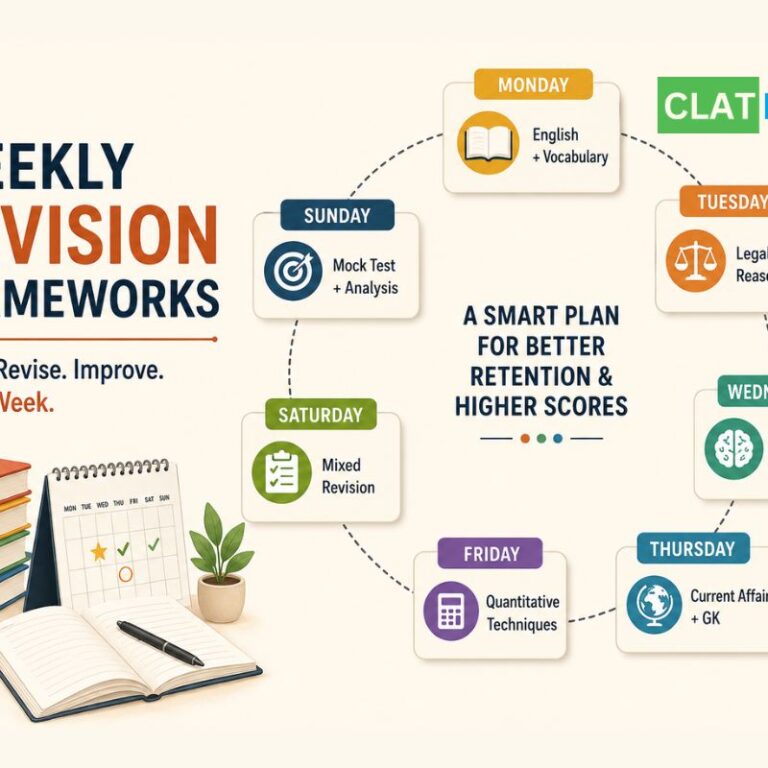


Monthly Revision Strategy for Long-Term CLAT Preparation

Preparing for CLAT is not only about studying new topics every day. The real challenge is remembering what you studied three months ago while still learning new concepts. Many students study continuously but struggle during mocks because they forget earlier topics, especially Current Affairs, Legal Reasoning concepts, and Logical Reasoning patterns.
That is why having a proper monthly revision strategy is extremely important for long-term CLAT preparation. If your revision system is weak, even 10 hours of daily study may not help much. But if your revision system is strong, even moderate study hours can give excellent results over time.
In this article, you will learn how to build a practical monthly revision strategy that actually works for CLAT and other law entrance exams.
Why Is Monthly Revision So Important for CLAT Preparation?
CLAT is not an exam where you can study everything once and remember it forever. The syllabus is vast, especially because of:
- Current Affairs
- Reading Comprehension
- Legal principles
- Logical concepts
- Quantitative techniques
Your brain naturally forgets information if you do not revisit it regularly. This is called the forgetting curve. Revision helps strengthen memory and improves recall speed during mocks and the actual exam.
A proper monthly revision strategy helps you:
- Retain concepts for a longer time
- Reduce stress before the exam
- Improve mock scores gradually
- Identify weak areas early
- Avoid huge backlogs
Most CLAT toppers revise smarter, not harder.
What Should Your Monthly Revision System Actually Look Like?
A good revision strategy is layered. You cannot revise everything only at the end of the month. Instead, your preparation should include:
- Daily revision
- Weekly revision
- Monthly revision
Think of revision like maintaining fitness. One intense workout in a month will not help if there is no consistency.
Your monthly revision should act as a reset point where you revisit everything studied during the previous weeks.
How Should You Divide Your Month During CLAT Preparation?
Instead of randomly studying topics every day, divide your month into structured phases.
Week 1 Should Focus on Learning
During the first week:
- Learn new concepts
- Read editorials regularly
- Build notes
- Solve sectional questions
This is your input-heavy week.
Week 2 Should Focus on Practice
Now start applying concepts through:
- Sectional tests
- Timed passages
- Legal reasoning sets
- Logical reasoning practice
This phase strengthens understanding.
Week 3 Should Focus on Mock Tests
This is where many students improve massively.
Attempt:
- Full-length mocks
- Mixed section practice
- Time-bound revision sessions
Mock analysis should become your priority here.
Week 4 Should Focus on Revision and Error Correction
This is your consolidation week.
During this phase:
- Revise current affairs
- Revisit weak concepts
- Analyse mistakes
- Reattempt wrong questions
This structure prevents last-minute panic.
How Can You Revise Current Affairs Every Month Without Feeling Overwhelmed?
Current Affairs becomes stressful only when students keep postponing revision.
If you ignore monthly revision, six months later you will have:
- Huge PDFs pending
- Forgotten events
- Mixed-up facts
- Incomplete notes
The best approach is layered revision.
What Should You Do Daily for Current Affairs?
Spend around 30 to 45 minutes on:
- Newspaper reading
- Important legal developments
- International events
- Government schemes
- Supreme Court judgments
Make very short notes while reading.
What Should You Do Weekly?
At the end of every week:
- Revise all important events
- Attempt quizzes
- Read summaries
- Highlight repeated topics
Weekly revision reduces pressure later.
What Should You Do Monthly?
At the end of every month:
- Revise one complete current affairs compilation
- Create final short notes
- Mark important appointments, awards, judgments, and bills
- Solve monthly GK quizzes
Your goal should not be memorising everything. Your goal should be repeated exposure.
How Can You Use Mock Tests as a Revision Tool?
Many students think mocks are only for checking scores. That is a mistake.
Mocks are one of the best revision tools available.
Every mock teaches you:
- Which topics are weak
- Which mistakes are repeating
- Which section wastes time
- Which concepts need revision
After every mock, spend proper time analysing:
- Wrong answers
- Guesswork
- Time management
- Accuracy levels
Mock analysis often matters more than the mock itself.
Why Should You Maintain an Error Notebook?
An error notebook can completely change your preparation.
Most students repeat the same mistakes because they never track them.
Your error notebook should include:
- Wrong Legal Reasoning questions
- Vocabulary mistakes
- Reading comprehension traps
- Calculation errors
- Silly mistakes under pressure
Once every month, revise this notebook carefully.
You will notice patterns like:
- Misreading options
- Falling for extreme statements
- Losing marks in inference-based questions
- Making calculation mistakes in Quant
This awareness improves accuracy significantly.
How Can You Revise Legal Reasoning Properly Every Month?
Legal Reasoning is not about memorising laws. It is about understanding principles and applying them logically.
Monthly revision for Legal Reasoning should include:
- Revisiting important legal principles
- Reading landmark judgments
- Solving passage-based questions
- Revising constitutional concepts
- Practising application-based reasoning
You should also maintain:
- A legal vocabulary notebook
- Important Latin maxims
- Frequently repeated concepts
Consistency matters more than volume here.
How Should You Revise English and Reading Comprehension?
Many CLAT aspirants stop revising English because they think reading alone is enough.
That is not true.
Monthly English revision should include:
- Revising difficult vocabulary
- Re-reading editorials
- Practising inference questions
- Revisiting difficult RC passages
- Analysing tone-based questions
You should also track:
- Reading speed
- Accuracy percentage
- Weak RC themes
The more exposure you get to good reading material, the more comfortable the actual exam feels.
How Can You Avoid Burnout During Monthly Revision?
Revision should reduce stress, not increase it.
Students usually burn out when:
- They study without breaks
- They compare themselves constantly
- They create unrealistic schedules
- They panic because of backlog
Instead, focus on manageable consistency.
Some Practical Ways to Avoid Burnout
- Keep one light study session weekly
- Sleep properly
- Take short breaks after mocks
- Avoid studying continuously for long hours
- Keep realistic targets
CLAT preparation is a marathon, not a sprint.
What Should You Do on the Last Sunday of Every Month?
Create a monthly reset day.
Use the last Sunday of every month for:
- Revising current affairs
- Reviewing mock performance
- Revisiting weak topics
- Organising notes
- Planning the next month
Avoid learning new concepts that day.
This habit helps you stay organised throughout the year.
How Does Revision Change in the Last Few Months Before CLAT?
Your revision intensity should increase as the exam approaches.
During the Early Phase
Focus more on:
- Concept building
- Reading habits
- Understanding basics
During the Middle Phase
Focus more on:
- Mixed practice
- Mock tests
- Speed building
During the Final Phase
Focus heavily on:
- Revision
- Mock analysis
- Current affairs consolidation
- Accuracy improvement
At this stage, revision becomes more important than learning new topics.
Final Thoughts
A strong monthly revision strategy can completely transform your CLAT preparation journey. You do not need perfect study hours every single day. What matters more is whether you are consistently revisiting and strengthening what you already studied.
The students who perform well in CLAT are usually not the ones who study the most. They are the ones who:
- Revise regularly
- Analyse mistakes honestly
- Stay consistent for months
- Build strong reading habits
- Trust the process
So instead of asking yourself how many hours you studied today, ask yourself one important question:
“Will I still remember this topic two months later?”
If the answer is yes, your preparation is moving in the right direction.
Calling all law aspirants!
Are you exhausted from constantly searching for study materials and question banks? Worry not!
With over 15,000 students already engaged, you definitely don't want to be left out.
Become a member of the most vibrant law aspirants community out there!
It’s FREE! Hurry!
Join our WhatsApp Groups (Click Here) and Telegram Channel (Click Here) today, and receive instant notifications.