

Handling Unfamiliar Legal Topics In CLAT Passages

If you are preparing for CLAT, you may sometimes open a legal reasoning passage and feel that the topic is completely new. It may be about privacy, artificial intelligence, environmental law, criminal liability, public policy, constitutional rights or some legal concept you have never studied before.
This is normal.
CLAT Legal Reasoning is not designed to check whether you already know every law. The official CLAT UG syllabus says that you do not need prior knowledge of law to attempt this section. The focus is on reading the passage, identifying the rules or principles given in it, and applying them to different fact situations.
So, when you see an unfamiliar topic, your first reaction should not be fear. Your first thought should be: “The answer is hidden in the passage. I just need to find the rule.”
Why Should You Not Panic When The Legal Topic Is New?
Many students panic because they think, “I have not studied this law, so I cannot solve this passage.” This mindset can reduce your accuracy even before you start reading.
In CLAT, an unfamiliar topic does not mean an impossible question. It simply means that you need to depend more on the passage and less on memory.
For example, if the passage is about data protection law, you may not know the technical provisions. But the passage may clearly explain that consent is needed before using personal data, or that sensitive data requires extra protection. Once you understand that rule, the questions become application-based.
You do not need to become an expert in that topic. You only need to understand what the passage says.
How Should You Read An Unfamiliar Legal Passage?
When the topic is new, read the passage in two layers.
First, read for the basic idea. Ask yourself: “What is this passage mainly talking about?” Do not stop at every difficult word. Try to understand the general direction.
Second, read for the legal rule. Ask yourself:
- What principle is being explained?
- Is there any condition attached to the rule?
- Is there any exception?
- What happens when the rule is violated?
- Who has a right, duty or liability?
This method helps you avoid getting lost in the topic. You start looking at the passage like a problem-solving exercise.
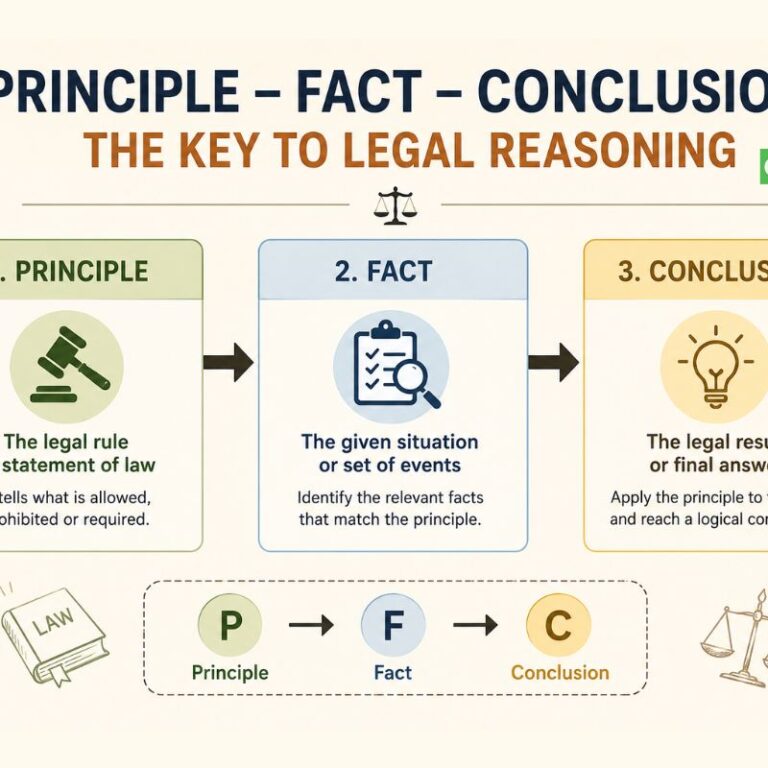
What Is The Principle-Fact-Conclusion Method?
The Principle-Fact-Conclusion method is one of the simplest ways to handle unfamiliar legal topics in CLAT Legal Reasoning.
Principle
This is the rule given in the passage. It may be directly stated or indirectly explained. Your job is to identify it carefully.
For example: “A person is liable for negligence if they fail to take reasonable care and cause harm to another person.”
Fact
This is the situation given in the question. You need to check whether the facts match the conditions of the principle.
For example: “A shopkeeper leaves water on the floor, a customer slips, and the customer is injured.”
Conclusion
This is the final answer after applying the principle to the facts.
For example: “The shopkeeper may be liable because they failed to take reasonable care.”
This method works even when the legal topic is unfamiliar because you are not depending on memorised law. You are depending on logic.
How Can You Identify The Legal Principle In A Long Passage?
In long CLAT passages, the legal principle may not always appear in one neat sentence. Sometimes, it is spread across the passage. You need to collect the important parts and convert them into a simple rule.
Look for words like:
- “A person is liable if”
- “The court held that”
- “The law requires”
- “However”
- “Unless”
- “Except”
- “Provided that”
- “This means”
These words often show where the rule, condition or exception is present.
For example, if a passage says that freedom of speech is protected, but speech that causes violence may be restricted, the principle is not simply “speech is protected.” The full principle is: speech is protected, but it can be restricted when it leads to violence or public disorder.
This is why reading exceptions is very important.
Why Is Outside Knowledge Dangerous In CLAT Legal Reasoning?
Outside knowledge can help you understand a topic, but it can also confuse you during the exam.
Suppose you know something about real criminal law, but the passage gives a simplified principle for the question. In that case, you must follow the passage, not your memory.
CLAT Legal Reasoning rewards passage-based thinking. If the passage creates a rule, apply that rule exactly. Do not think, “But in real life, the law is different.” The exam is testing whether you can apply the given principle, not whether you can argue like a lawyer.
This is especially important for students who read a lot of current affairs or legal news. Your knowledge is useful, but during the question, the passage is the boss.
How Can You Deal With Difficult Legal Words?
Legal passages may contain words that sound heavy, such as negligence, liability, jurisdiction, injunction, mens rea, consent, arbitration, defamation or natural justice.
Do not stop your reading because of one word.
Most of the time, the meaning can be understood from the surrounding sentences. For example, if the passage says, “The court granted an injunction to stop the company from continuing the harmful activity,” you can understand that an injunction is some kind of court order to stop an action.
Use context. Ask:
- What is happening before and after this word?
- Is the word connected to a right, duty or punishment?
- Does the passage give an example?
- Can I replace the word with a simple meaning?
You do not need perfect legal definitions. You need enough understanding to answer the question correctly.
What Should You Underline Or Mark While Reading?
When you read an unfamiliar legal passage, do not underline everything. That will only make the passage look more confusing.
Mark only the useful parts:
- Main legal rule
- Conditions
- Exceptions
- Important examples
- Words like “unless”, “however” and “only if”
- Rights and duties of parties
- Consequences of breaking the rule
For example, if the passage says, “A person is not liable if the harm was caused by an unforeseeable event,” the word “unforeseeable” is important. It changes the result.
Good marking helps you return to the passage quickly when solving questions.
How Should You Eliminate Options In Unfamiliar Legal Topics?
Option elimination becomes very powerful when the topic is unfamiliar.
First, remove options that go beyond the passage. If the passage does not support a statement, be careful.
Second, remove extreme options. Words like “always”, “never”, “all”, “none” and “completely” are often risky unless the passage clearly supports them.
Third, remove options that ignore exceptions. If the passage gives an exception and the option applies the rule blindly, it may be wrong.
Fourth, compare the final two options with the exact facts of the question. Many CLAT options are close, but one option usually matches the principle more accurately.
Your goal is not to choose the option that sounds legally impressive. Your goal is to choose the option that best follows the passage.
What Mistakes Do Students Make With New Legal Topics?
Students usually make a few common mistakes when they face unfamiliar topics.
They read too fast because they want to escape the passage. This leads to missing the main principle.
They use personal opinion. For example, they think, “This seems unfair, so this option must be wrong.” CLAT does not ask what feels fair. It asks what follows from the principle.
They ignore exceptions. One small word like “unless” can change the entire answer.
They overthink simple rules. Sometimes, the passage gives a very clear rule, but students complicate it because the topic sounds difficult.
They spend too much time on one question. If the question is taking too long, mark it and return later if time permits.
How Can You Practise Unfamiliar Legal Topics Before The Exam?
You can train yourself to become comfortable with new topics. Start reading short legal explainers, editorials and current affairs pieces related to law and public policy. You do not need to memorise everything. Focus on understanding the issue, the rule and the reasoning.
While practising, choose passages from different areas:
- Constitutional rights
- Criminal law basics
- Torts and negligence
- Contracts
- Environment law
- Technology and privacy
- Consumer law
- Public policy
- International law
After every passage, ask yourself:
- What was the main rule?
- What facts mattered?
- Which option confused me?
- Did I use outside knowledge?
- Did I miss any exception?
This reflection is more useful than solving many questions without analysis.
How Can You Stay Calm During The Actual Exam?
In the exam hall, unfamiliar topics feel scarier because of time pressure. That is why you need a fixed strategy.
When you see a difficult-looking legal passage, take a small pause and remind yourself that prior legal knowledge is not required. Then follow this order:
- Read the passage for the main idea.
- Identify the rule and exceptions.
- Read the question carefully.
- Match the facts with the rule.
- Eliminate unsupported options.
- Choose the most passage-based answer.
Do not judge the passage by its topic. A passage on a new topic may actually have easy questions, while a familiar topic may have tricky options.
How Much Legal Knowledge Is Actually Needed?
You should know basic legal concepts because they make reading easier. Topics like rights, liability, negligence, contract, consent, intention and punishment appear often in law entrance exams.
But legal knowledge is not a replacement for reasoning. Even if you know many laws, you still need to apply the principle given in the passage.
Think of legal knowledge as background support. It helps you feel comfortable. But your final answer must come from the passage.
What Is The Best Mindset For CLAT Legal Reasoning?
The best mindset is simple: “I am not here to show how much law I know. I am here to apply the rule correctly.”
This mindset protects you from panic, overthinking and personal bias.
Every unfamiliar topic is an opportunity to score because many students get scared and make mistakes. If you stay calm and follow the passage, you can perform better than students who know the topic but ignore the given principle.
Conclusion
Handling unfamiliar legal topics in CLAT passages is not about memorising every law. It is about reading carefully, identifying the principle, understanding the conditions and applying the rule to the facts.
When a topic looks new, do not panic. Slow down, trust the passage and use the Principle-Fact-Conclusion method. Avoid outside knowledge, watch for exceptions and eliminate options logically.
In CLAT Legal Reasoning, unfamiliar does not mean difficult. It only means you need to reason with discipline.
Calling all law aspirants!
Are you exhausted from constantly searching for study materials and question banks? Worry not!
With over 15,000 students already engaged, you definitely don't want to be left out.
Become a member of the most vibrant law aspirants community out there!
It’s FREE! Hurry!
Join our WhatsApp Groups (Click Here) and Telegram Channel (Click Here) today, and receive instant notifications.