

Supreme Court Allows Euthanasia Of Rabid, Incurably Ill & Dangerous Dogs Under Statutory Protocols
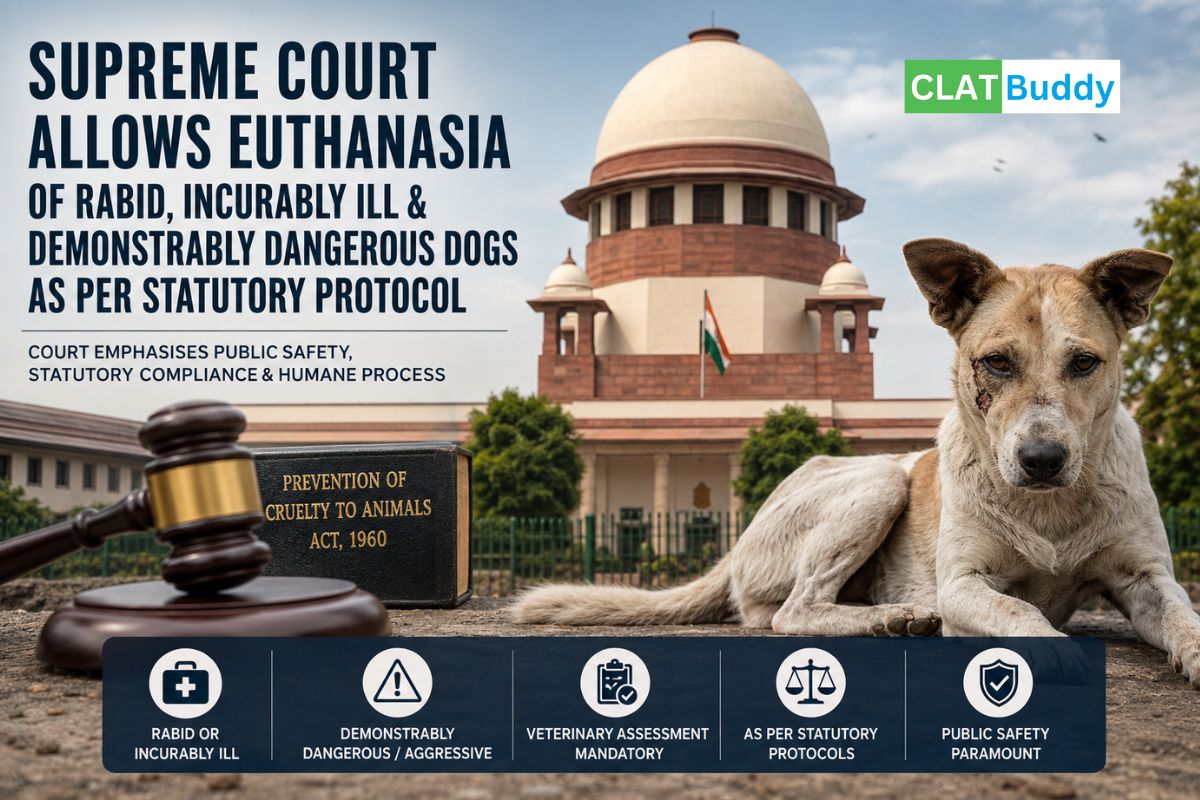
The Supreme Court on Monday permitted authorities to carry out euthanasia of rabid, incurably ill and demonstrably dangerous or aggressive dogs in appropriate cases, while dealing with the growing stray dog menace across the country. The Court clarified that such action must strictly follow the provisions of the Prevention of Cruelty to Animals Act, 1960, the Animal Birth Control Rules, 2023 and other applicable statutory protocols.
A Bench comprising Justice Vikram Nath, Justice Sandeep Mehta and Justice N. V. Anjaria passed the directions in a suo motu case concerning the increasing incidents of stray dog attacks and dog bites in several parts of the country.
The Court observed that reports relating to attacks by stray dogs, especially on children and elderly persons, were “deeply disturbing” and required urgent intervention by authorities. Refusing to dilute its earlier directions for removal of stray dogs from sensitive public areas such as educational institutions, hospitals, bus stands, railway stations and sports complexes, the Court emphasised that public safety cannot be compromised.
The Bench ordered that in areas where stray dog populations have reached alarming levels and repeated aggressive attacks pose a continuing threat to human life, authorities may take legally permissible measures, including euthanasia, after proper assessment by qualified veterinary experts. The Court specified that such measures would apply only in cases involving rabid, incurably ill or demonstrably dangerous dogs.
Apart from permitting euthanasia in limited circumstances, the Supreme Court also issued a detailed set of directions to strengthen the implementation of the Animal Birth Control (ABC) framework and improve public health response systems.
Key Directions Issued By The Supreme Court
The Court directed all States and Union Territories to take coordinated and time-bound measures for improving infrastructure under the Animal Birth Control framework. It ordered the establishment of at least one fully functional ABC centre in every district with trained personnel, surgical facilities and supporting logistics.
Authorities were also directed to assess population density and territorial requirements to determine whether additional ABC centres were necessary in particular districts.
The Bench reiterated that stray dogs removed from sensitive public places should not be returned to the same locations after sterilisation or vaccination if such return poses danger to public safety. States and Union Territories were instructed to implement previous directions of the Court “in letter and spirit” without delay.
The Court further stated that authorities may examine whether similar restrictions should be extended to other high-footfall public spaces and transit areas after assessing local ground realities and risks to public safety.
To strengthen implementation, the Court ordered comprehensive capacity-building measures including training of personnel, strengthening veterinary services, improving shelter facilities and expanding vaccination drives in coordination with relevant departments.
Recognising the public health dimension of dog bite incidents, the Court directed all States and Union Territories to ensure adequate availability of anti-rabies vaccines and immunoglobulin in government medical facilities and establish effective emergency response systems for dog bite cases.
Directions Regarding National Highways
The Supreme Court also issued directions to the National Highways Authority of India (NHAI) and concerned States and Union Territories for addressing the presence of stray animals on national highways and expressways.
The Court directed authorities to formulate a comprehensive mechanism for safe handling and relocation of stray cattle and other animals. This includes deployment of specialised transport vehicles, creation of shelter and holding facilities and coordination with animal welfare organisations.
Protection For Officials Implementing Orders
In an important direction aimed at ensuring effective implementation, the Court stated that officers carrying out the Court’s directions in good faith would receive legal protection for actions taken in discharge of official duties.
The Bench clarified that no FIR or criminal proceedings should ordinarily be initiated against officers implementing the Court’s directions unless there is a prima facie case of mala fide intention or gross abuse of authority.
High Courts Directed To Monitor Compliance
For ensuring continuous monitoring of compliance, the Supreme Court directed all High Courts to register suo motu writ petitions as continuing mandamus proceedings.
The High Courts were authorised to monitor implementation of the directions and tailor additional measures according to local conditions, provided the essence and intent of the Supreme Court’s directions remain intact.
The Court further stated that jurisdictional courts would be empowered to initiate contempt proceedings or take appropriate action against officers responsible for wilful non-compliance or inaction.
The directions were passed in the case titled In Re : ‘City Hounded By Strays, Kids Pay Price’, SMW(C) No. 5/2025 and connected matters.
Calling all law aspirants!
Are you exhausted from constantly searching for study materials and question banks? Worry not!
With over 15,000 students already engaged, you definitely don't want to be left out.
Become a member of the most vibrant law aspirants community out there!
It’s FREE! Hurry!
Join our WhatsApp Groups (Click Here) and Telegram Channel (Click Here) today, and receive instant notifications.