


Time Management Techniques During Mock Tests for CLAT
Preparing for CLAT is not just about studying concepts. It is equally about how efficiently you manage your time in the exam. Many aspirants feel that they could have scored better if they had just managed their time properly.
If you are facing the same issue, this guide will help you build a strong time management strategy during mock tests so that you can maximise your score without increasing stress.
What Does Time Management Really Mean in CLAT Mocks?
Time management in CLAT is not about solving questions quickly. It is about making smart decisions within limited time.
You have 120 minutes and around 120 questions. But the real challenge is that not all questions are equal. Some are easy, some are lengthy, and some are traps.
Good time management means:
- You identify which questions to attempt and which to skip
- You avoid getting stuck on difficult passages
- You maintain accuracy while attempting a good number of questions
- You stay calm throughout the paper
Once you understand this, your approach to mocks will completely change.
Why Do Students Struggle With Time in Mock Tests?
Before fixing the problem, you need to understand why it happens.
Most students struggle because:
- They try to attempt everything
- They spend too much time on one passage
- They read passages too slowly or too deeply
- They panic when they see unfamiliar questions
- They do not have a fixed attempt strategy
The good part is that all of these issues can be solved with practice and the right approach.
How Should You Divide Time Across Sections?
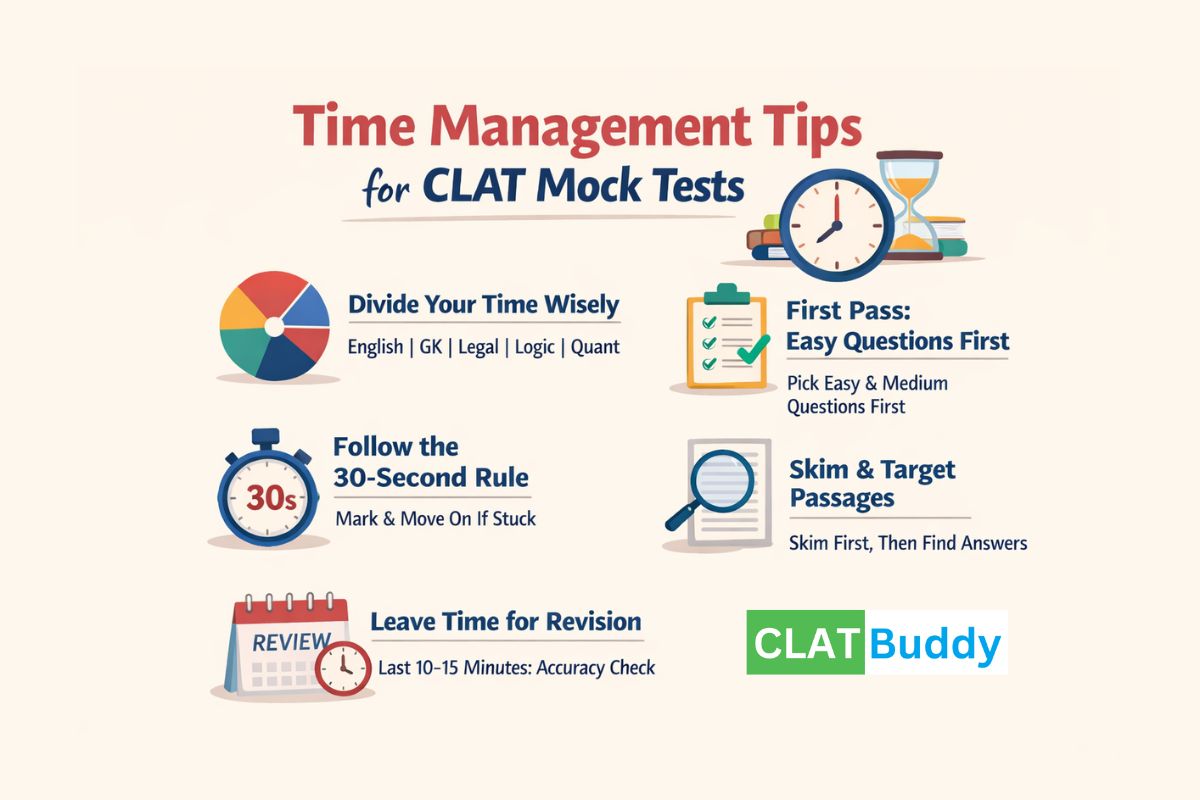
You do not need a rigid rule, but having a basic structure helps you stay on track during the mock.
A balanced time division can look like this:
- English Language: 20 to 25 minutes
- Current Affairs and GK: 10 to 15 minutes
- Legal Reasoning: 35 to 40 minutes
- Logical Reasoning: 25 to 30 minutes
- Quantitative Techniques: 10 to 15 minutes
This distribution ensures that no single section takes away time from others.
At the same time, you should adjust this based on your strengths. If Legal is your strong area, you can spend slightly more time there and compensate elsewhere.
What Is the Best Attempt Strategy During a Mock?
Many aspirants enter a mock test without a clear plan. This leads to confusion and poor time usage.
A structured attempt strategy can make a huge difference.
First Pass: Focus on Easy and Medium Questions
Your goal in the first round is to collect easy marks.
Start by:
- Quickly scanning passages
- Attempting questions that you understand immediately
- Skipping questions that look confusing
Do not try to solve everything in one go. Your focus should be on building momentum and confidence.
Second Pass: Return to Marked Questions
Once you finish your first round, go back to the questions you skipped.
At this stage:
- Your mind is more settled
- You have already secured some marks
- You can think more clearly
Try to solve moderate questions that require a bit more effort but are still doable.
Final Pass: Smart Decision Making
In the last phase:
- Attempt only those questions where you can eliminate options
- Avoid blind guessing
- Focus on accuracy rather than quantity
This stage is about maximising your score without increasing risk.
How Can You Handle Lengthy Passages Efficiently?
CLAT is heavily passage-based, so your reading strategy plays a big role in time management.
Use the Skim and Target Approach
Instead of reading the entire passage in detail, try this:
- Read the first few lines carefully to understand the theme
- Move to the questions
- Refer back to the passage for specific answers
This approach saves time and helps you focus only on relevant parts of the passage.
How Much Time Should You Spend Per Question?
A clear sense of timing per question can prevent you from wasting time.
A general guideline is:
- Easy questions: 20 to 30 seconds
- Moderate questions: 40 to 60 seconds
- Difficult questions: maximum 60 to 75 seconds
If a question takes longer than this, it is better to skip and come back later.
What Should You Do When You Get Stuck?
Getting stuck is normal. Staying stuck is the problem.
Follow the 30 Second Rule
If you cannot understand a question within 30 seconds:
- Mark it for review
- Move to the next question
When you return later, you may find it easier because your brain has already processed it in the background.
How Can You Avoid Panic in the Last 20 Minutes?
The last part of the exam is where many students lose marks due to panic.
To stay in control:
- Keep at least 10 to 15 minutes for revision
- Avoid starting new lengthy passages
- Focus on marked questions
- Stay calm and avoid rushing through questions
A calm mind performs much better than a rushed one.
Should You Follow a Fixed Section Order?
This depends on your comfort level.
Fixed Order Strategy
This is ideal if you are starting out.
You can follow:
English, GK, Legal, Logical, Quant
It creates a consistent rhythm and reduces decision fatigue.
Flexible Order Strategy
Once you gain experience, you can experiment.
For example:
- Start with your strongest section
- Build confidence early
- Move to weaker sections later
Try both approaches in mocks and see what works best for you.
What Are the Common Time Management Mistakes?
Avoiding mistakes is as important as following strategies.
Here are some common ones:
- Spending too much time on one difficult passage
- Trying to attempt the entire paper
- Ignoring GK or leaving it for the end
- Not keeping time for revision
- Making random guesses at the end
Each of these mistakes can reduce your score significantly.
How Can You Improve Time Management Through Practice?
Time management is a skill that improves with consistent practice.
Here is how you can train yourself:
Take Mocks Seriously
Always attempt mocks in a real exam-like environment. Avoid distractions and follow the exact time limit.
Analyse Your Performance
After every mock, analyse:
- Which section took the most time
- Where you got stuck
- Which questions you should have skipped
This analysis is where real improvement happens.
Experiment With Strategies
Try different approaches:
- Change section order
- Adjust time allocation
- Modify your attempt strategy
Once you find what works, stick to it.
Track Your Progress
Maintain a simple record of:
- Time spent per section
- Number of attempts
- Accuracy
This helps you identify patterns and improve consistently.
What Is a Simple Time Management Plan You Can Follow?
If you are confused about where to start, follow this basic structure:
- First 70 to 80 minutes: Attempt easy and moderate questions
- Next 25 to 30 minutes: Solve marked questions
- Last 10 to 15 minutes: Review and improve accuracy
This plan keeps your attempt structured and reduces panic.
Final Thoughts
Time management is one of the most powerful tools in your CLAT preparation. You do not need to know everything to score well. You just need to use your time wisely.
If you learn to:
- Pick the right questions
- Skip the wrong ones
- Stay calm under pressure
You will see a clear improvement in your mock scores.
Remember, every mock test is not just a test of knowledge. It is a training ground for decision-making.
Use it well, and your performance will improve with every attempt.
Calling all law aspirants!
Are you exhausted from constantly searching for study materials and question banks? Worry not!
With over 15,000 students already engaged, you definitely don't want to be left out.
Become a member of the most vibrant law aspirants community out there!
It’s FREE! Hurry!
Join our WhatsApp Groups (Click Here) and Telegram Channel (Click Here) today, and receive instant notifications.