

Can a Person Who Has Lost an Election Be Appointed as Chief Minister in India?
The idea that a person who has lost an election can still become the Chief Minister may appear unusual at first. In a democracy, electoral victory is often seen as the primary route to power. However, the Indian Constitution provides a more flexible mechanism for the appointment of the Chief Minister. Constitutionally, a person who has lost an election can still be appointed as Chief Minister, subject to certain conditions.
This position is not an exception or a loophole. It is a recognised constitutional practice that has been followed multiple times in India.
What Does the Constitution Say About Appointing a Chief Minister?
The Constitution of India lays down the framework for the appointment of the Chief Minister and other ministers. While it does not explicitly state that the Chief Minister must be a member of the State Legislature at the time of appointment, it provides a mechanism to address such situations.
What Does Article 164(4) of the Constitution of India Provide?
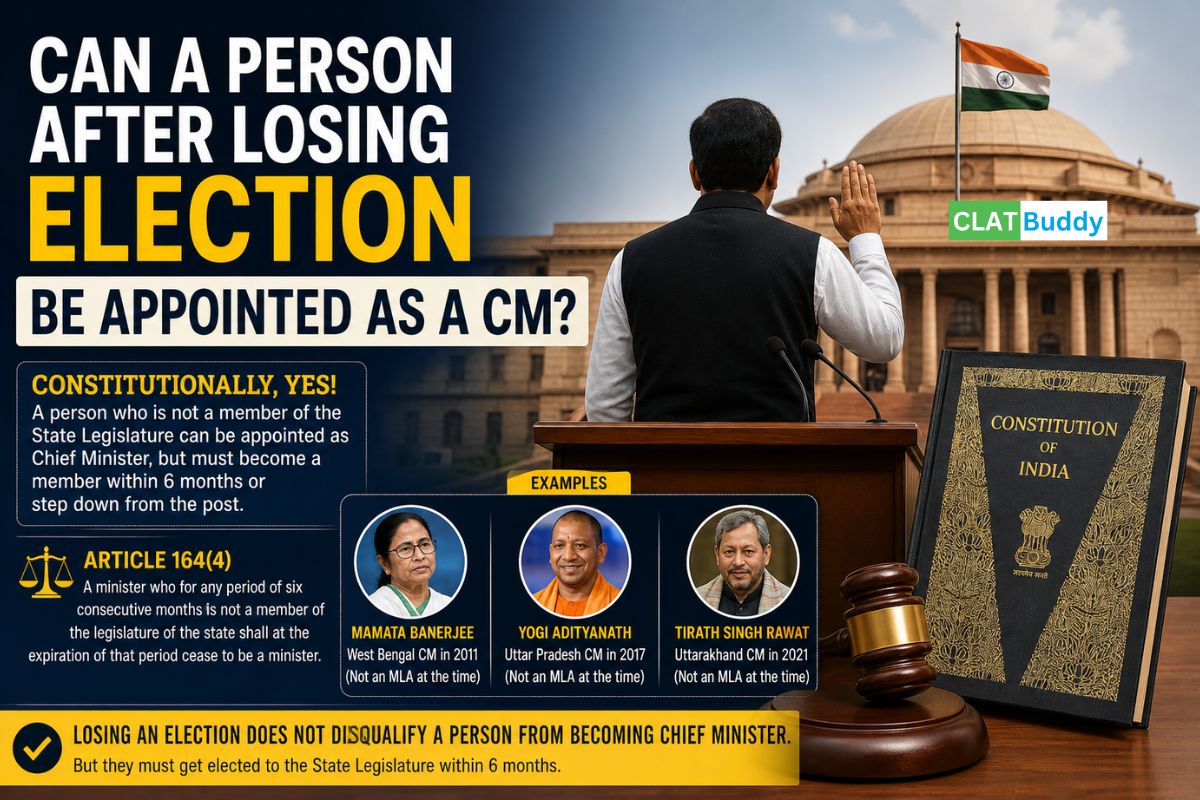
The answer lies in Article 164(4) of the Constitution of India, which states that a minister who is not a member of the State Legislature for six consecutive months shall cease to be a minister after that period.
Since the Chief Minister is also a part of the Council of Ministers, this provision applies equally to that office. This means that a person can be appointed as Chief Minister even if they are not a member of the Legislative Assembly or Legislative Council at that time.
However, the Constitution imposes a clear condition: the individual must become a member of the State Legislature within six months of appointment.
Can a Non-MLA Be Appointed as Chief Minister in India?
Yes, a non-MLA can be appointed as Chief Minister. The Constitution does not require immediate membership in the legislature as a pre-condition for appointment. Instead, it allows a temporary window for the individual to secure a seat.
This flexibility ensures that governance is not disrupted due to technical disqualifications. Political parties can appoint their chosen leader as Chief Minister even if that person is not currently an elected member.
Can a Person Who Has Lost an Election Become Chief Minister?
A person who has lost an election is simply a non-legislator at that point. Therefore, the same constitutional rule applies.
Does Losing an Election Disqualify a Person from Becoming CM?
No, losing an election does not disqualify a person from being appointed as Chief Minister. The Constitution does not impose any restriction based on electoral defeat.
What matters is whether the person has the confidence of the majority in the Legislative Assembly. If a political party or coalition supports the individual, the Governor can appoint that person as Chief Minister.
Thus, electoral defeat does not act as a legal barrier to holding executive office.
Time Limit to Become MLA After Being Appointed as Chief Minister
The Constitution provides a strict timeline for regularising such appointments. A person appointed as Chief Minister must become a member of the State Legislature within six months.
This can be achieved by:
- Contesting and winning a by-election to the Legislative Assembly
- Getting elected to the Legislative Council (in States where it exists)
If the individual fails to secure membership within this period, they must step down from the office of Chief Minister.
Supreme Court Judgment on Appointment of Non-MLA Chief Minister
The constitutional validity of appointing a non-legislator as Chief Minister has been tested before the judiciary.
Har Sharan Verma v. Tribhuvan Narain Singh Case Explained
In Har Sharan Verma v. Tribhuvan Narain Singh, the appointment of Tribhuvan Narain Singh as Chief Minister of Uttar Pradesh was challenged. The contention was that he was not a member of either House of the State Legislature at the time of his appointment.
The petitioner argued that such an appointment was unconstitutional.
What Did the Supreme Court Say on Validity of Such Appointment?
The Supreme Court rejected the challenge and upheld the appointment. It held that Article 164(4) clearly permits a person who is not a member of the legislature to be appointed as a minister, including the Chief Minister, for a period of six months.
The Court clarified that such appointments are valid and lawful, provided the individual becomes a member of the legislature within the prescribed time.
This judgment confirms that the Constitution intentionally allows such flexibility.
Real Examples of Chief Ministers Appointed Without Being MLAs
The constitutional provision has been applied in practice several times.
- Mamata Banerjee took oath as Chief Minister in 2011 before becoming an MLA.
- Yogi Adityanath was a Member of Parliament when he became Chief Minister in 2017.
- Tirath Singh Rawat also assumed office without being an MLA at the time.
These instances show that the practice is well-established and constitutionally accepted.
What Happens If the Chief Minister Fails to Get Elected Within 6 Months?
While the Constitution allows such appointments, it also ensures accountability.
If the Chief Minister does not become a member of the State Legislature within six months, they automatically cease to hold office. This rule ensures that democratic legitimacy is eventually established.
The six-month condition acts as a safeguard against misuse of the provision.
Conclusion
A person who has lost an election can be appointed as Chief Minister in India. This position is supported by Article 164(4) of the Constitution and has been upheld by the Supreme Court.
However, this is not an unrestricted power. The individual must become a member of the State Legislature within six months. If this requirement is not fulfilled, the person cannot continue in office.
Calling all law aspirants!
Are you exhausted from constantly searching for study materials and question banks? Worry not!
With over 15,000 students already engaged, you definitely don't want to be left out.
Become a member of the most vibrant law aspirants community out there!
It’s FREE! Hurry!
Join our WhatsApp Groups (Click Here) and Telegram Channel (Click Here) today, and receive instant notifications.